


The global energy sector is undergoing a profound transformation, shifting from traditional, centralized models toward a dynamic, data-driven, and decentralized future. At the heart of this revolution lies powerful digital transformation catalysts: artificial intelligence (AI) and machine learning (ML). Far from being a fleeting trend, these technologies have moved beyond the hype to establish a clear and practical framework, delivering tangible value across the entire energy value chain.
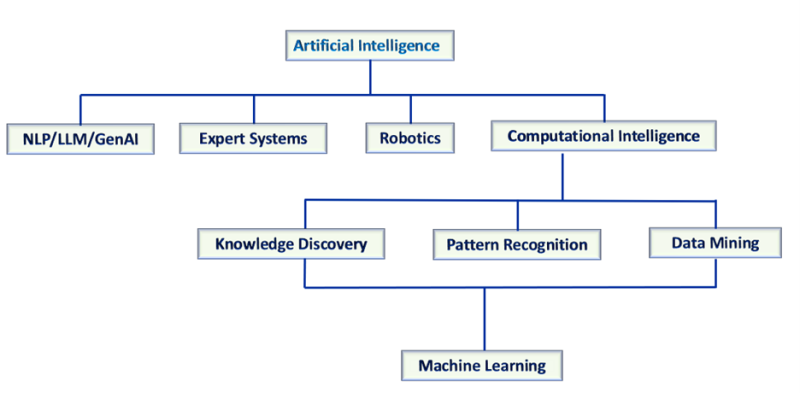
To fully grasp their impact, it is essential to understand the hierarchy of this technological ecosystem. AI is the superset of technologies or systems embedded with intelligence and human-like capabilities to solve complex problems. ML is a subset of AI, the computational aspect AI that uses adaptive algorithms to parse data, extract embedded patterns, learn from them, and use them to make informed decisions. At the cutting edge of this methodology are artificial neural networks, decision trees, and random forests—the set of powerful, brain-inspired tools that drive complex pattern recognition and predictive analytics, fueling this digital evolution.
Another subset of AI technology includes the generative aspect, which covers the generation and synthesis of multimedia and multidimensional content such as text, images, videos, and language translation. Other subsets of the AI superset are the neuro-mechanical aspect (namely robotics) and rule-based systems, also called expert systems.
Fig. 1 summarizes the relationship between the AI superset and its subsets.
As we unpack the applications of AI from optimizing grid stability and forecasting renewable output to predictive maintenance for infrastructure, a central and reassuring theme emerges. The future of energy is not a dystopian vision of technology replacing human experts. Instead, it is a collaborative future focused on augmenting our capabilities with digital tools that enhance innovation and creativity and foster collaboration. By partnering with intelligent systems, we can enhance human decision-making, unlock unprecedented efficiencies, and accelerate the transition to a more sustainable, reliable, and intelligent energy ecosystem for all.
Challenges
Despite the promises and successful use cases of the application of AI and ML in the energy sector, a number of challenges still stand in the way of further successes and development.
This strategic discussion is grounded in the tangible, daily data, operational, and algorithmic challenges that define the modern energy industry. We moved beyond theoretical models to confront the persistent and costly realities that impede efficiency and accuracy. Some of the identified challenges include the following.
- Data quality and integrity: We grapple with pervasive issues like seismic noise, low-vertical resolution, and signal interference, which obscure critical subsurface insights and introduce significant uncertainty into our interpretations. AI- and ML-based solutions rely on data with high reliability, integrity, and accuracy.
- Data scarcity and cost: The acquisition of fundamental data, such as physical core samples, remains expensive, time consuming, and logistically complex, creating critical knowledge gaps in our reservoir models. Robust AI- and ML-based solutions rely on accurate, reliable, and consistent ground truth data that honor the physics of the problem being modeled.
- Operational reliability: Unexpected downhole tool failures lead to costly nonproductive time, project delays, and the loss of vital subsurface/borehole data, jeopardizing safety, model accuracies, and financial returns. Reliable and accurate sensor- and tool-measured data provide the backbone to map abundantly available data to scarce and sparse ground truth data for efficient ML modeling.
- Analytical latency: Even when data is available, time-consuming laboratory measurements create a bottleneck, delaying decision-making, and preventing real-time operational adjustments.
Collectively, these persistent problems highlight a critical reality: traditional methods and conventional analytics alone are no longer sufficient. They are increasingly overwhelmed by the volume, velocity, and complexity of data in today's operational environment. This is where ML algorithms come in to automate and augment traditional workflows to make them more efficient, effective, and robust.
It is these pervasive gaps and challenges that impede the capabilities of legacy approaches, thereby fundamentally repositioning the application of the ML methodology. It is no longer a technological buzzword to be experimented with on the sidelines. Instead, it has emerged as a business-critical solution, a necessary evolution, creating a technological revolution to unlock hidden value in our existing data, mitigate inherent risks, and build a more resilient, efficient, and intelligent future for the industry.
Opportunities
The identified challenges and gaps create opportunities for creativity, collaboration, and innovation. Having diagnosed the critical data, operational, and algorithmic challenges, we identified a suite of tangible, high-impact opportunities where the ML methodology transitions from a theoretical concept to a practical engine for value creation.
These opportunities are strategically created to directly address the gaps left by traditional methods using digital tools and ML-based solutions.
- Enhanced safety and efficiency through automation: We can deploy ML to automate high-frequency, repetitive, and hazardous tasks. From routine monitoring of equipment to safety protocol checks, automated and AI-based solutions such as robots can increase the efficiency and improve the accuracy of such systems. This not only protects personnel by removing them from harm's way but also optimizes operations by freeing up human expertise for higher level analysis and decision-making, thereby boosting overall productivity.
- Deciphering complexity with data-driven models: The ML methodology excels at identifying intricate, nonlinear patterns and relationships within vast, multidimensional datasets. This capability is crucial where explicit physics-based models are too slow, incomplete, or simply do not exist. ML is also beneficial when traditional equations are too complex to understand or were derived and oversimplified with assumptions that may not honor operational or physical realities. By learning directly from the data, ML models can provide accurate predictions and insights in scenarios that have traditionally confounded conventional analytical approaches.
- Data enrichment and predictive synthesis: To combat the issues of data scarcity and cost, ML acts as a powerful force multiplier. Advanced algorithms can intelligently synthesize, integrate, and correlate disparate data sources. For example, generating continuous, high-fidelity synthetic logs from a limited set of core measurements and conventional logs is one of the common applications of ML learning in petroleum reservoir characterization. This significantly enriches our subsurface characterization, filling in the gaps with statistically robust predictions and enabling more confident, precise decision-making.
- Workflow innovation for a new era: Beyond improving existing processes, ML enables fundamental workflow innovation. It allows us to design safer, faster, and more efficient alternative pathways to achieve our objectives. This means maximizing the utility of every data point, predicting equipment failures before they occur to schedule proactive maintenance, and ultimately driving down costs while simultaneously enhancing resource utilization and operational integrity. In addition, maximizing real-time data in a way that was not previously envisaged is a great opportunity that the ML methodology brings to the energy industry.
In essence, the ML methodology provides the necessary toolkit to not only keep pace with the industry's growing complexity but to pioneer a new standard of performance, safety, and intelligence.
Conclusion and Key Takeaways
This journey of discovery in the digital world serves as more than just an analysis; it is a compelling and urgent call to action. The digital transformation of the energy sector is not a distant future, it is already underway, reshaping the competitive landscape at an unprecedented pace. To navigate this shift successfully, we must move beyond passive observation and actively embrace the dual engines of change: the technical knowledge to deploy these tools effectively and the strategic mindset to reimagine our workflows and business models around them.
Our path forward is not one of replacement, but of powerful synthesis, collaboration, and integration. By proactively uniting our deep, irreplaceable domain expertise with the predictive power of ML and AL, we create a formidable partnership. This collaboration is key to unlocking previously intractable problems, from optimizing complex reservoir dynamics to building a more resilient and efficient grid.
Ultimately, the future we are building is a collaborative one, fundamentally powered by the synergy of human intuition and machine intelligence. It is a future where our experts are empowered to make faster, more accurate, and more impactful decisions. Let us not merely adapt to this new era, but boldly lead it, harnessing the best of both our human and digital capabilities to drive meaningful innovation, ensure a sustainable energy future, and secure a decisive competitive advantage. The time for strategic action is now.

Chimeremma Jennifer Okolodibe, SPE, is a geology graduate from Nnamdi Azikiwe University, Awka, Nigeria. Equipped with a solid scientific foundation and a keen analytical mindset, she is poised to apply her knowledge to real-world challenges that positively impact communities and ensures a sustainable environment. During her academic tenure, she successfully guided and coordinated her team to complete their final year project. This experience honed her skills in collaboration, problem-solving, and project management. She is a member of the Nigerian Mining and Geosciences Society, Nigerian Association of Petroleum Explorationists, and SPE.

Fatai Anifowose, SPE, is an independent researcher in the field of machine learning. His research focuses on automating geological and petroleum engineering workflows and application of machine learning to increase accuracy, improve efficiency, and enhance productivity. He has an accomplished researcher with over 90 papers, an innovator with over 10 granted patents and several filed, and received a number of R&D awards, including the 2021 SPE Middle East and North Africa Regional Service Award, 2021 SPE Middle East and North Africa Regional Data Science and Engineering Analytics, and 2024 IChemE Learning and Development Award. He is a technical reviewer for international conferences and reputable journals. He is a member of EAGE, SPE, AAPG, and Dhahran Geoscience Society.