[Editor's Note: Mohammad Rasheed Khan is a member of the TWA Editorial Board and the author of previous TWA articles.]
The oil and gas industry is undergoing significant transformation with the advent of digital drilling operations. This shift toward digitalization is driven by the need for increased efficiency, safety, and cost-effectiveness. Digital drilling operations leverage advanced technologies such as artificial intelligence (AI), machine learning, real-time data analytics, and automation to optimize drilling processes and enhance overall performance. This article explores various aspects of digital drilling operations, including key technologies, benefits, challenges, and case studies.
Key Technologies in Digital Drilling Operations
Digital Twin Technology
One of the most groundbreaking innovations in digital drilling is the concept of the digital twin. A digital twin is a virtual replica of physical assets, processes, and systems, allowing operators to monitor and optimize drilling activities in real time. By leveraging digital twins, engineers can make informed decisions, mitigate risks, and enhance well performance. Digital twins enable real-time monitoring of drilling operations, predictive maintenance, and enhanced collaboration among teams.
Real-Time Data and Analytics
Digital drilling operations rely heavily on real-time data and advanced analytics. Connected solutions enable continuous monitoring of drilling equipment and well conditions, providing valuable insights that can be used to optimize operations. Real-time advisory and monitoring applications can alert operators to potential issues, helping to prevent nonproductive time (NPT) and improve overall efficiency. Data analytics also play a crucial role in optimizing drilling parameters such as rate of penetration and weight on bit.
Automation and AI Integration
Automation and AI are integral components of digital drilling operations. Automated workflows and AI-driven event detection allow for rapid adjustments to drilling plans, reducing the burden on engineers and enhancing operational efficiency. These technologies also enable predictive maintenance, ensuring that equipment is serviced at the right time to avoid costly breakdowns.
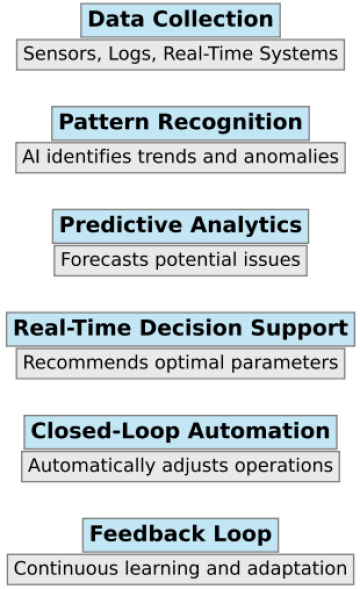
AI algorithms can analyze vast amounts of data to identify patterns and predict potential issues, further improving the efficiency and safety of drilling operations. Over the years, it has been proven that digitalization and automation are central to achieving truly transformative experiences in the drilling domain.
Cloud Computing and Edge Computing
Cloud computing plays a pivotal role in modern drilling operations, where vast volumes of data (ranging from real-time sensor feeds to historical well logs) are continuously generated. By leveraging cloud infrastructure, operators can store, process, and analyze this big data at scale, enabling faster and more informed decision-making. Cloud platforms facilitate seamless integration of advanced analytics, machine learning models, and digital twins, all of which require high computational power and data accessibility.
Edge computing facilitates automation and autonomous drilling by enabling real-time data processing directly at the rigsite, reducing latency and ensuring faster response to dynamic downhole conditions. This localized computing power supports immediate decision-making and control, which is essential for maintaining safety and optimizing performance in high-speed, data-intensive drilling environments.
Benefits of Digital Drilling Operations
Improved Efficiency
Digital transformation is fundamentally reshaping drilling operations by enhancing efficiency and reducing operational costs. Strategic Gears highlights that 40% of executives surveyed identified improved operational efficiency as a key benefit of digital adoption. In drilling, this translates to optimized rig performance, reduced NPT, and better resource allocation. Technologies such as real-time data analytics, automated drilling systems, and cloud-based monitoring platforms allow operators to make faster, data-driven decisions, ultimately lowering the cost per barrel.
Enhanced Safety
Shell and Chevron exemplify how digitalization is transforming safety in drilling operations. Shell employs AI, robotics, and real-time monitoring to proactively detect hazards and reduce human exposure, aligning with its “Goal Zero” ambition of no harm and no leaks. Meanwhile, Chevron enhances safety through remote operations and digital workflows, enabling centralized decision-making that minimizes on-site risks and ensures faster, more accurate responses to drilling challenges.
Cost-Effectiveness
Digital technologies are proving to be highly cost-effective in drilling operations, as highlighted by leading consultancy firms. According to Deloitte, even a modest 1% improvement in capital productivity through digital transformation can offset billions in industry losses, with real-time analytics and automation significantly reducing drilling time and operational costs. Similarly, BCG reports that advanced data analytics and AI can lower production costs by over $3 per barrel, potentially unlocking $150 billion in value. These technologies enhance drilling efficiency, reduce NPT, and optimize asset utilization, making digitalization a strategic imperative for cost control and value creation in upstream operations.
Environmental Sustainability
Digital drilling technologies significantly contribute to environmental sustainability by reducing the carbon footprint and resource consumption associated with traditional drilling operations. IEA’s Global Critical Minerals Outlook reports that innovations such as AI-based geological exploration can reduce drilling costs by up to 60% and increase discovery success rates by as much as four times, while also minimizing waste and emissions. These efficiencies translate into fewer drilling attempts, reduced fuel consumption, and lower greenhouse gas emissions—key factors in improving the sustainability of oil and gas operations.
Challenges in Implementing Digital Drilling Operations
Data Integration Issues. Inconsistent and poor-quality data from diverse sources can hinder the performance of AI models. For example, multiple publications highlight the challenges in aligning real-time data streams for utilizing AI models for wellbore-stability prediction (Kamgue Lenwoue et al. 2023) and implementation of automation systems (Goodkey et al. 2021). Additionally, the scalability of digital solutions and the ability to handle large volumes of data are critical factors that need to be considered.
Workforce Resistance. Digital adoption often meets cultural resistance. Organizational culture remains a significant barrier. Field teams and decision-makers may resist adopting new tools due to unfamiliarity, fear of job displacement, or lack of digital skills. Training and reskilling the workforce to work with digital tools and systems is essential. Building confidence in the data and computational models used by digital twins is crucial for gaining acceptance among operators and engineers.
Cybersecurity and Connectivity: As drilling becomes more connected, cybersecurity risks grow. Remote sites also struggle with limited digital infrastructure, making it difficult to deploy real-time, autonomous systems reliably.
The integration of IoT, AI, and cloud/edge computing in drilling operations offers transformative potential for efficiency and safety, but its success depends heavily on overcoming challenges related to data interoperability, cybersecurity, and workforce adaptation.
Case Studies of Digital Drilling Operations
Eni’s Digital Transformation in Drilling Operations
Eni revolutionized its drilling and completion operations through a comprehensive digital program that integrates big data analytics, virtual reality, rig automation, and advanced safety systems. By leveraging predictive algorithms and real-time data monitoring, Eni aimed for a 30% reduction in NPT and up to 40% improvement in operational performance across key metrics (Burrafato et al. 2019). The implementation of immersive virtual training environments and digital twins enhanced safety awareness and planning accuracy, while automation and predictive maintenance tools minimized human exposure and equipment failures. This digital transformation not only optimized operational efficiency but also fostered a collaborative, data-driven culture, setting a benchmark for innovation in the oil and gas industry.
Digital Transformation of Brunei Shell Petroleum’s Real-Time Drilling Operations
Brunei Shell Petroleum (BSP) successfully transformed its Real-Time Performance Center into a high-performance digital hub, driving significant improvements in drilling efficiency and operational transparency. By integrating real-time data streaming, automated performance dashboards, and advanced analytics, including Best Composite Well Time computation and Drilling Efficiency Optimization workflows, BSP enabled proactive decision-making and continuous performance benchmarking. The initiative led to measurable gains, including a 32% reduction in backreaming time, over 30% improvement in connection times, and more than 60% increase in tripping speed (Ahmad et al. 2021). This transformation fostered a results-driven culture, enhanced collaboration across disciplines, and established a scalable digital framework that can be replicated across other real-time centers in the industry.
The Next Frontier: Quantum Intelligence and Autonomous Rigs
Looking ahead, the next frontier in digital drilling lies in the convergence of quantum computing and generative AI to solve complex subsurface challenges in real time. While current digital systems rely on classical computing to process vast data sets, quantum algorithms promise exponential speed-ups in simulating reservoir behavior, optimizing well trajectories, and managing uncertainty in geomechanical models. When combined with generative AI, these systems could autonomously generate and test thousands of drilling scenarios, adapting plans dynamically based on evolving downhole conditions. Simultaneously, the next generation of rig automation will move beyond mechanized task execution toward fully autonomous rigs equipped with intelligent control systems, capable of self-diagnosing equipment health, adjusting drilling parameters in real time, and coordinating with digital twins for seamless execution. These rigs will operate with minimal human intervention, supported by edge computing and AI-driven diagnostics, transforming the rig site into a smart, self-optimizing ecosystem.
While quantum computing and generative AI represent exciting long-term possibilities, near-term enablers will determine how quickly digital drilling moves from vision to reality. Practical adoption requires bridging innovation with operational execution through the following pathways.
Open Data Architectures
Industry initiatives like the Open Subsurface Data Universe (OSDU) provide a cloud-native, standards-based platform that eliminates data silos and enables interoperability across applications and vendors. OSDU’s reference architecture is already supported by major cloud providers (AWS, Azure, Google Cloud), accelerating deployment of digital workflows and reducing lifecycle costs.
Edge–Cloud and Cloud–Cloud Interoperability
Hybrid architecture is critical for real-time decision-making. For example, SLB’s collaboration with AVEVA integrates Agora edge AI with the DELFI cloud environment, enabling operators to process data locally at the rig while leveraging cloud analytics for predictive insights. The OSDU Edge Lab, launched by the OSDU Forum, is an new initiative aimed at advancing edge computing in the energy sector. As industry shifts toward digital transformation, the lab supports innovation in managing data from millions of distributed oil and gas production sites, which are often remote and vary in complexity. Similarly, Energistics emphasizes how WITSML v2.1 and ETP v1.2 enhance data security, real-time efficiency, and interoperability as key enablers for seamless edge-cloud integration
Cloud–cloud interoperability is emerging as a key enabler for scalable, collaborative energy workflows. Microsoft and INT’s IVAAP deployment on Azure demonstrates how OSDU-compliant visualization tools can operate seamlessly across cloud platforms. Further, a study highlights how federated querying and standardized APIs within OSDU architecture support unified data exchange across distributed cloud environments.
Collaborative Ecosystems
Digital transformation in drilling is not something any one company can achieve alone. It is increasingly clear that collaboration between operators, service companies, and technology providers is the key to unlocking scalable innovation. Equinor, for example, teamed up with SLB to integrate the DELFI environment with the OSDU Data Platform, and partnered with Cognite to enhance data-driven operations. By doing so, Equinor is building a strong digital ecosystem that supports smarter, faster decision-making. Similarly, ADNOC’s joint venture AIQ, formed with Group 42, is embedding AI across its operations. In 2023 alone, ADNOC reported $500 million in added value and avoided over 1 million tonnes of CO₂ emissions, clear proof that collaboration can drive both performance and sustainability.
On the research frontier, DigiWells, a Norwegian consortium, brings together operators, service companies, and academia to accelerate digital transformation in well delivery. By focusing on data integration, automation, and collaborative decision support, DigiWells helps shape the future of drilling from the ground up.
These examples show that when companies align their goals and share expertise, they can move faster, scale smarter, and innovate more sustainably. As digital drilling continues to evolve, collaborative ecosystems will be the foundation for industrywide transformation.
Cross-Industry Alignment and Governance
As digital drilling matures, technology alone will not be enough. For transformation to scale across the industry, we need shared standards, secure data practices, and strong governance frameworks. This is where cross-industry alignment becomes essential.
Organizations like the IOGP’s Digital & Information Standards Subcommittee are helping harmonize taxonomies and data definitions across the supply chain, making it easier for operators, service companies, and tech partners to speak the same digital language and integrate solutions consistently. Furthermore, a strong data governance framework is also key. It ensures that data is not only secure and accessible but also trusted and interoperable. Mapping governance components, like roles, standards, and processes, to strategic assets such as data quality and accessibility enables value-driven collaboration across organizations.
The Road Ahead: Enabling Scalable Transformation
By combining forward-looking technologies with practical enablers, like open data architectures, seamless edge-cloud integration, and stronger collaboration across the value chain, the industry is ready to move beyond isolated digital efforts. But this shift is not just about better tools; it is about rethinking how decisions are made. We are moving from reactive to anticipatory drilling strategies, where decisions are not only data-informed but also scenario-forecasted. This paves the way for ultra-efficient, low-carbon, and eventually autonomous drilling ecosystems. With the right governance and cross-industry alignment, this transformation can be both scalable and sustainable.
For Further Reading
Digital Transformation in the Oil & Gas Industry, Strategic Gears.
From Bytes to Barrels by A. Slaughter, V. Bansal, and A. Mittal, Deloitte
Harnessing the Power of Data in Oil and Gas by H. Holmås, M.H. Samoun, S. Santamarta, et al.
Integration of Formation and Drilling Parameters to Generate a Deterministic ROP Model by M. Khan, A. Sadeed, S. Kalam, et al.
Global Critical Minerals Outlook 2025, IEA
Recent Advances and Challenges of the Application of Artificial Intelligence to Predict Wellbore Instabilities during Drilling Operations by A. Lenwoue, Z. Li, C. Tang, et al.
Recipe for Digital Change: A Case Study Approach to Drilling Automation by B. Goodkey, R. Carvalho, A. Davila, et al.
Digital Disruption in Drilling & Completion Operations by S. Burrafato, A. Maliardi, S. Spagnolo, et al.
Transforming Real Time Drilling Operation Center into a High-Performance Enabler in the Digital Era: A Brunei Case Study by M. Ahmad, J. Dayem, N. Noh, et al.
Schlumberger and AVEVA Announce Agreement to Advance Digital Solutions for Oil & Gas Production Operations, SLB
Realizing Business Value from WITSML v2.1 and ETP v1.2, Energistics
Integration Patterns for Open Subsurface Data Universe (OSDU) by S. Patidar
ADNOC Says AI Added $500 Million of Extra Value in 2023 by Y. Saba, Reuters