Editor's Note: Mohamed Alzaabi is a member of the TWA Editorial Board and a contributing author of previous TWA articles.
The upstream oil and gas sector has always operated at the intersection of geological uncertainty, significant capital investment, and tight operating margins. For decades, digitalization promised to improve efficiency, but the true economic step change is occurring now, with the rise of artificial intelligence (AI) and its integration into core upstream workflows.
AI is not merely automating tasks; it is compressing exploration cycles, improving drilling performance, enhancing field productivity, and accelerating engineering decisions. PwC estimates that Gulf national oil companies (NOCs) can reduce upstream operating costs by 10–15%, equivalent to $3–4.5 billion annually, through targeted AI adoption.
Unlike earlier digital initiatives, this new generation of AI-driven by machine learning (ML), physics-informed models, and industrial-scale large language models (LLMs), is delivering validated, quantifiable results across the value chain. And the industry is entering an era where AI transforms not only efficiency, but economic competitiveness.
Where AI Creates Measurable Business Value
Across diverse world-leading upstream organizations such as ADNOC, Aramco, Shell, ConocoPhillips, Chevron, SLB, Halliburton, Baker Hughes, and other international oil companies and NOCs, AI success stories reveal a consistent pattern of impact across five domains.
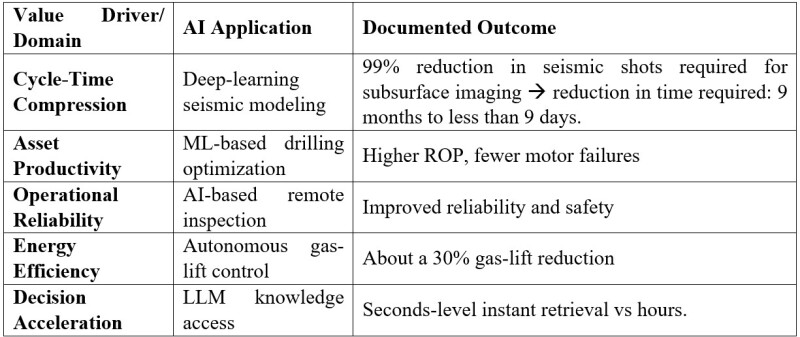
These results are not theoretical projections; they are drawn from publicly documented, production-scale deployments. The remainder of this article expands on these examples, offering deeper insight into how AI reshapes operational and economic outcomes.
Exploration: Faster Insight, Earlier Barrels
The exploration domain contains some of the largest AI-driven step changes. One of the most striking examples comes from Shell’s collaboration with SparkCognition (now known as Avathon), where deep-learning models were used to predict optimal seismic shots. This enabled Shell to reduce total required shots by approximately 99%, compressing a 9-month offshore seismic program into just 9 days, a transformation in both cycle time and logistics.
In Abu Dhabi, ADNOC’s ENERGYai platform integrates LLMs with agentic workflows to support geoscientists across seismic, petrophysics, and reservoir modeling. According to publicly shared performance results, pilots have shown large gains in interpretation speed and quality due to AI-assisted data synthesis and anomaly detection.
For exploration teams, cycle-time compression translates into earlier prospect maturation, faster appraisal, and substantial Net Present Value uplift, especially in offshore and frontier basins.
Drilling and Completions: Optimization and Autonomy
Drilling consumes the largest portion of upstream CAPEX, making it highly sensitive to performance improvements. AI’s impact here has been especially strong.
ConocoPhillips: ML-Driven ROP Optimization
ConocoPhillips applied ML to Eagle Ford drilling data, allowing the model to optimize parameters such as weight on bit, revolutions per minute, and mud properties. Documented outcomes included higher rate of penetration (ROP), fewer motor failures, and measurable cost savings per well. These improvements demonstrate that AI can outperform traditional manual parameter adjustments.
AIQ and ADNOC: RoboWell
The AI-enabled autonomous well control system RoboWell was deployed in ADNOC fields, enabling real-time tuning of gas-lift. Documented results include about a 30% reduction in gas-lift consumption, significant reduction in manual interventions, and improved production stability. RoboWell marks a transition from supervisory control toward closed-loop, AI-driven operational tuning.
Production and Operations: Intelligent Field Optimization
Once wells are onstream, AI’s value shifts from speed to continuous optimization. Leucipa, developed by Baker Huges and Repsol, is an automated production system that integrates AI-driven surveillance, choke optimization, ESP management, and autonomous control. Public releases confirm that early deployments helped recover millions of barrels that would have been missed, improved energy efficiency, and reduced flaring and fuel consumption.
Leucipa is also notable for its global footprint including deployment in 20 countries, with more than 75,000 wells, and more than 10,000 ESPs supported. This scale demonstrates AI’s potential not only at the asset level, but across entire production ecosystems.
Reliability, Integrity, and Inspection: Shift From Reactive to Predictive
AI is redefining equipment reliability and facility integrity programs. Chevron’s deployment of AI-driven drones, developed by software company Percepto, allows remote inspection and automated anomaly detection using computer vision models. Benefits include reduced HSE exposure due to fewer manual field visits, faster detection of leaks and corrosion, and improved asset uptime through early intervention.
The role of AI here is not simply cost reduction; it materially improves safety and asset longevity.
Planning, Forecasting, and Knowledge Management: Instant Expertise
Upstream planning is information-heavy and often bottlenecked by data retrieval. AI is transforming this landscape. Analysis in the 2025 International AI report confirms that ExxonMobil achieved a reduction in well planning and design time from 9 months to 7 months through AI-enabled tools. This outcome has been repeatedly cited as a turning point for engineering productivity.
Aramco’s METABRAIN, a 7-billion-parameter industrial LLM trained on 90 years of internal data, allows engineers to conduct natural-language queries across decades of operational knowledge. What took hours of manual document retrieval now completes in seconds. This shift in decision velocity compounds upstream value across every workflow.
The Architectural Foundations Behind AI Success
Behind every successful AI deployment in upstream operations lies a set of common architectural principles. These are not optional enhancements, they are structural enablers that determine whether AI becomes a pilot curiosity or a scalable value engine. Across all verified cases, four architectural pillars consistently emerge.
Integrated, High-Quality Data
AI’s performance depends fundamentally on the quality, granularity, and continuity of the data it is trained on. Operators seeing the highest returns have built unified data ecosystems inspired by the Open Subsurface Data Universe model where seismic, well logs, SCADA, drilling parameters, production histories, and maintenance records sit in standardized formats. This eliminates the traditional friction of siloed data stores and enables AI agents to analyze cross-domain relationships (e.g., correlating drilling dysfunctions with formation properties or linking ESP failure patterns with historical choke settings). High-quality data isn’t only about storage, it requires rigorous data governance, lineage tracking, and continuous quality checks.
Hybrid, Physics-Informed Models
While pure ML can detect correlations, the upstream domain demands physics-consistent predictions. The most reliable models blend reservoir physics, drilling mechanics, flow dynamics, and thermodynamics with data-driven learning, creating hybrid or physics-informed ML models. These models balance the statistical flexibility of AI with the physical constraints engineers trust. This is why ConocoPhillips’ ROP optimization and SLB’s autonomous geosteering systems can operate in safety-critical environments. The AI is bounded by first principles, ensuring predictions remain realistic even in data-sparse or out-of-distribution scenarios.
Agentic AI Workflows
Modern AI architectures increasingly rely on agentic systems rather than single models. In this structure, multiple specialized AI agents, seismic interpreters, drilling optimizers, production controllers, and failure predictors, work together under the orchestration of an LLM that understands intent, context, and sequence. This “AI teamwork” mirrors human collaboration. One model analyzes seismic volumes, another recommends casing design adjustments, a third determines optimal lift-gas injection, while a supervisory agent ensures alignment with operational objectives. In platforms like ADNOC’s ENERGYai and Baker Hughes’ Leucipa, these agentic workflows close the perception–reasoning–action loop, enabling continuous optimization.
Human–AI Collaboration
Contrary to fears about automation replacing human expertise, the most productive deployments demonstrate that AI amplifies engineers rather than replacing them. Human–AI collaboration appears in three patterns.
- AI as a tactical assistant, accelerating tasks such as data retrieval, pattern recognition, and scenario generation.
- AI as a strategic advisor, providing recommendations that engineers validate, refine, or override.
- AI as an operational copilot, enabling semi-autonomous control loops where humans supervise and govern the system.
In each case, domain expertise remains central; engineers validate outputs, tune models, and embed operational context. The result is not automation but augmentation: faster decision cycles, better accuracy, and more consistent operational execution.
AI as the New Upstream Advantage
AI is no longer an experimental technology. It is a proven creator of economic value in upstream oil and gas. From Shell’s 99% seismic reduction to ADNOC’s autonomous gas-lift control, from ConocoPhillips’ drilling gains to Aramco’s enterprise LLM, the evidence base is now deep and publicly documented.
The next frontier is clear: moving from isolated use cases to integrated, agentic systems that deliver continuous optimization across the entire value chain. Operators who embrace this shift today will define the economics of tomorrow’s barrels: faster, smarter, and more competitive.