


[Editor's Note: Andrew Yule is a member of the TWA Editorial Board and is the author of previous TWA articles.]
Modern vehicles increasingly come equipped with idle-stop/start (ISS) systems, commonly known as auto-stop, which automatically shut off the gasoline engine when the car comes to a complete stop and restart it the moment the driver releases the brake. Automakers market the technology as a meaningful contributor to fuel savings and lower greenhouse gas emissions.
There is, however, a legitimate counterargument that surfaces in conversations on the topic.
All that constant starting and stopping drains the battery much faster. Replacing it sooner means manufacturing a new battery, and battery manufacturing has its own significant carbon footprint. Does auto-stop actually help the planet when you account for that?
This article works through both sides of the question using real data. The objectives are to
1. Quantify the fuel and CO2 savings from auto-stop over a 10-year ownership period.
2. Model the battery-life impact and the manufacturing carbon cost of the additional absorbent glass mat (AGM) replacements that result.
3. Compute the net CO2 balance across a range of real-world scenarios
For an oil and gas readership, auto-stop is a relevant case study in the same life cycle accounting the industry increasingly applies to its own operations.
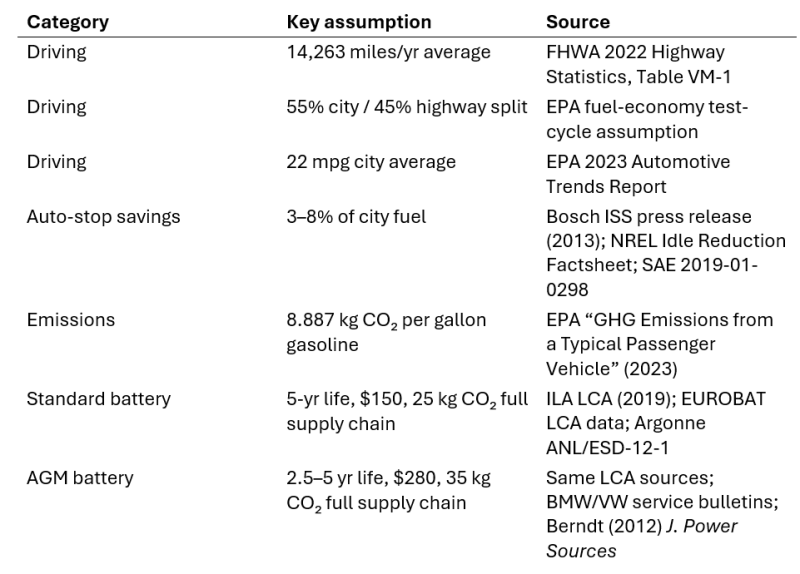
Assumptions and Data Sources
Every number used in this analysis is documented below. Where a single figure cannot capture real-world variation, a low/central/high range is used and all three values are carried through the analysis.
A Note on Battery CO2 Methodology
These are lead-acid batteries, not lithium-ion, containing no rare earth elements, cobalt, or lithium, and they use a US-based supply chain with approximately 70–80% recycled lead content. The CO2 figures cover the full supply chain (mining through transport) and use the conservative (higher) midpoints of published ranges.
Part 1: How Much Fuel Does Auto-Stop Actually Save?
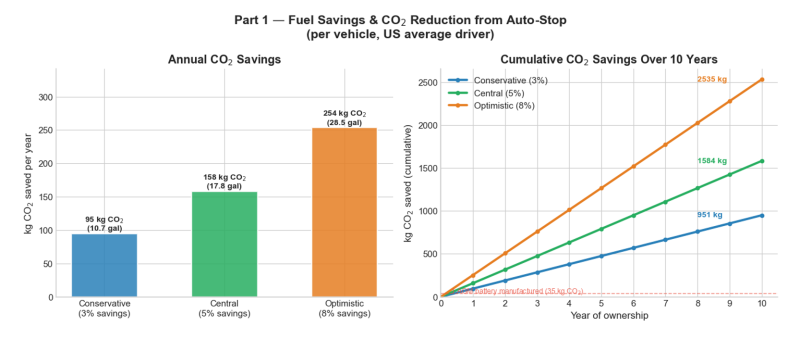
Auto-stop only affects city driving. The engine shuts off at red lights, drive-throughs, and traffic jams. An idling engine burns roughly 0.2–0.6 gal/hr, and a typical US city driver is stationary 15–20% of the time, so cutting fuel flow during those idle periods is where the savings come from.
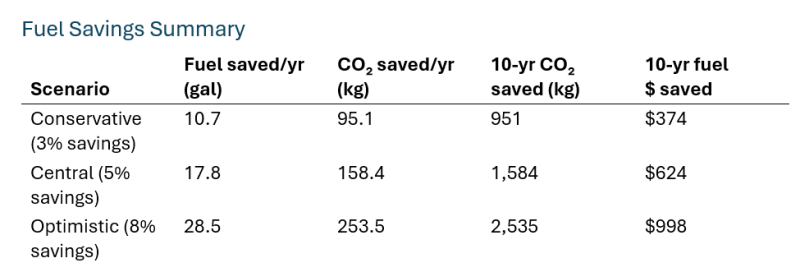
For context, the average vehicle in this analysis emits roughly 4,527 kg of CO2 annually from driving alone. The central-scenario savings represent about 3.5% of total annual driving emissions, a modest but non-trivial share.
Part 2: The Battery Counter-Argument
Auto-stop is hard on batteries. Each restart pulls a 200–400 amp current burst from the 12V battery, and with auto-stop that happens dozens of times per commute instead of once per trip. The deeper issue is partial-state-of-charge (PSOC) cycling: the alternator only has a brief window to recharge before the next stop, so the battery typically operates at a 70–90% state of charge, a range in which lead-acid batteries can experience sulfation and gradual capacity loss.
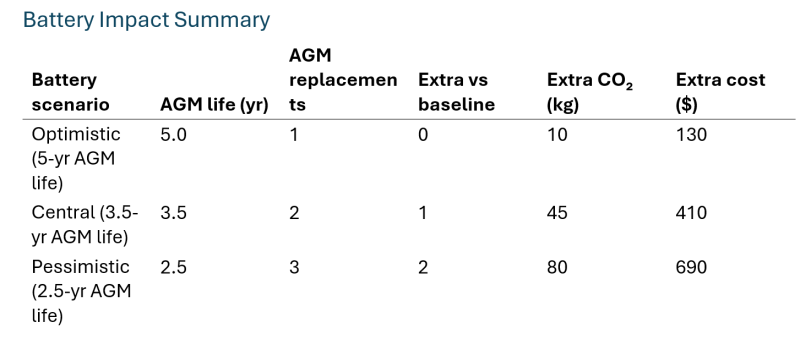
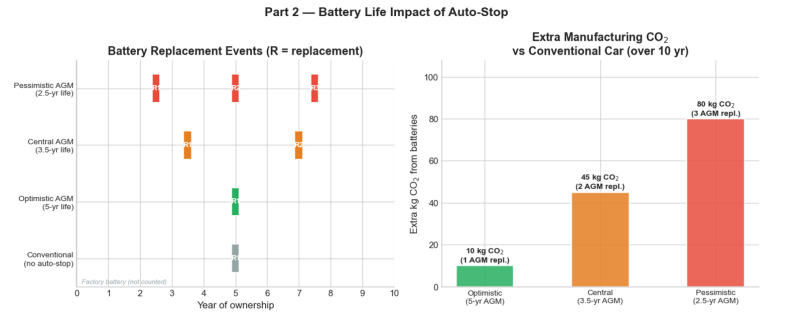
OEMs responded by mandating AGM or enhanced flooded batteries (EFB) in auto-stop vehicles. Standard EFB can fail within 3–6 months under this duty cycle, whereas AGM batteries can withstand approximately 360,000 engine starts (vs. approximately 30,000 for standard flooded batteris) and handle PSOC-cycling far better. Even so, real-world data shows AGM life in stop-start applications running 20–50% shorter than in conventional vehicles. The question is whether that erases fuel savings.
The analysis compares a conventional vehicle (one standard battery replacement over 10 years) against an auto-stop vehicle (AGM, three life-span scenarios), counting only replacement batteries.
Part 3: Does the Math Still Work Out?
Both sides of the analysis can now be combined. For each fuel-savings scenario and battery-life scenario, the key questions is: Do the CO2 savings from reduced fuel consumption exceed the CO₂ emissions associated with manufacturing replacement batteries?
Net CO2 = CO2 saved from not burning fuel − CO2 added from manufacturing extra batteries.
If the result is positive, auto-stop is a net environmental win. If negative, the battery cost outweighs the fuel savings.
Net CO2 Saved Over 10 Years (kg)
Positive values indicate auto-stop wins; negative values indicate battery cost exceeds the fuel savings.
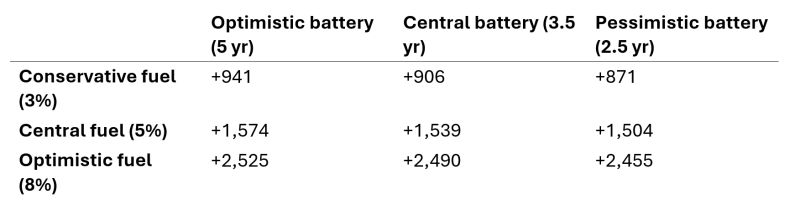
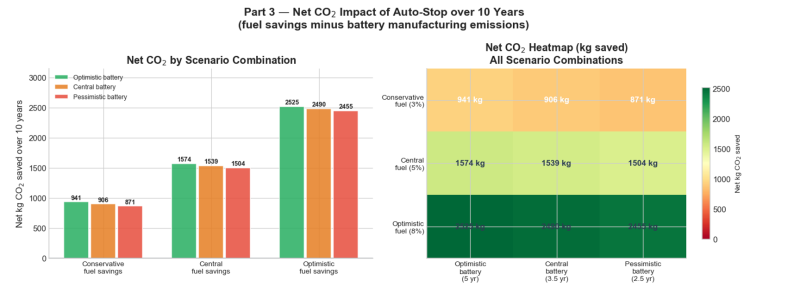
Across all nine scenario combinations, net savings range from a worst case of +871 kg CO2 to a best case of +2,525 kg CO2 over a decade, with a central estimate of +1,539 kg CO2. For perspective, the central net saving is equivalent to the emissions from driving about 4,850 miles in an average car, roughly 34% of one year’s total driving emissions.
Conclusion
Auto-stop is net CO2 positive in every scenario modeled. Even in the worst case, conservative fuel savings paired with three AGM replacements over 10 years, the system still saves roughly 870 kg of CO2 net, and the fuel savings far outweigh the battery manufacturing cost in every case examined. Auto-stop saves several tanks of gas a year (~24 kg CO2 each); at most, it costs the owner one or two extra AGM batteries (~35 kg CO2 each) over a decade.
Author's Note: Going into this analysis, I genuinely expected the numbers to favor ISS, but only narrowly. The battery counterargument is one I had heard repeated often enough that I assumed it would meaningfully eat into the fuel savings. What I didn’t appreciate before working through the data was that automakers had already responded to the durability problem by switching to AGM batteries purpose-built for the duty cycle, which blunts the degradation effect considerably. I was also surprised by how comparatively small the manufacturing CO2 footprint of a lead-acid battery is, especially given the maturity and high recycled content of the supply chain. The end result was a much more lopsided answer in favor of auto-stop than I would have predicted at the outset.
For Further Reading
Highway Statistics 2022, Federal Highway Administration. Table VM-1: Annual Vehicle Distance Traveled. US Department of Transportation. Average annual miles driven (14,263 mi/yr).
Federal Test Procedure (FTP) and Highway Fuel Economy Test (HWFET) Driving Cycles, US Environmental Protection Agency. City/highway split (55% / 45%).
The 2023 EPA Automotive Trends Report: Greenhouse Gas Emissions, Fuel Economy, and Technology since 1975, US Environmental Protection Agency. Average city and combined fuel economy (22 mpg city, 28 mpg combined).
Start/Stop System Press Information, Robert Bosch GmbH (2013). Idle-stop/start fuel savings of 3–8% in European drive cycles (conservative and optimistic bounds).
Idle Reduction for Personal Vehicles, National Renewable Energy Laboratory, US Department of Energy. 5–7% fuel savings in US urban driving (central estimate).
Greenhouse Gas Emissions from a Typical Passenger Vehicle, US Environmental Protection Agency (2023). Emission factor of 8.887 kg CO2 per gallon of gasoline.
Gasoline and Diesel Fuel Update, US Energy Information Administration. Average U.S. retail gasoline price (Approximately $3.50/gallon).
Life Cycle Assessment of Lead-Based Batteries, International Lead Association (2019). Full-supply-chain CO2 for lead-acid batteries.
Battery Innovation Roadmap, EUROBAT. Lead-acid battery LCA data.
Energy and Environmental Impacts of Lead-Acid Battery Production and Recycling by L. Gaines and M. Singh, Argonne National Laboratory. Battery supply-chain CO₂ (standard 25 kg, AGM 35 kg).
Reliability Issues of Start–Stop Batteries by D. Berndt, Journal of Power Sources. AGM battery degradation of 20–50% under stop-start (partial-state-of-charge) cycling; informs AGM life scenarios.
Car Battery Buying Guide/Reliability Data by J. Bartlett, Consumer Reports. Median standard 12V battery service life (4.5–5.5 years).
Service Information Bulletin SI-12-05-19, BMW AG. AGM/EFB battery requirement for stop-start vehicles.
Technical Service Bulletin 99-20-18, Volkswagen AG. AGM/EFB battery requirement for stop-start vehicles.
National Recycling Rate Study, Battery Council International. About 99% lead-acid battery recycling rate in the US.
