

Risk management

Operational drift in oil and gas starts with small, undocumented deviations that compound over time, making real-time visibility, digital workflows, and frontline execution data critical for preventing safety incidents, compliance failures, and costly operational disruptions.

As upstream operators move beyond isolated experiments, the hardest part of the AI journey is not building a model, it is making it stick.

This article from the SPE Integrated Reservoir Management Technical Section (IRMTS) addresses decision timing across the reservoir cycle.
-
 Digital drilling technologies are enabling a shift toward more predictive, efficient, and sustainable operations.
 -
This article analyzes Nigeria’s deepwater fiscal framework by examining its legal foundations, the practical operation of production-sharing contracts, and the allocation of financial risk between the government and international oil companies.
-
Lean Six Sigma, through its DMAIC framework, offers a data‑driven approach for reducing waste and variation in oil and gas operations and is explored here as a practical solution for improving drill-bit inventory and lease management despite limited industry adoption.
-
This article from the SPE Sustainable Development Technical Section (SDTS) explores how the next phase of methane performance will be defined less by pledges and more by measurement, response, and verifiable results.
-
SPE President Jennifer Miskimins lent her expertise to Science Friday’s conversation about Venezuelan oil, explaining the reality of what it would take to extract and refine it.
-
In complex energy projects, technical excellence alone is not enough—successful delivery depends on disciplined execution skills such as scope clarity, realistic scheduling, stakeholder coordination, and proactive risk management, particularly for young professionals turning concepts into real-world results.
-
The event on 14 January in Houston will bring together leading economists and industry leaders and will debut the North American edition of Energython, “Molecule to Megabyte,” a business case challenge for students focused on gas-to-data-center solutions.
-
This article introduces a tender strategy framework—a four-pillar model built on nearly 2 decades of international upstream experience—that integrates engineering rigor with business strategy to improve contract awards, strengthen transparency, and deliver lasting project performance.
-
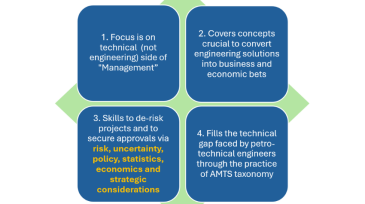
The SPE Asset Management Technical Section (AMTS) is teaming up with the University of Houston to launch a pilot program that advances asset management practices and supports the growth of energy professionals worldwide—setting a model for future collaborations between universities and SPE technical sections.
-
The SPE Management Technical Section has been officially renamed the Asset Management Technical Section. The new name better reflects the section’s focus on asset management as a core discipline in the upstream oil and gas industry.


Page 1 of 3