


Editor's Note: Piergiuseppe Fiore is a member of the TWA Editorial Board and a contributing author of previous TWA articles.
Over the past decade, energy transition has often been presented as a straight and ordered process. Renewable energy has grown steadily, fossil fuels are gradually declining, and policy frameworks guide economies toward decarbonization. However, recent geopolitical developments, from the uncertainty surrounding oil production in Venezuela to escalating tensions across the Middle East, are reminding the energy sector that the transition will not be linear.
For energy professionals, especially those entering the industry today, these events highlight a crucial lesson. The global energy system is not simply replacing one source with another one. It is evolving under the combined pressures of geopolitics, economics, security, and climate policy.
As a result, the path to a low-carbon future will be far more complex than many early transition scenarios suggested.
The Return of Energy Security
In the years following the Paris Agreement, decarbonization targets, electrification, and the rapid growth of renewable energy were the center of the energy industry dialogue. Solar and wind deployment accelerated, electric vehicles gained market share, and many governments, as well as international associations, introduced net-zero roadmaps.
However, the geopolitical shocks of the 2020s have reshaped the priorities of many policymakers. Energy security, once considered a largely solved issue in many regions, has reemerged as a central concern.
Instability in major producing regions illustrates why the Strait of Hormuz remains one of the most critical chokepoints in the global energy system, with a substantial share of the world’s crude oil passing through the narrow passage between the Persian Gulf and the Arabian Sea. Even minor disruptions in this corridor can create immediate volatility in global oil markets.
Recent tensions across the Middle East have once again demonstrated how quickly geopolitical events can influence global energy prices and supply chains. While renewable energy capacity continues to expand worldwide, the underlying energy infrastructure remains heavily dependent on oil and natural gas.
The transition must proceed without undermining the reliability of the existing energy system.
Venezuela and the Supply Question
The situation in Venezuela offers another example of the complex dynamics between geopolitics and energy transition. The country holds the largest proven oil reserves in the world, yet its production has fluctuated dramatically over the past decade due to political instability, economic challenges, technical limits, and international sanctions.
From a purely geological perspective, Venezuela represents a significant potential source of global supply. The country's refineries can be seen in Fig. 1.

In practice, the ability of the country to restore and sustain production depends on a wide range of factors, including investment conditions, infrastructure rehabilitation, and international political dynamics (Watters and Dakalia, 2026).
This uncertainty illustrates a broader issue in the global energy transition: The world still relies heavily on oil supply stability. Even as demand growth slows in some scenarios, sudden disruptions can trigger significant economic and political consequences.
This means that producing regions may remain strategically important even during a period of long-term decarbonization. In other words, the transition does not eliminate the importance of hydrocarbon resources.
The Paradox of the Energy Transition
One of the most overlooked aspects of the energy transition is the paradox that fossil fuels may still play a stabilizing role during the transition itself.
Renewable energy technologies are expanding rapidly, but their integration into power systems requires time, infrastructure investment, and grid modernization. Large-scale electrification, storage deployment, and transmission upgrades cannot occur instantaneously. In some cases, long-term standby would be required.
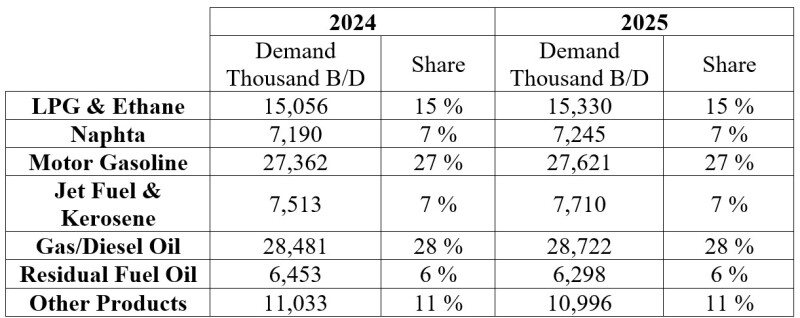
In the meantime, oil and natural gas continue to provide critical flexibility to the global energy system. Natural gas often supports power generation during periods of variable renewable output, while petroleum products remain central to aviation, shipping, petrochemicals, and many industrial processes. A summary of oil global demand by product is provided in Table. 1.
From this perspective, an abrupt decline in hydrocarbon supply could create economic disruptions, dramatically slowing down the transition. Stable and mature energy markets provide a strong foundation for further investment in new technologies.
This paradox suggests that transitioning to a lower-carbon energy system may require carefully managing the decline of hydrocarbons, rather than attempting to accelerate it.
A Nonlinear Transition
Traditional energy transition narratives often depict a smooth substitution process: renewables gradually replace fossil fuels as costs fall and technologies mature. In reality, energy systems evolve in waves, shaped by economic cycles, policy shifts, and geopolitical events. The global transition now appears increasingly nonlinear.
Periods of rapid renewable expansion may be followed by moments of renewed investment in hydrocarbons, particularly when supply disruptions or price spikes occur. Likewise, technological breakthroughs, such as improvements in energy and battery storage, hydrogen systems, or carbon capture, may suddenly reshape the economics of entire sectors.
This dynamic pattern is typical of large technological transitions. Historical shifts, from coal to oil or from steam power to electricity, involved overlapping energy systems rather than abrupt replacements, adding one source to the existing ones. The global energy mix by source can be seen in Fig. 2.

The current transition is likely to follow a similar trajectory. Fossil fuels, renewables, nuclear energy, and emerging low-carbon technologies will coexist within a hybrid global energy system for many years.
The Changing Geography of Energy
Another important dimension of the transition is the changing geography of energy resources.
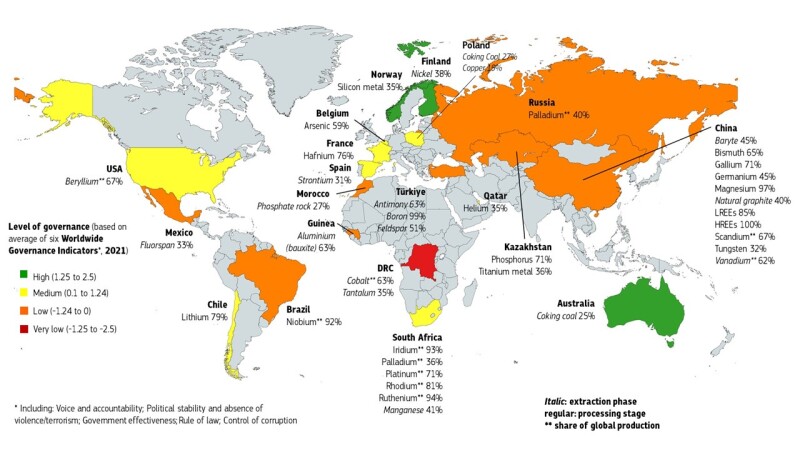
For much of the 20th century, global energy geopolitics revolved around hydrocarbon-producing regions, particularly the Middle East. Today, while hydrocarbons remain important, the transition is also shifting attention toward the supply chains of critical minerals required for low-carbon technologies (De Donno, 2024).
Lithium, cobalt, nickel, and rare earth elements have become essential inputs for the electrification. As a result, new resource centers, from South America’s lithium triangle to Southeast Asia’s nickel deposits, are gaining strategic importance (Fig. 3).
This emerging “mineral geopolitics” does not replace traditional oil geopolitics but adds another layer of complexity. Energy security in the 21st century may involve managing both hydrocarbon supply and critical material supply simultaneously.
Implications for Energy Professionals
For young professionals entering the energy sector, these developments carry several important lessons.
First, the energy transition will require interdisciplinary expertise. Engineers, geoscientists, and energy analysts must increasingly understand not only technical systems but also policy frameworks, economic dynamics, and geopolitical risks.
Second, flexibility will be a key professional skill. The future energy workforce will likely operate in a system where traditional oil and gas operations coexist with renewable energy projects, carbon management technologies, and digital energy systems (Fig. 4).
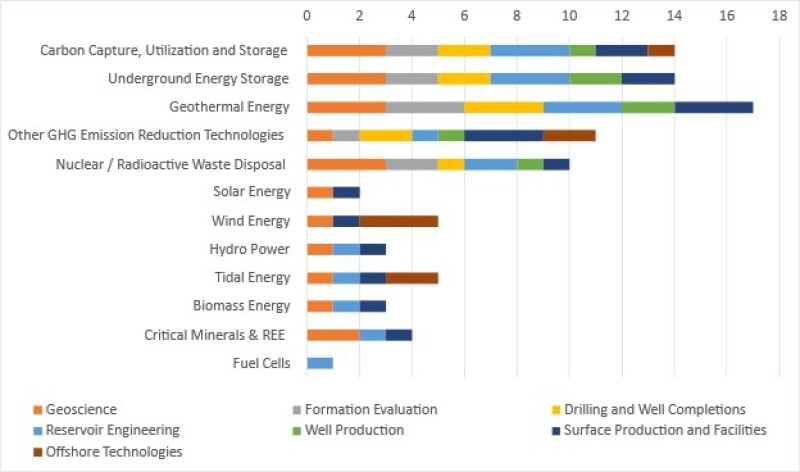
Finally, the transition should be viewed as an opportunity rather than a decline in a particular sector. Many of the developed capabilities within the hydrocarbon industry, large-scale project management, subsurface expertise, complex infrastructure development, are directly applicable to emerging fields such as geothermal energy, hydrogen production, and carbon capture and storage (Okoroafor et al., 2022).
In this sense, the energy transition represents an evolution of the energy sector rather than its replacement.
Looking Ahead
Geopolitical developments in regions such as Venezuela and the Middle East serve as reminders that energy systems are deeply interconnected with global politics and economics. While the long-term trajectory toward lower carbon emissions remains supported by governments and industry, the path toward that future will almost certainly include periods of volatility and trajectory adjustments.
Rather than a simple shift from fossil fuels to renewables, the coming decades are likely to feature a complex coexistence of energy sources, technologies, and geopolitical realities.
For the global energy community and particularly for the next generation of professionals, the challenge will be to navigate this evolving landscape while maintaining the reliability, affordability, and sustainability of the world’s energy supply.
The energy transition is underway, but it is not unfolding along a straight line. Instead, it is progressing through a dynamic interplay of innovation, policy, and geopolitics. An evolution that will continue to shape the global energy system for decades to come.
For Further Reading
Venezuela: The Oil Trade, and Who Stands To Benefit by T. Watters and R. Dakalia, S&P Global.
SPE 219988 Metals for the Energy Transition: Exploring Opportunities Amidst Supply-Demand Imbalance, by M.G. De Donno, Istituto Analisi Relazioni Internazionali.
SPE 212040 Mapping Relevant Petroleum Engineering Skillsets for the Transition to Renewable Energy and Sustainable Energy, by E.R. Okoroafor, Stanford University; C.P. Offor, ExxonMobil; I.P. Ekeoma, SLB.
Drilling Into the Details of Venezuela's Oil, Science Friday.
Global Oil Prices Soar as Gulf Energy Infrastructure Comes Under Fire by T. Jacobs, JPT.
Middle East Conflict Disrupts Global Energy Flows as Strait of Hormuz Traffic Slows by T. Jacobs, JPT.
