


[Editor's Note: Bright Eyindah Odike is a member of the TWA Editorial Board and the author of previous TWA articles.]
Methane abatement, the deliberate reduction of methane that escapes into the atmosphere throughout the full life cycle of oil and gas operations, is central to the near-term drive toward global decarbonization. Methane (CH4), the primary component of natural gas, is a potent greenhouse gas with a global warming potential approximately 80 times greater than carbon dioxide (CO2) over a 20-year horizon. Since the Industrial Revolution, methane has been responsible for around 30% of the rise in global temperatures alongside significant degradation of air quality (IEA, 2026).
As illustrated in Fig. 1, atmospheric methane concentrations continue to rise despite increasing climate commitments and emissions-reduction initiatives worldwide, a trend supported by assessments from the Intergovernmental Panel on Climate Change. Zooming in on the energy sector specifically, the International Energy Agency (IEA) reports that emissions plateaued near record highs in 2025, underscoring a significant gap between stated emissions-reduction ambitions and field-level implementation. At the same time, projections continue to show substantial long-term demand for natural gas within the global energy sector, even under policy-driven energy transition pathways. As energy security concerns intensify, ensuring a reliable natural gas supply has emerged as a strategic priority. This shift, therefore, places greater value on capturing and commercializing gas that would have otherwise been wasted during production, extending value creation beyond delivery to end users.
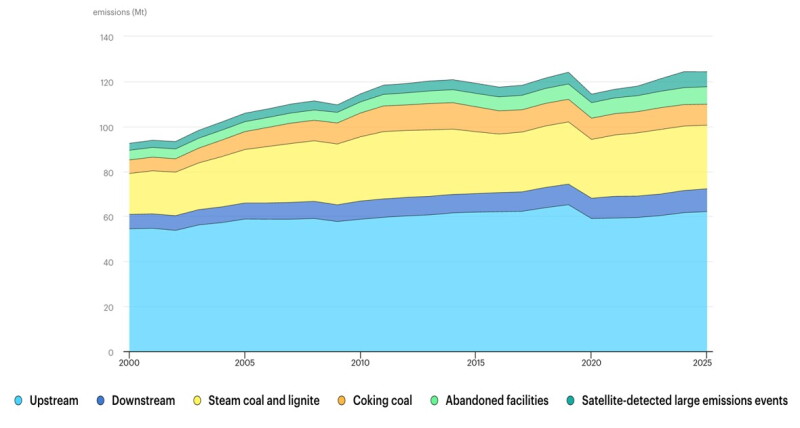
The IEA estimates that fully deploying known abatement measures could make around 200 Bcm of natural gas available annually, gas that is currently leaked, vented, or flared rather than delivered to market (IEA, 2026). Consequently, improving methane management across natural gas production and supply chains is increasingly viewed as essential not only for reducing emissions intensity, but also for strengthening energy security and sustaining the long-term role of natural gas in the evolving energy landscape.
In the industry, with most methane emissions occurring predominantly in the upstream sector and some at the midstream/downstream level, which intersects the production and transportation phase, methane emission pathways include, but are not limited to: fugitive leaks from wellheads, valves, and compressors; vented releases from pneumatic devices and pressure-relief systems; and flaring, which generates unburned methane when combustion is incomplete. To address these emissions, cost-effective methane-abatement technologies that typically integrate prevention, continuous detection, timely repair, and independent verification are therefore essential. This positions methane abatement as one of the most immediate climate interventions available to the industry.
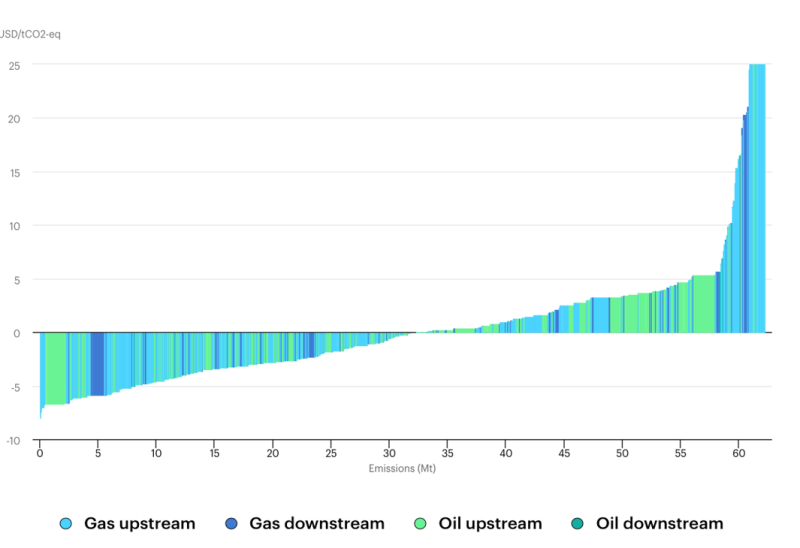
The IEA Marginal Abatement Cost Curve (Fig. 2) estimates that existing technologies can abate approximately 30% of methane emissions from oil and gas operations at no net cost; the value of natural gas recovered can offset much of the associated mitigation expenses. Abatement measures are ranked by cost, with the least-expensive options delivering the largest emission reductions at no net cost, and higher-cost interventions requiring dedicated capital outlay to implement. This no-net cost threshold, however, is price-sensitive and fluctuates with prevailing market economics.
The evolution of methane abatement in the industry was shaped as much by operational pragmatism as by environmental or climate imperatives. Many of the industry’s earliest methane-reduction practices emerged from production-level efforts to improve gas-recovery efficiency, reduce operational waste, and better commercialize associated-gas streams. However, what began decades ago as an operational cost-saving exercise, driven by voluntary frameworks and regulatory requirements, is now becoming a market signal, with low-emissions natural gas emerging as a differentiated and increasingly valuable commodity.
Captured gas has long been a marketable product, and where infrastructure and gas prices supported commercialization, reducing venting and flaring practices was viewed primarily as a form of asset optimization. Voluntary frameworks such as the US Environmental Protection Agency’s Natural Gas STAR Partnership and the World Bank’s Zero Routine Flaring by 2030 initiative sought to scale this perspective across the industry. Their impact, however, was constrained by uneven participation, a lack of independently verified reporting, and weakened compliance due to low gas prices that reduce the economic value of captured gas. These shortcomings made the case for binding regulation inevitable, and the accountability landscape has since shifted decisively in response, driven by both technological advancement and regulatory actions.
Satellite monitoring and advanced detection technologies provide real-time, global traceability of methane emissions, narrowing the gap between actual emissions and self-reported inventories.
Optical gas imaging, enables real-time visualization of methane plumes that would otherwise remain invisible to conventional inspection methods.
At the same time, binding measures such as leak detection and ranging requirements, financial penalties for excess emissions, and import verification standards in the US and EU have transformed inaction from a reputational risk into a direct financial liability. Together, these developments have aligned methane abatement as both a cost-saving operational practice and an enforceable compliance obligation.
More consequential, however, is the commercial shift in the energy transition mix. As the energy transition progresses, natural gas can no longer rely on its edge as a low-cost fuel with a dependable supply to secure market access. Current market access is increasingly reliant on verified methane performance, particularly as investors now incorporate methane intensity into natural gas valuation. This shift has led to a growing preference among buyers for certified low-emissions supplies, with some buyers even willing to pay a premium for these options. At the level of international trade, regulatory measures such as the import intensity thresholds set by the EU Methane Regulation 2024/1787, reinforce this trend by embedding emissions criteria into market access conditions. The intersection of these markets, financial, and regulatory dynamics is reshaping the upstream economics: low-emitting producers benefit from improved pricing, financial incentives, and market access, while high-emitting producers face penalties and the growing risk of exclusion from key import markets.
Despite substantial abatement potential, progress remains uneven and constrained by a few uncertainties, including inconsistent regulatory enforcement, fragmented gas markets, and insufficient price signals to support operational investments. Even so, these developments point to a deeper redefinition of methane abatement’s role in the oil and gas industry. What began as an operational-efficiency practice has evolved into a fully commercialized dimension of upstream gas value creation. This trajectory marks the industry’s shift in the energy transition from operations to commercialization.

Bright Eyindah Odike, SPE, is a PhD student in chemical engineering and a doctoral researcher in the Mary Kay O’Connor Process Safety Center at Texas A&M University. His current research focuses on exploring coupled physics-based and deep learning frameworks for safety-centric development of subsurface energy and carbon storage systems. An SPE member since 2016, he is a recipient of the 2022 SPE Foundation Imomoh Scholarship. A a member of the 2025 and 2026 Texas A&M SPE PetroBowl teams, he has participated in several SPE roles, including serving as the secretary of the SPE Rivers State University Student Chapter and as the captain of the chapter’s PetroBowl team. He holds a master’s degree in energy and mineral engineering (a minor in petroleum and natural gas engineering) from Pennsylvania State University, with a research focus on integrating advanced data-driven and analytical modeling techniques for the development and performance evaluation of multiphase natural gas reservoirs. He graduated top of his class with a bachelor’s degree in petroleum engineering from Rivers State University.

Shammah Ndubuisi, SPE, is a graduate assistant at Hensard University, contributing as both a teaching and research assistant in the faculty of engineering. He graduated with a first class in petroleum engineering from Rivers State University and placed third in the 2025 SPE Africa Student Paper Contest. He has coauthored four SPE conference papers and was twice selected as an IPTC student delegate to Saudi Arabia and Malaysia in 2024 and 2025. His industry experience includes asset integrity and inspection work at TotalEnergies E&P Nigeria, where he supported risk analysis, inspection planning, and maintenance of pressure vessels and piping systems.