


Lean Six Sigma (LSS) focuses on creating continuous improvement by reducing variation and eliminating waste. While its positive impact on return on investment (ROI) has been a cornerstone of the manufacturing sector for decades, its integration into the oil and gas industry remains limited, often due to awareness gaps or management misconceptions.
At the core of LSS is the Define, Measure, Analyze, Improve, and Control (DMAIC) framework. This systematic approach allows project managers and engineers to diagnose operational bottlenecks and implement data-driven solutions. By integrating these lean concepts, oil and gas companies can eliminate non-value-added activities such as unnecessary transportation, excessive inventory, and rework fostering a culture of continuous operational improvement (Johnson, 2021).
In this article, we explore how LSS methodologies and tools can be successfully applied to drill-bit inventory and lease management, aimed at correcting and improving their existing process, as well as reducing existing variations.
Problem Description for Drill-Bit Inventory and Lease-Management System
A significant logistical challenge is presented by the management of a vast inventory of drill bits across multiple warehouses, sales locations, and diverse client bases. Without a suitable database to store detailed tracking information for each bit, underutilization and potential bit loss are faced, which directly lower the ROI. Additionally, seamless data transfer between the inventory database and clients is required, even across slow internet connections. Therefore, it is critical that bit utilization is improved, operating costs are reduced, and superior customer experience is provided. To achieve these value-generation goals, the DMAIC framework is utilized alongside additional lean tools to maximize operational efficiency.
Application of DMAIC and Lean Tools to Drill-Bit Inventory and Lease-Management System
1. Define Phase
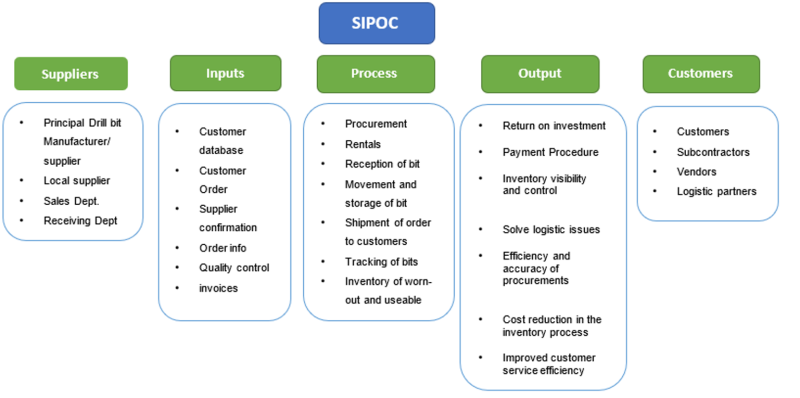
The end goal of the project is defined in this phase. Problems associated with the current workflow are identified, alongside opportunities for improvement. Because operations are hindered by improperly developed inventory database management systems, the improvement of inventory visibility and accuracy is prioritized. To gain a bird’s-eye view of the inventory process, the Suppliers, Inputs, Process, Outputs, and Customers (SIPOC) tool is deployed. This framework is used to identify the relationships between suppliers, inputs, and processes, while the Voice of the Customer (VOC) and their specific requirements are actively acknowledged (Fig. 1).
2. Measure Phase
In the measure phase, quantitative data is collected through physical inventories of drill bits in warehouses and at drilling sites. To facilitate this data collection, a process map of the drill-bit inventory-management workflow is developed (Fig. 2).
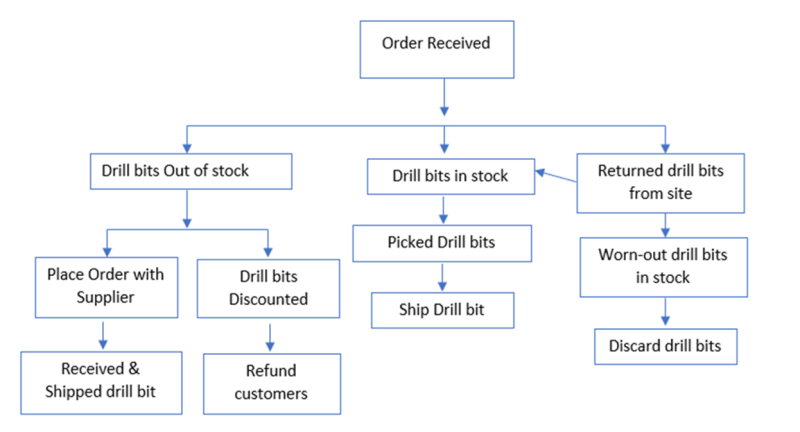
The data collected during this phase includes the number of drill bits returned at the expiration of drilling contracts, inspection reports, and estimations of the bit’s remaining useful life. An inventory cycle count is carried out so that all erroneously stored drill bits of varying outer diameters are identified and recorded. Additionally, the drill-bit reordering points are estimated. Ultimately, every step in the management cycle is detailed using the inventory process map, including contingency workflows for when backorders must be placed or refunds must be issued due to specific drill bits being out of stock.
3. Analyze Phase
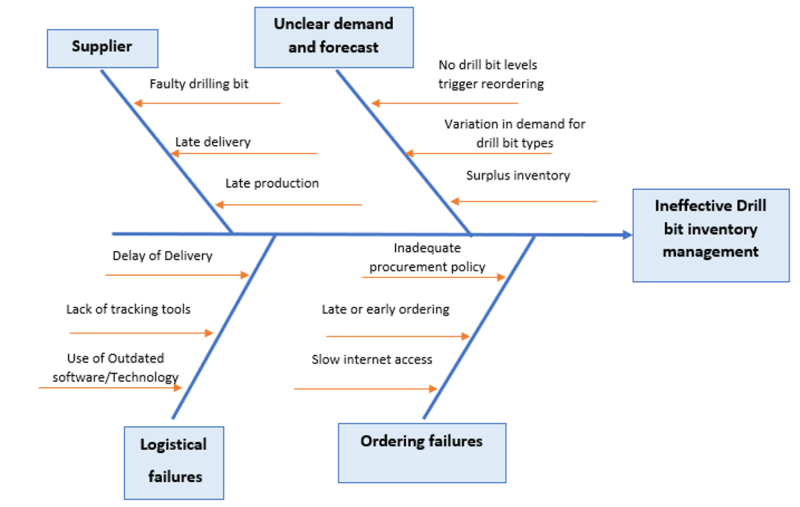
Using the data collected during the measure phase, the probable causes of the problems highlighted in the define phase are identified. Brainstorming techniques, the 5 Whys, cause-and-effect analysis, and fishbone diagrams are utilized to pinpoint the actual root causes of the bottlenecks encountered in the drill-bit inventory-management process. Specific problems are analyzed, such as logistical failures, ordering errors, unclear demand forecasting, and supply chain disruptions. These underlying causes (process inputs) are mapped to their corresponding effects (process outputs), as illustrated in the fishbone diagram (Fig. 3).
Process performance is improved in this phase by ensuring the identified root causes are addressed and eliminated. A synchronization system is deployed to maintain 100% data integrity. Through this database system, all handwritten forms and documents are digitized. Every aspect of the inventory is computerized, including buying, leasing, inspections, re-inspections, client/warehouse tracking, and shipping. By the implementation of this optimal, upgradable inventory-management system, cycle counting is improved and manual tracking efficiency is increased by 300% while overall accuracy is boosted.
Furthermore, waste such as excess overhead expenses are eliminated through this robust software system by the implementation of Kanban and the Just-in-Time (JIT) inventory model. Under this model, no extra drill bits are stored in the warehouse; instead, it is ensured that bits are delivered only as needed to fulfill client orders.
4. Control Phase
In the control phase, the inventory-management process is continuously monitored to ensure high performance levels are maintained. Key parameters are defined such as the percentage utilization of the existing inventory and routine field audits so that system information can be cross verified.
At the outset, inventory operations lacked formal documentation and consistent oversight. To address these gaps, LSS principles were applied to diagnose deficiencies and standardize processes. This approach led to measurable improvements in inventory transparency, operational control, requisition workflows, and data reliability. Following implementation, inventory-management practices achieved markedly better visibility, with cycle-count performance improving by as much as 50% over a 2‑year span, according to 6Sigma.
Conclusion
Although LSS is not as widely popularized in the oil and gas industry as it is in the automotive and manufacturing sectors, its positive impact on ROI, customer satisfaction, and waste elimination is proven when it is properly implemented.
The following lessons should be applied to drill-bit inventory and lease-management systems.
- A fishbone diagram should be used so that the root causes of ineffective inventory management such as logistical failures, ordering errors, unclear demand, and supply issues are identified.
- The JIT inventory model, a core LSS tool, should be applied, as it has been proven to increase drill-bit inventory utilization and generate millions in annual savings.
For Further Reading
