

Reservoir characterization

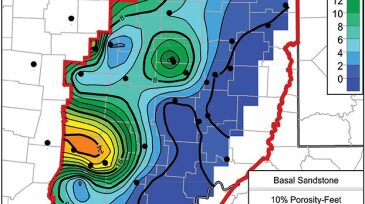
In part one of this two-part series, explore five underdeveloped US shale and tight-rock plays, from the Tuscaloosa Marine Shale to the Brown Dense, and discover why proven hydrocarbons and successful wells have yet to translate into repeatable unconventional development.

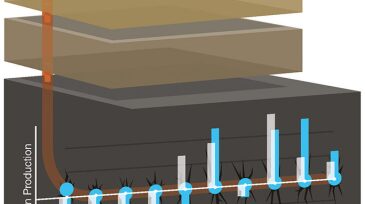
Proxy models are transforming reservoir management by enabling engineers to rapidly evaluate and optimize thousands of operating scenarios, helping improve CO2-EOR, carbon storage, geothermal, and underground gas storage decisions while keeping high-fidelity reservoir simulation at the core of validation.

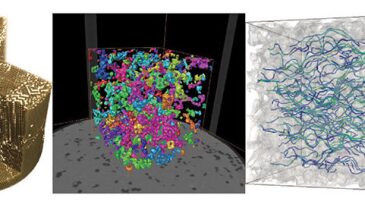
Rock sample characterization, widely used in hydrocarbon exploration and production, is emerging as a critical tool for understanding and optimizing subsurface mineral extraction through in-situ leaching.
-
 Earthquake in Cushing, OK -- home to the largest oil storage facility in the world -- leads to further regulatory action on disposal wells in the area.
 -
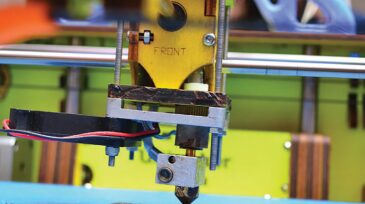
Researchers at Heriot-Watt University in Edinburgh, Scotland, are building replica core samples using 3D printers and installing sensors inside them as they go. Their goal is to directly monitor pore-scale flow behavior from the inside of these so-called “smart rocks.”
-
Research and development firm Battelle is working on a new induced-seismicity study that aims to help wastewater disposal well operators in Ohio stay on the good side of state regulators.
-
In an effort to foster collaboration in an area where there is currently very little, researchers at the University of Texas at Austin (UT) created a new web-based application for storing and sharing CT images of rocks.
-
For the past 2 decades, the use of DNA sequencing technology has largely been relegated to the domains of criminal forensics and the healthcare industry. One company is betting that the shale industry soon will join that list.
-
Industry regulators in Oklahoma have rolled out broad new restrictions on more than 600 disposal wells as part of the largest action of its kind taken in response to earthquakes.
-
Rising demand for flowback technologies to reduce uncertainties is leading to the creation of more hydrocarbon and water tracers. These chemical-based tracers may play an important role in the shale industry’s effort to come up with more cost-effective fracture designs.
-
An area of great interest to those researching flowback is the interaction of water and salt inside the shale reservoir. After a well is stimulated, the flowback fluids tend to show a rising concentration of salt that falls back to near zero over time.
-
Pulled directly from the reservoir rock, core samples provide critical data used to determine how exploration should proceed. Until recently, core analysis remained old school, however, there is an ongoing transition to bring the process of core description into the digital age.
-
David Sinton, University of Toronto, discusses how microfluidics is gaining traction in the oil and gas industry and how this field of study can be used for understanding pore-scale transport.





Page 3 of 4