


As global decarbonization efforts accelerate, the rapid deployment of clean energy technologies is expected to significantly increase the demand for strategic and critical minerals, positioning the energy sector as a major contributor to global mineral demand. The type and quantity of mineral resources required vary across clean energy technologies, as shown in Fig. 1, with copper playing a significant role in nearly all applications, while lithium, nickel, cobalt, manganese, and graphite are essential for battery systems, and rare earth elements are critical for permanent magnets used in wind turbines and electric vehicle motors. In particular, copper is a critical material in conventional generators and rotating electrical machinery (Hipchen, 2026), whereas, cobalt and graphite are critical for lithium-ion battery cathodes and anodes, respectively.
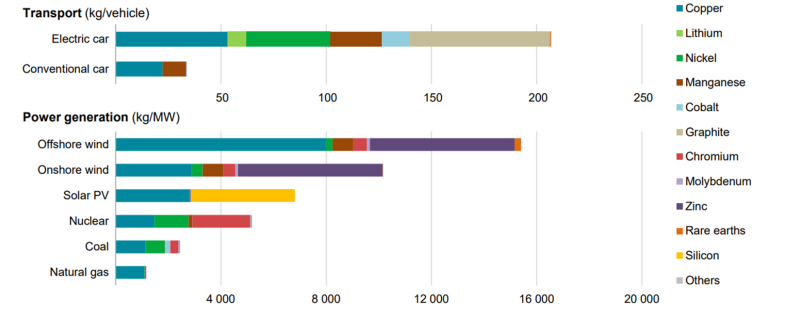
Over the next 2 decades, clean energy technologies are expected to account for more than 40% of total demand for copper and rare earth elements, 60–70% for nickel and cobalt, and nearly 90% for lithium (IEA, 2021).
Other strategic minerals of interest include lead, which is used in advanced lead-acid battery systems, and zirconium, a critical material for aerospace industries due to its exceptional heat resistance. These valuable elements are commonly extracted from ore bodies, which are geological formations containing economically recoverable concentrations of valuable minerals. Depending on the ore characteristics, extraction may be achieved through emerging in-situ leaching techniques, where chemically reactive fluids, known as lixiviants, are injected into the target formation to dissolve and recover minerals from the rock body and produce them at the surface. The technical viability of in-situ leaching depends not only on the ability of a lixiviant to dissolve the target mineral, but also on whether the formation can support controlled fluid injection, contact, and recovery without mineral precipitation, loss of permeability, or uncontrolled migration.
To reduce uncertainty prior to pilot testing and field-scale applications, comprehensive laboratory characterization becomes critical for defining mineral occurrences within the subsurface, optimizing leaching performance through appropriate lixiviant selection and operating conditions, and identifying the main technical and geological barriers affecting mineral recovery.
Key Characterization Parameters
Several key characterization parameters must be evaluated to establish an effective in-situ leaching framework that improves the understanding of mineral composition, leaching behavior, flow dynamics, and fluid-rock interactions. This framework should include both initial characterization to establish baseline ore properties, and post-leaching characterization to evaluate petrophysical and chemical changes following the lixiviant injection in order to determine leaching efficiency and optimize mineral recovery performance.
Chemical parameters include changes in
- Mineral (crystalline phase) abundance (DXi), measured in %.
- Solid-phase elemental concentration (DCi) measured in wt%.
- Dissolved metal concentration in solution (Ci) measured in mg/L.
- Elemental mapping and spatial distribution.
- Secondary mineral formation.
- Acidity and alkalinity of the leaching solution (DpH).
- Oxidation-reduction potential of the leaching solution (DEh).
Petrophysical parameters include
- Porosity changes (Df).
- Permeability evolution (Dk).
- Pore structure alterations.
- Evolution of preferential flow pathways.
Leaching performance parameters include
- Leaching efficiency (h).
- Leaching rate (r).
- Leaching selectivity relative to non-target minerals.
- Temperature and pressure response.
Laboratory Characterization Techniques
To quantify the key parameters, several laboratory characterization techniques and instruments can be integrated within the in-situ leaching evaluation workflow. Chemical characterization commonly involves a combination of analytical techniques that quantify both mineralogical and elemental properties. X-ray diffraction (XRD) is primarily used to identify and quantify crystalline mineral phases based on their crystal structures, whereas X-ray fluorescence (XRF) and inductively coupled plasma spectrometry (ICP) focuses on determining elemental concentrations within the solid and liquid phases, respectively (Fig. 2).

In contrast, scanning electron microscopy coupled with energy-dispersive spectroscopy (SEM-EDS) provides microscale imaging and spatial elemental mapping that can help determine mineral textures and elemental associations, whereas micro-computed tomography (micro-CT) primarily captures the internal pore structure, fracture networks of the rock sample without directly providing elemental composition insights.
Building on these imaging-based techniques, petrophysical characterization is further conducted through helium-porosimetry, which quantifies connected pore volume from the expansion of helium into pore spaces, whereas nuclear magnetic resonance characterizes porosity and pore structure distribution by analyzing the response of hydrogen atoms within pore fluids (i.e., water or brine) under an applied magnetic field. The signal relaxation behavior, defined as the time required for the hydrogen signal to return to equilibrium after magnetic excitation, reflects variations in pore size and pore connectivity within the pore network.
On the other hand, permeability can be directly measured through single-phase coreflooding experiments by injecting brine through the core plug under controlled conditions while monitoring the resulting fluid flow and pressure response across the sample, where permeability is commonly calculated using Darcy’s Law:

Where:
Q: Volumetric flow rate, cm3/s or mL/min
k: Permeability, Darcy (D) or millidarcy (mD)
A: Cross-sectional area, cm2
DP: Pressure drop across core, psi
µ: Fluid viscosity, cp
L: Core length, cm
Sample Preparation for Characterization
Proper sample preparation before characterization ensures analytical accuracy and experimental consistency, and may include drying the sample to remove moisture and prevent particle clumping, followed by homogenization, which may include crushing/splitting processes to reduce particle size while maintaining sample representativity, as well as pulverization to produce a uniform distribution of mineral and elemental components throughout the sample. Following homogenization, prepared samples may be directly analyzed using techniques such as XRD and XRF for mineralogical and elemental characterization, or subjected to acid digestion to dissolve the solid matrix into a liquid solution suitable for ICP analysis to measure solution metal concentrations.
Laboratory Characterization to Scale Up Workflow
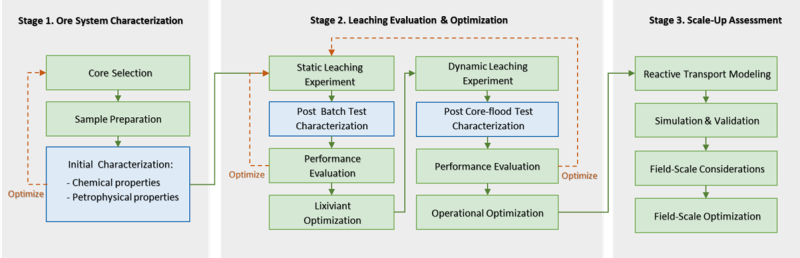
Following sample preparation, a systematic laboratory characterization and evaluation workflow is required to quantify mineral resources within ore bodies, assess ore behavior under controlled leaching conditions, and generate the data necessary for process optimization, scale-up assessment, and field-scale implementation of in-situ leaching. Fig. 3 illustrates how ore characterization serves as a critical step within the in-situ leaching framework, linking directly to static and dynamic leaching experiments, and reactive transport modeling. The combined workflow helps simulate the coupled interactions between fluid flow, chemical reactions, and mineral dissolution to predict and validate leaching behavior under field-scale conditions.
Key Challenges
Although in-situ leaching comes with its own unique set of risks, it can result in significant environmental advantages over conventional mining if these risks are addressed (Sinclair & Thompson, 2015). Despite the advancement of characterization instruments and the significant potential of the process, further laboratory investigations are still required to address technical and operational challenges of the ore systems to support field-scale implementation, which may include:
- Low permeability and limited hydraulic connectivity. Certain geological settings may be unsuitable if flow cannot be reliably achieved through the presence of natural flow paths (Sinclair & Thompson, 2015).
- Secondary mineral precipitation and pore clogging. Reactions between the lixiviant, formation minerals, and dissolved species can influence porosity and permeability (Hidalgo et al., 2021).
- Complex fluid-rock interactions and geological heterogeneity. Variability in rock composition and structure can affect the uniform dissolution and recovery (Chan, 2024).
- Lixiviant cost, consumption and losses. The choice of lixiviant should be based on technical, economic, and regulatory factors as they have significant influence on these parameters.
- Fluid containment and environmental risks. Preventing contamination of groundwater outside of the leached area is a major concern.
- Other challenges include incomplete mineral dissolution, channel development and uneven sweep.
Conclusions
The growing global demand of strategic and critical minerals has increased interest in in-situ leaching, where successful implementation requires a comprehensive characterization strategy capable of providing the mineralogical, petrophysical, and geochemical data necessary to understand and optimize the process prior to field-scale implementation. Various analytical characterization techniques can be utilized including XRD, XRF, ICP, SEM-EDS, micro-CT, etc., to enable both baseline and post-leaching evaluations. However, further laboratory investigation and optimization are still required to address existing technical and operational challenges and ultimately unlock the full potential of in-situ leaching systems.
For Further Reading
How Copper Supports Power Grid Expansion and Rising Energy Demand by J. Hipchen, Copper Development Association.
The Role of Critical Minerals in Clean Energy Transitions, IEA.
In-Situ Leaching of Copper: Challenges and Future Prospects by L. Sinclair and J. Thompson, Cornell University.
Comparative Analysis of Copper Dissolution and Mineral Transformations in Coarse Chalcopyrite for Different Oxidant/Lixiviant Systems at Elevated Temperature (110°C and 170°C) by T. Hildago, Curtin University; R. McDonald, CSIRO Mineral Resource; and A. Beinlich, University of Bergen, et al.
Advantages and Challenges of In-Situ Leaching: Extraction of Minerals by L. Chen, Hanyang University.

Deena Tayyib, SPE, is a petroleum engineer at Saudi Aramco’s Upstream Advanced Research Center. She has played an active role in Saudi Arabia’s CCUS project from reservoir and production engineering perspectives and has significantly contributed to the R&D of sustainability and carbon reduction efforts, including CO2 mineralization, CCS sequestration in deep saline aquifers and mitigation of CO2 gravity override, and currently she’s expanding her research into in-situ mineral leaching and critical mineral recovery. She has authored and coauthored various technical papers and filed several patents applications. She holds a BS degree from University of Louisiana at Lafayette and an MS degree from Texas A&M University.

Sarah AlSultan is a chemical engineering student at King Fahd University of Petroleum and Minerals with interests in process engineering, separation processes, and research. She is currently an intern at Saudi Aramco’s Upstream Advanced Research Center in Reservoir Performance and Dynamic Division, where she’s been actively participating in hands-on lab experiments and conducting research on in-situ mineral leaching and critical mineral recovery. She’s passionate about applying engineering principles to solve real-world challenges while building practical experience through academic and research projects.

Aliya Aldhamen is a chemical engineer from Saudi Aramco’s Upstream Advanced Research Center. She specializes in selective separations, electrochemical systems, carbon dioxide capture and conversion, and lithium recovery from brines. Her work addresses critical energy and sustainability challenges through advanced materials and process development. She has authored several publications, holds a granted patent, and is expanding her expertise into in-situ leaching technologies for subsurface mineral recovery.