

Data & Analytics

Known as Arena, the collaboration aims to improve decision-making across increasingly complex reservoirs and growing volumes of subsurface data.

Robotic and autonomous systems are transforming energy operations, but their full value emerges only when paired with data science, engineering analytics, and AI/ML to turn data into decisions. The transition of the SPE Robotic & Autonomous Systems Technical Section into the SPE Data Science & Engineering Analytics Technical Section helps bridge this critical technolo…
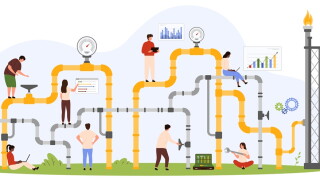
A credible custody-transfer record depends on far more than the accuracy of a single meter. It is the product of an integrated measurement chain. While meter performance supports measurement-system integrity, commercial confidence also depends on traceability, governance, and authorization.
-
 The Seismos full-scale research center opens to industry, universities, and national laboratories, advancing acoustic sensing across upstream energy, pipelines, critical infrastructure, and national security.
 -
The Society’s archive of technical papers, maps, figures, and geological data sets will be integrated into the GIX platform, enabling geoscientists to query AI agents about exploration opportunities within specific geographic regions while combining historical research with public data, proprietary information, and advanced analytics.
-
Canada’s development of large-scale digital drilling core libraries and open geoscience data platforms follows approaches pioneered in Australia, particularly Western Australia, through decades of government investment in geoscience data collection and preservation.
-
This research focuses on combining physics-based expert rules with machine learning to improve the detection of failure-related events in electrical submersible pumps.
-
A combination of physics principles and machine-learning techniques is used in this work to develop a virtual flowmeter for oil-production optimization in electrical-submersible-pump-lifted oil wells, resulting in reliable generalization.
-
This paper presents the deployment of an artificial intelligence-enabled autonomous gas lift optimization system, integrating real-time centralized advanced process control with cloud-based analytics to enhance artificial gas lift performance in producer wells.
-
After years of market shocks, technological breakthroughs, and rising uncertainty, ATCE 2026 will provide new insights on how industry leaders and technical experts are preparing for the next era of the upstream business.
-
SponsoredWith operators under pressure to deliver more energy with fewer resources, predictable drilling performance is more important than ever. Discover how a unified digital workflow can turn drilling data into better decisions and consistent execution—providing the foundation for autonomous drilling and more predictable, profitable, and productive wells at scale.
-
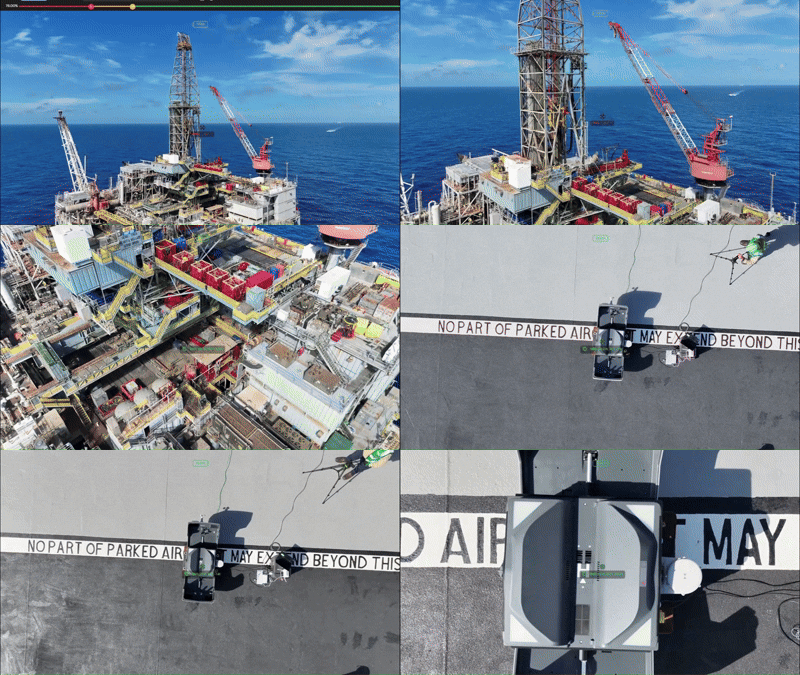
Shell has demonstrated drone-in-a-box operations from its Mars floating production unit, becoming the first operator in the region to secure FAA approval for self-approved offshore beyond-visual-line-of-sight flights. JPT Senior Technology Editor Jennifer Pallanich visited Shell Technology Center Houston to see the system in action.
-
Panelists at the SPE Subsea Well Intervention Symposium discussed where AI is delivering value today, where risks remain, and how engineers can best determine its usefulness.



Page 1 of 170