


[Editor's Note: Adeshina Badejo and Bright Eyindah Odike are members of the TWA Editorial Board and the authors of previous TWA articles.]
The US unconventional resources revolution demonstrated an important distinction by proving that hydrocarbons being present and producible is not the same as establishing a repeatable development model. A source rock may contain hydrocarbon, a horizontal well may produce it, and a hydraulic-fracture treatment may deliver an encouraging initial rate. Yet none alone shows that similar results can be reproduced consistently across a play.
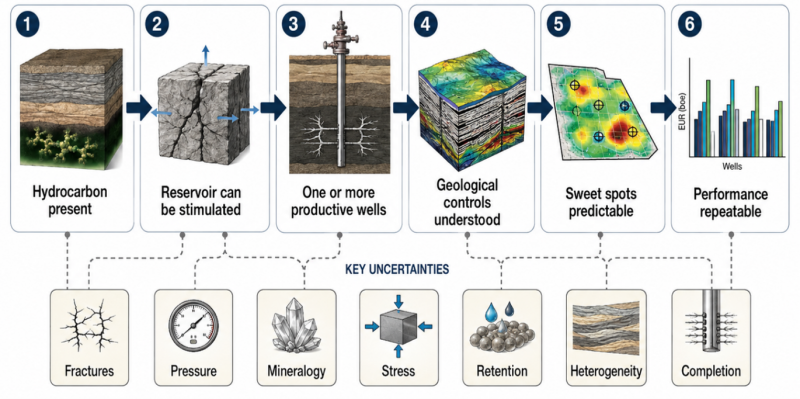
Several petroleum systems across the Lower 48 remain in this intermediate category. They are neither unexplored frontiers nor mature unconventional plays comparable with the Permian, Eagle Ford, Bakken, or Marcellus. Rather, they contain demonstrated hydrocarbons, but their development histories continue to raise questions about natural fractures, reservoir pressure, mineralogy, hydrocarbon retention, geomechanics, heterogeneity, and completion response.
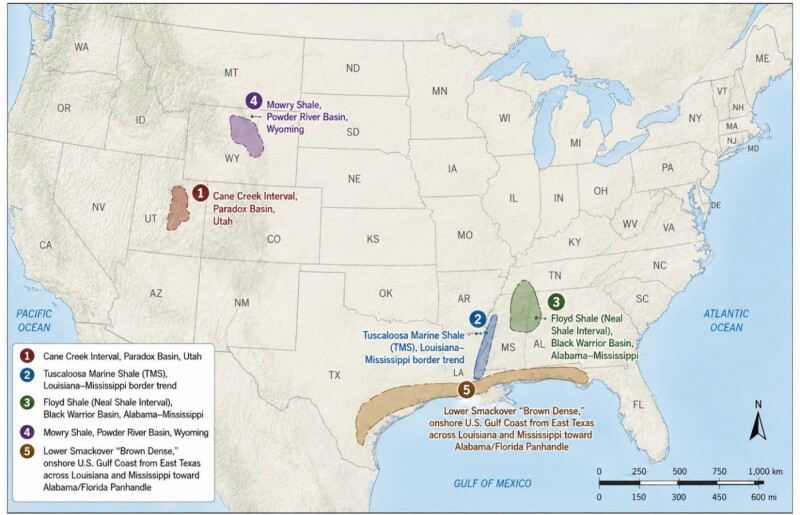
This first article in a two-part series examines five examples: the Cane Creek interval, Tuscaloosa Marine Shale (TMS), Floyd Shale’s Neal interval, Mowry Shale, and Lower Smackover Brown Dense. Their approximate locations are shown in Fig. 1. Rather than asking where the industry should drill next, this article examines a more fundamental question: Why have known hydrocarbons and technically successful wells in these intervals not yet translated into consistently repeatable development?

As summarized in Fig. 2, hydrocarbon presence and individual well success are only intermediate steps toward a repeatable development model.
Cane Creek Interval, Paradox Basin, Utah
The Cane Creek interval occurs within the lower Pennsylvanian Paradox Formation in the fold and fault belt of the northern Paradox Basin, primarily in southeastern Utah. Although the Cane Creek is commonly referred to as “shale,” it is a heterogeneous interval of evaporites, dolomitic mudstone, siltstone/sandstone, and organic-rich mudstone. The organic-rich beds provide source-rock potential, while sandstone and silty dolomite intervals form the main reservoirs.
Core studies from the northern part have identified organic-rich beds with total organic content (TOC) values locally reaching 13 wt% and thermal maturity within the oil window. Thick halite beds above and below the interval provide effective seals and contribute to overpressure. However, the siliciclastic reservoir intervals have low matrix permeability, meaning that commercial fluid flow depends strongly on the presence and connectivity of natural fractures (Jagniecki et al., 2019). More recent work at the State 16-2 LN-CC well reported a pore-pressure gradient of about 0.97 psi/ft and a nearly isotropic stress state, conditions that can make hydraulic-fracture behavior more complicated than in conventional stress settings (McCormack et al., 2025).
Horizontal drilling increases the likelihood of intersecting productive natural fractures, but McCormack et al. (2025) documented considerable variation in fracture density, orientation, and geomechanical stability along the State 16-2 lateral. Salt tectonics introduce another layer of uncertainty by affecting structural geometry, well trajectories, casing integrity, wellbore stability, and potentially fracture conductivity during stimulation. Reservoir modeling also suggests that mineral precipitation from fluid-rock reactions can reduce fracture conductivity during production (Panja et al., 2026). The key challenge is predicting where favorable reservoir facies, connected natural fractures, local stress, overpressure, and salt-related structural effects occur together, and whether the resulting flow pathways remain conductive during production.
Tuscaloosa Marine Shale, Louisiana and Mississippi
The Upper Cretaceous TMS extends across southern Mississippi and central Louisiana into parts of Alabama and the Florida Panhandle, with development concentrated near the Louisiana-Mississippi boundary at depths of about 11,000–14,000 ft. Despite decades of exploration and drilling, however, the TMS remains much less developed than major US shale plays.
The TMS exists as both source rock and reservoir, and geochemical studies have shown that it is the principal source of oil produced from the shale while also contributing hydrocarbons to nearby conventional Tuscaloosa reservoirs (Hackley et al., 2020). Drilling has generally targeted an overpressured, high-resistivity interval near the base of the formation. Lu et al. (2015) showed in one core that this elevated resistivity was closely associated with in-situ oil generation, higher organic-carbon content, and a greater proportion of oil-prone Type II kerogen rather than simply variations in bulk mineralogy or porosity. Reflecting this petroleum potential, the USGS estimated mean undiscovered, technically recoverable resources of approximately 1.5 billion bbl of oil and 4.6 Tcf of gas. These estimates are not proved reserves or economic forecasts (Hackley et al., 2018).
More than 80 horizontal wells were drilled and hydraulically fractured in the core area between 2007 and 2016, demonstrating commercial producibility in the core area but not consistent repeatability across the play (Ruse and Mokhtari, 2024). Enomoto et al. (2017) reported that their TMS samples averaged about 47 wt% total clay and exhibited substantial variation in organic content and thermal maturity, factors that can influence both reservoir quality and hydraulic-fracture response.
Ruse and Mokhtari (2024) identified predominantly vertical to subvertical fractures with a general east-west orientation, but many were partly or completely filled with calcite. Open fractures may provide flow pathways, whereas calcite-filled fractures may contribute little permeability and complicate hydraulic stimulation. Completion design must also account for the risk of fracture growth into water-bearing lower Tuscaloosa sandstones, which can increase water production and reduce effective hydrocarbon recovery. The key question is whether pressure, maturity, mineralogy, natural fractures, stress orientation, and completion design can be predicted well enough to reproduce successful wells.
Floyd Shale (Neal Shale Interval), Black Warrior Basin, Alabama and Mississippi
The Upper Mississippian Floyd Shale occurs in the Black Warrior Basin of Alabama and Mississippi, a basin better known for coalbed methane production. Its organic-rich interval is commonly referred to informally as the Neal shale and has been investigated as an unconventional gas target. The Floyd-Chattanooga petroleum system is well established, with the Floyd recognized as an important source rock for hydrocarbons produced from conventional carboniferous sandstone reservoirs in the basin (Pawlewicz and Hatch, 2007; Dembicki and Madren, 2014).
Based on conventional shale-screening criteria, the Neal initially appeared to have many favorable characteristics. Dembicki and Madren (2014) identified areas with TOC ranging from about 2-7 wt%, thermal maturity above 1.3% vitrinite reflectance, and organic-rich intervals approaching 200 ft in thickness. More recently, Sondergeld and Rai (2023) reported clay contents commonly exceeding 50 wt%, pore bodies and throats smaller than about 15 nm, and unusually strong elastic anisotropy approaching 40% in two Thomsen parameters.
Despite these favorable source-rock characteristics, tests did not approach commercial gas rates. Dembicki and Madren (2014) noted that reservoir pressure was approximately normal rather than strongly overpressured and that gas-charged sandstones immediately above the Neal could indicate loss of part of the generated gas through an imperfect seal. Laboratory work reported by Dembicki and Madren (2014) identified fluid-clay interactions and proppant embedment as possible contributors to poor fracture performance. Legg et al. (2014) also found that the underlying Lewis Limestone is substantially stronger than the Neal, suggesting that it may act as a mechanical barrier to downward hydraulic-fracture growth.
The unresolved issue is therefore not simply whether the Neal generated sufficient gas, but how much of that gas remains in place and whether the retained resource can be stimulated effectively. The Floyd Shale therefore illustrates why favorable TOC, maturity, thickness, and porosity do not by themselves establish a repeatable unconventional play.
Mowry Shale, Powder River Basin, Wyoming
The Cretaceous Mowry Shale is a siliceous, organic-rich marine mudrock in the Powder River Basin of Wyoming and Montana. It is both a major source rock for Lower Cretaceous accumulations and an unconventional reservoir, making hydrocarbon retention as important as generation.
Modica and Lapierre (2012) showed that pore space associated with kerogen develops as organic matter thermally matures, linking maturity to the capacity of the rock to retain hydrocarbons. Pore-scale studies have further shown that reservoir quality depends on rock fabric, clay distribution, and silica diagenesis, with recrystallized microquartz associated with some of the better reservoir intervals (Olson et al., 2022). More recently, the US Geological Survey (USGS) began evaluating low-temperature hydrous pyrolysis as another approach for estimating the quantity and quality of oil retained in thermally mature Mowry Shale (Lewan et al., 2026).
A 2026 review reported 47 completed horizontal Mowry wells in the Powder River Basin, while still characterizing the play as largely underdeveloped. Development is complicated by low permeability, complex stratigraphy, difficulty identifying productive sweet spots, and abundant bentonite-rich intervals. Bentonite and clay-rich layers can contribute to wellbore instability when exposed to water and may also complicate hydraulic-fracture propagation and conductivity. High water production has been another reported concern (Nwankwo and Dejam, 2026).
Johnson et al. (2024) found substantial geographic differences in production and only a weak relationship between mapped TOC and well performance. Productivity likely reflects the combined influence of retained-oil quantity and quality, thermal maturity, pore-system development, lithology, pressure, natural fractures, bentonite distribution, and completion response. The remaining challenge is determining whether these controls can be mapped well enough to identify repeatable sweet spots.
Lower Smackover “Brown Dense” Continuous Play, US Gulf Coast
The Upper Jurassic Smackover Formation extends across the onshore US Gulf Coast from Texas to the Florida Panhandle. Its more porous Upper Smackover carbonates have a long history as conventional reservoirs, whereas the organic-rich lower section, commonly called the Brown Dense, consists mainly of carbonate mudstone and dense argillaceous limestone and is an important regional source rock. The unconventional question is whether this source-rich interval, including locally porous or fractured facies, can also function as a productive reservoir (Yang et al., 2015; Whidden et al., 2023).
A major challenge is that the Brown Dense is highly heterogeneous. Core studies show repeated depositional cycles accompanied by substantial vertical variations in lithology, organic richness, cementation, porosity, and permeability (Yang et al., 2015). Brown (2014) linked differences in deliverability to maturity, fluid properties, natural fracturing, burial history, and the Monroe Uplift. Walkinshaw (2020) proposed a related hybrid-play concept in which locally porous siliciclastic beds, carbonate lenses, or fracture swarms within the source-rich Brown Dense may provide substantially better reservoir quality than the surrounding tight micritic rock. Historical drilling also showed that wells targeting very low-porosity, low-permeability micritic rock often performed poorly, whereas more fractured and thermally mature areas around the Monroe Uplift produced better results (Brown, 2014; Walkinshaw, 2020).
The difficulty is that relatively few wells are available to calibrate these geological controls. In the data set used for the 2023 USGS assessment, only 41 wells across the US Gulf Coast had targeted the lower Smackover, and only three had sufficient production history for estimated ultimate recoveries to be calculated. The data set was limited enough that USGS used results from Upper Jurassic continuous-resource assessments in northeastern Mexico to help constrain some assessment inputs (Whidden et al., 2023). USGS nevertheless estimated mean undiscovered, technically recoverable continuous resources of approximately 0.8 billion bbl of oil and 16 Tcf of gas. These are technically recoverable resource estimates, not proved reserves or economic forecasts. The key question is whether better-performing fractured, carbonate, and siliciclastic intervals form mappable fairways where reservoir quality, maturity, pressure, fluid properties, fractures, and structure align consistently.
From Discovery to Repeatability
These five systems show that hydrocarbon presence is only the beginning of the development story. Cane Creek highlights fractures, salt, and stress; TMS, mineralogy and fracture behavior; Floyd, pressure, retention, and stimulation; Mowry, retained oil and sweet-spot prediction; and Lower Smackover, heterogeneity and limited unconventional calibration.
Limited development does not necessarily indicate geological failure. Capital competition, infrastructure, commodity prices, drilling and completion costs, and better-understood opportunities also influence where industry invests. The lesson is that a successful well is not the same as a successful play. Repeatability requires understanding the controls on performance well enough to predict where success should occur.
Part two of this two-part series will shift from development repeatability to frontier systems where the more fundamental question is whether source, maturity, migration, reservoir, trap, seal, and preservation align at all.

Adeshina Badejo, SPE, is a PhD student in petroleum engineering at Texas A&M University, working within the Subsurface Engineering for Sustainable Energy (SESE) research group. His current research focuses on understanding the coupled geomechanical and geochemical effects of CO2 storage at the field scale. He integrates numerical modeling and machine learning techniques to advance this work. His research excellence has earned him awards including the Texas A&M Chevron Energy Graduate Fellowship and IADC scholarship. Passionate about mitigating the environmental impact due to anthropogenic greenhouse gas emissions, he actively contributes to efforts in sustainable energy initiatives. He was selected as one of 32 emerging leaders from 14 universities in the 2025 OpenMinds NextGen program. Through the program, he collaborates with industry experts to tackle the Dual Challenge: more energy, less emissions, and faster. An SPE member since 2016, Badejo has held several volunteer and leadership roles and led the Texas A&M SPE PetroBowl team to the 2025 PetroBowl International Competition. He holds a master’s degree in subsurface energy systems (now sustainable geoenergy) from Heriot-Watt University, Edinburgh, where he received the 2023 SPE Aberdeen Section Bursary Award and led the university team to the 2023 PetroBowl regional qualifiers. He holds a bachelor’s degree in petroleum and gas engineering from the University of Lagos, Nigeria. During this time, he served as the 2018–2019 SPE Programs Chairperson for his student chapter and co-initiated the inaugural edition of The Industry Discourse, a student-led energy conference.

Bright Eyindah Odike, SPE, is a PhD student in chemical engineering and a doctoral researcher in the Mary Kay O’Connor Process Safety Center at Texas A&M University. His current research focuses on exploring coupled physics-based and deep learning frameworks for safety-centric development of subsurface energy and carbon storage systems. An SPE member since 2016, he is a recipient of the 2022 SPE Foundation Imomoh Scholarship. A member of the 2025 and 2026 Texas A&M SPE PetroBowl teams, he has participated in several roles under SPE, including serving as the secretary of the SPE Rivers State University Student Chapter and the captain of the chapter’s PetroBowl team. He holds a master’s degree in energy and mineral engineering (a minor in petroleum and natural gas engineering) from Pennsylvania State University, with a research focus on integrating advanced data-driven and analytical modeling techniques for the development and performance evaluation of multiphase natural gas reservoirs. He graduated top of his class with a bachelor’s degree in petroleum engineering from Rivers State University.

Priscilla Osei, SPE, is a graduate student at Texas A&M University pursuing a master's degree in petroleum engineering. Her research focuses on hydraulic fracture diagnostics using distributed fiber-optic sensing in unconventional oil reservoirs. She integrates skills and knowledge in geology, geomechanics, data analysis, and computer programming. She has been actively involved with SPE through leadership, volunteering, and technical engagement, and was recognized as an outstanding student member for her contributions and community impact. During her undergraduate studies, she led the SPE University of Mines and Technology (UMaT) Student Chapter, as the president, to being awarded by the SPE Africa region as an outstanding chapter. She is committed to continuous learning and seeks opportunities that broaden her professional perspective and build her technical versatility to contribute to the evolving energy industry. She is a strong advocate for youth empowerment and believes that engineering solutions and building people are not separate missions. She holds a bachelor's degree from the UMaT in Ghana where she graduated with honors.