


[Editor's Note: Ashwith Kyatham is a member of the TWA Editorial Board and is the author of previous TWA articles.]
As conventional onshore reservoirs undergo irreversible depletion, deepwater exploration and production has moved from a peripheral bet to the center of the industry's supply strategy. The era of “easy oil” from supergiant, shallow, high-pressure reservoirs that needed minimal technical intervention is effectively coming to an end. What replaced it was a generation of harder resources such as shale needing miles of lateral wellbore, oil sands requiring mining or steam, deepwater fields necessitating the installation of floating platforms (Fig. 1), and subsea infrastructure kilometers below the surface. For most of the 2010s, deep water sat at the difficult end of that spectrum. That hierarchy has quietly inverted, and the shift isn't confined to one or two headline basins or blocks. It's showing up simultaneously across the Atlantic Margin, West Africa, the North Sea, and Asia Pacific. On the two metrics that now decide which barrels get produced first, cost and decline management, deep water has become the closest thing this industry has to an easy barrel.
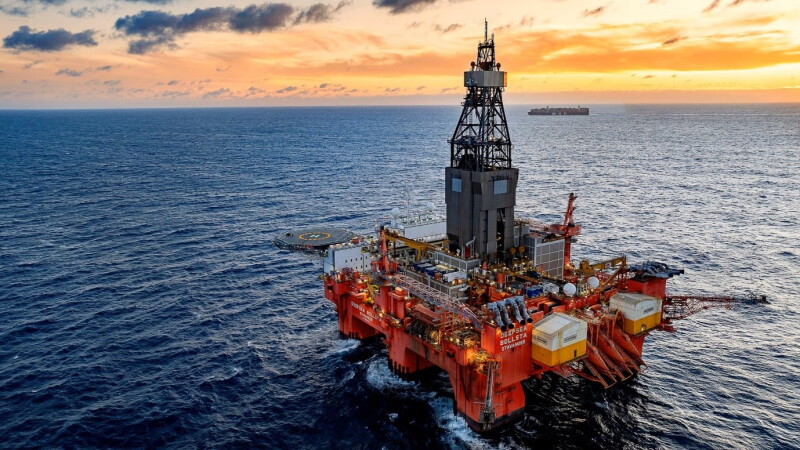
Why Deep Water, Why Now?
Deep water is generally defined as water depths beyond 1,000 ft (roughly 300 m), where fixed platforms give way to floating production systems and subsea infrastructure. The numbers explain the urgency. Since 2019, nearly 90% of upstream investment has gone toward offsetting production declines rather than meeting new demand, according to the IEA's Implications of Oil and Gas Field Decline Rates. Left uninvested, advanced-economy fields face a roughly 65% production decline over the next decade, compared with a shallower decline of approximately 45% in the Middle East and Russia. Decline management, not exploration for its own sake, is now the industry's central challenge.
Deep water sits at an unusual point on that curve. IEA data shows deepwater discoveries average roughly 16 times larger than onshore finds, but they decline more than 10% annually, which is well above the 4% decline typical of onshore fields. Multiple reservoir compartments, lower permeability, rapid pressure depletion, and aggressive water encroachment mean that without continuous reinvestment, deepwater production falls off fast. As supergiant onshore fields mature, new supply growth is shifting toward Brazil's pre-salt, Guyana's offshore discoveries, Namibia, and West Africa more broadly.
The New Math: Deep Water’s Cost Curve Flips
According to Rystad Energy's global cost-of-supply data, the current ranking is as follows: Onshore Middle East resources remain the cheapest at roughly $27/bbl; offshore shelf developments average around $37; offshore deepwater projects about $43; and non-OPEC greenfield projects overall roughly $47/bbl of Brent. Oil sands sit at the expensive end, averaging $57 and running as high as $75. The averages shown in Fig. 2 are subject to project-to-project variation.

The more striking comparison is with shale. Service-cost inflation, longer laterals chasing thinner rock, and rising water-handling costs have pushed new-well breakevens in core US shale plays into the $61–$70 range, up from the high $50s a few years ago, per the Dallas Fed Energy Survey. Deep water has moved the opposite direction: standardized subsea architecture, repeatable floating production, storage, and offloading (FPSO) designs, longer-reach tiebacks, and hard-won lessons from the 2014–2016 downturn have compressed costs even as inflation pushed the rest of the industry's costs up.
NOV told investors in late 2025 that it expects a deepwater revival beginning in late 2026, driven by deep water's marginal cost now undercutting North American shale. Petrobras makes the point at the basin level as its average portfolio breakeven sits near $25/bbl, with the Búzios pre-salt field breaking even below $35, numbers that would have been unthinkable for a deepwater development a decade ago.
None of this makes deep water simple. High-pressure, high-temperature reservoirs, ultradeep salt sections, and mooring and riser designs for hostile metocean conditions remain some of the hardest problems in the industry. What changed is capital efficiency and execution predictability, the things that determine whether a project reaches a final investment decision (FID) and stays on budget. That's what “easy” means here: not simple, but also bankable.
A Global Snapshot: Deep Water Everywhere
This is not a two-basin story. Guyana’s Stabroek Block went from first oil in December 2019 to more than 900,000 B/D by early 2026, on a path toward 1.5–1.7 million B/D by decade’s end. Next door, Suriname sanctioned its first offshore project, TotalEnergies’ $10.5 billion GranMorgu, in 2024. Brazil’s pre-salt hit a record 3.41 million B/D in March 2026, roughly 80% of national output, at a portfolio breakeven near $25. Mexico entered the ultradeepwater club via Woodside and Pemex’s Trion field, and the US Gulf of Mexico is on track for a fresh deepwater record near 2.5 million BOE/D in 2026. In West Africa, Angola’s Block 17 extended its Dalia FPSO to 2045, Nigeria sanctioned Shell’s Bonga North after a decade-long drought, Côte d’Ivoire’s Baleine scaled from 20,000 to 60,000 B/D in 3 years, Senegal produced its first barrels via Sangomar, and Venus & Mopane is nearing FID (by late 2028) on discoveries that could add approximately 350,000 B/D. Norway’s Johan Castberg reached full 220,000 B/D capacity within months of its 2025 Barents Sea startup. And after 2025’s weakest discovery year in a decade, frontier deepwater drilling is returning across Malaysia, Indonesia, India, and Papua New Guinea. Demand for capacity to serve all of this is real: the global FPSO orderbook now exceeds 40 vessels, with newbuild lead times stretching from 5 to 6 years.
Cost isn't the only axis on which deepwater has repositioned itself. Deepwater developments cut per-barrel emissions largely because a single large floating facility can process output that would otherwise require many scattered onshore wellheads. Electrification pushes the gap much further. Equinor reports that its shore-powered Johan Sverdrup field emits only 0.67 kg of CO2 per barrel, against roughly 15 kg globally. A peer-reviewed review notes, however, that such gains depend on how low-carbon the onshore electricity supply is.
Deep water's role is strategic as much as technical: A handful of discoveries in Guyana, Brazil, and Namibia have shown a single basin can transform a national economy within a decade, while giving energy-importing nations an alternative to Middle East-concentrated supply. The trade-off is volatility because deep water's capital intensity and steep decline curves make it more sensitive to price cycles than legacy onshore developments. This is why operators increasingly pair new projects with phased investment and portfolio diversification rather than single-basin bets.
The forecast in Fig. 3 indicates that global deepwater production is entering a sustained growth cycle from 14.5 million BOE/D in 2026 to a projected peak of 17.4 million BOE/D around 2035, driven primarily by Brazil's pre-salt, Guyana's Stabroek Block, the US Gulf of Mexico, and emerging projects in Namibia and West Africa. Beyond 2035, production is expected to plateau before gradually easing to approximately 16 million BOE/D by 2045, as natural decline from mature fields is increasingly offset by subsea tiebacks, FPSO redeployments, and brownfield optimization. The highlighted projects illustrate how successive investment waves continue to sustain deepwater output over the next 2 decades.

Engineering Deep Water Differently
The economics described above are possible only because deepwater development has become part of integrated subsurface, wells, facilities, and commercial optimization. Field development is fundamentally about geology. Structurally simple settings such as continental platforms found in the Middle East support continuous reservoirs and dense, low-cost well spacing. Offshore rift and salt basins, by contrast, are heavily faulted and compartmentalized which means sand bodies are discontinuous, and because every deepwater well costs an order of magnitude more than an onshore one, drilling into a small isolated compartment is rarely economic. Every well must be engineered to drain the largest possible volume, which puts a premium on integrated reservoir characterization and pre-drill uncertainty analysis where a single miscalculation on a subsea tieback can strand an otherwise promising discovery.
That reality shapes the deepwater life cycle differently from onshore. Front-end concept selection starting from the FPSO, tension-leg platform, spar, or subsea tieback carries outsized weight because retrofitting topside capacity later is prohibitively expensive. Reservoir surveillance is proactive, using 4D seismic, permanent downhole gauges, and digital twins to track pressure depletion and water breakthrough in near real time. Flow assurance is its own discipline, since long subsea tiebacks in cold, high-pressure water are prone to hydrate and wax formation. Since well intervention is costly and rare, completions favor intelligent systems, inflow-control devices, and strong artificial lift built for decades of reliability rather than easy workovers.
Technology as the Equalizer
Subsea processing starting from boosting, separation, and compression on the seabed has extended tieback distances and reduced dependence on costly host platforms, while standardized, modular subsea equipment has compressed cost and schedule enough to make smaller satellite discoveries economic. High-resolution ocean-bottom seismic paired with machine-learning interpretation is de-risking sub-salt and pre-salt targets once considered too uncertain to drill. Digitalization compounds these gains: real-time drilling optimization, cloud-based reservoir simulation, and predictive maintenance extend the life of facilities designed to run unmanned, kilometers below the surface, for 20–30 years.
The Catch
None of this guarantees smooth sailing. Despite more than $200 billion in deepwater capex committed this decade, only three standalone FPSO projects reached FID in 2025, as operators held to strict capital discipline. That matters because deepwater operates on long investment cycles such that first oil may come 3 to 6 years after sanction, while project payback can extend beyond a decade, so a project greenlit in 2026 is a 2046 asset. Without steady replenishment of the pre-FID pipeline, the climb from approximately 8 to 10 million B/D projected through the early 2030s could stall after 2035. Long-term demand forecasts remain contested, the IEA's Stated Policies scenario sees demand plateauing near 102 million B/D around 2030, while OPEC's 2026 outlook projects growth to 120–124 million B/D by 2050. Both scenarios agree the barrels produced will increasingly be the lowest-cost with lowest-decline available which is exactly deepwater's profile, wherever in the world it's produced.
What This Means for Engineers
For early-career engineers, this is a career signal as much as a market one, and a genuinely global one. Deep water demands fluency across reservoir engineering, subsea systems, flow assurance, and digital analytics in a way few other environments do and as decline management becomes the industry's defining problem, engineers who can extract maximum value from a small number of high-cost, high-consequence wells will shape supply security for the next 2 decades. That skill set travels because expertise used to scale an FPSO in Guyana is directly transferable to projects in Namibia, Suriname, or the Andaman Sea.
The Bottom Line
Deep water earned its new "easy oil” label the hard way, through a decade of cost discipline and technological maturation that followed one of the industry's roughest downturns. It isn't easy in any literal sense: it remains among the most technically demanding work in energy, and the decline curves that make it prolific also make continuous reinvestment non-negotiable. But on cost and decline management, the two metrics now shaping which barrels get built first, deep water competes with, and often beats, the resources that displaced it a decade ago. The fields sanctioned today, by the engineers reading this article, will still be producing when today's students are running their own asset teams, not because of a single dramatic breakthrough, but because of 2 decades of steady, engineered advantage, basin by basin, on every continent that has water deep enough to float a hull.
