Data & Analytics

How AI-powered well planning is transforming field development by accelerating trajectory design, reducing drilling risk, optimizing costs, and helping engineers deliver safer, more efficient wells.

2026 TWA Energy Influencer Muhammad Karimi shares how he transformed academic research into a globally deployed energy technology, offering insights on innovation, entrepreneurship, oilfield digitalization, and the energy transition.

Discover how AI leader Fatai Anifowose transformed skepticism into innovation, sharing insights on artificial intelligence in energy, leadership, continuous learning, and the skills shaping the future of the industry.
-
 The event, taking place on 2 April, will explore the theme "Beyond Automation: AI as the Catalyst Reshaping the Oil and Gas Industry."
 -
Agentic AI could help upstream oil and gas operations reduce emissions by enabling real-time methane detection, optimizing flaring and energy use, and improving carbon capture efficiency.
-
This article examines how domain experts can use no-code ML platforms to explore decision-relevant problems, validate hypotheses, quickly build prototypes, and engage more effectively with data science teams when solutions transition toward production.
-
AI-driven analytics and digital platforms are reshaping offshore operations, enabling smarter, faster decision-making.
-
Venezuela’s oil recovery will depend on restoring disciplined, reliable day-to-day operations by stabilizing existing assets, fixing operational failures, and using practical tools to rebuild predictable production.
-
The free, virtual program is designed to help participants build data-driven capabilities for the energy industry.
-
Digital transformation in oil and gas depends less on adopting advanced technologies and more on maturing data so people and processes can reliably convert raw information into aligned, asset-level value.
-
As global electricity demand surges, driven by AI, digitalization, and electrification, offshore innovation, spanning oil and gas, renewables, nuclear, and data infrastructure, will be critical to delivering a cleaner, more resilient energy future.
-
Agentic AI can enhance subsurface workflows when its autonomy is deliberately designed around physics, data integrity, and accountable decision-making through architectures that separate reasoning, computation, interpretation, and validation.
-
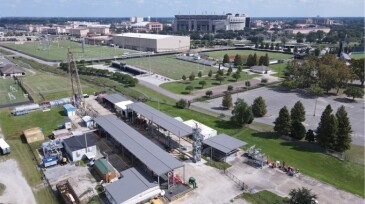
For more than a century, LSU has shaped petroleum engineering education, but few assets showcase its impact like the PERTT Lab. With six deep test wells and rare reservoir-depth gas-injection capabilities, the facility is helping drive breakthroughs in well control, carbon-dioxide injection, and next-generation energy technologies.