

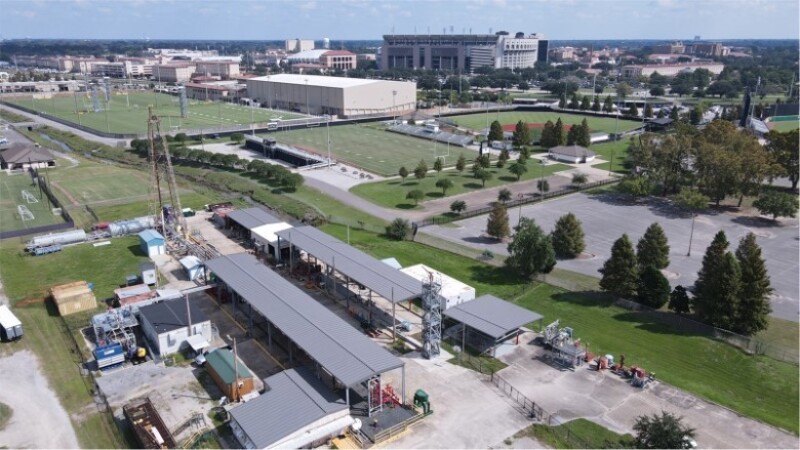
Louisiana State University’s (LSU) journey in petroleum engineering education and research spans over a century, underscoring its role as a premier institution at the forefront of advancement in the oil and gas and CCS sectors. At the heart of this effort is the LSU Petroleum Engineering Research, Training and Testing (PERTT) Lab, located on LSU’s Baton Rouge campus near Patrick F. Taylor Hall, home to the Craft and Hawkins Department of Petroleum Engineering.
Spanning 4.5 acres, the PERTT Lab features six cased wells ranging from 1,200 to 5,200 ft in depth. The facility's design allows for well-scale multiphase flow testing under downhole conditions, with the unique capability of injecting gases at reservoir depth, which is a rare feature in academic research environments. This capability supports research and validation for emerging technologies in well control, CO2 injection, transportation, and enhanced oil recovery.
State-of-the-Art Testing and Monitoring Capabilities
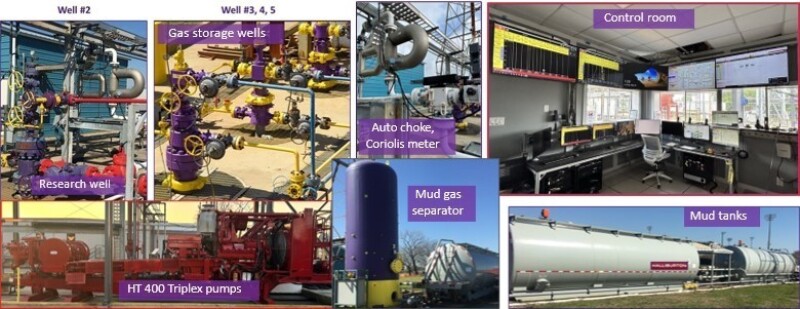
- A full-scale well-circulation system equipped with mud pumps, tanks, separators, and multiple chokes capable of simulating deepwater drilling environments.
- Two Halliburton HT‑400 triplex pumps for high‑pressure, high‑rate circulation, enabling realistic operational scenarios.
- High-resolution distributed fiber-optic sensing (DFOS), consisting of distributed acoustic sensing (DAS) and distributed temperature sensing (DTS) arrays, deployed along the length of tubing to monitor temperature gradients and detect influx in real time.
- Multiple high-resolution downhole pressure and temperature gauges for precise detection of gas front and tail position, void fraction, and velocity during gas influx and injection experiments.
- An advanced laboratory-scale flow testing setup, complemented by custom in-house fabricated flow loops for multiphase flow experimentation.
Early Roots and Academic Expansion
The LSU petroleum engineering program began as a curricular option within the geology department in 1922, marking one of the earliest efforts in formal petroleum engineering education in the US. During this nascent phase, foundational courses in petroleum geology, production methods, and utilization were offered to address the emerging needs of the oil industry. The program expanded rapidly, becoming a full-fledged petroleum engineering department by 1939 under the School of Geology and later relocating to the College of Engineering in 1956, where it evolved into a leading academic program.
A pivotal figure in shaping LSU’s petroleum engineering program was Benjamin C. Craft, hired in 1929 as its first full-time petroleum engineering faculty member. Craft’s dedication to practical, industry-relevant education led to the creation of a rigorous curriculum that set a national standard and laid the groundwork for LSU’s later prominence as a research and training school. Murray F. Hawkins, who joined in 1946, expanded and modernized reservoir engineering education. Together, their collaboration and landmark textbook established LSU’s Craft & Hawkins Department of Petroleum Engineering as a national leader in petroleum engineering education and research.
During the 1970s, escalating offshore drilling activity caused a rise in well-control incidents, compelling LSU to act. The university partnered with the US Minerals Management Service (MMS) to enhance offshore safety research and training. Planning commenced between 1978 and 1979 for a dedicated blowout-prevention facility, reflecting industry demand for hands-on, realistic training beyond theoretical instruction.
Industry-Backed Milestones in LSU Well-Control Research
This initiative received strong backing from a consortium of 53 petroleum and construction companies. A significant milestone was the donation of a 10,000-ft dryhole well by Goldking Production Co. to LSU’s campus, then valued at $670,000. Thirteen major oil corporations provided grants totaling $200,000 to complete the well and surface facilities. This well, referred to as Well 1, was recompleted as a 6,000-ft test bed with subsurface equipment, enabling full-scale modeling of flow geometries typical of floating drilling vessels operating in 3,000-ft water depths. Industry partners and the MMS contributed additional equipment, services, and funding, culminating in the 1982 dedication of a $2‑million facility for well-control research and training centered around this well.
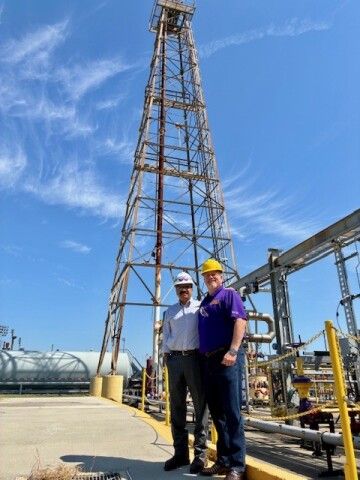
LSU’s Well 2 was drilled in 1985, funded in collaboration with MMS and multiple industry partners. Three 2,000-ft wells (Wells 3, 4, and 5) were drilled and cased with 7-in. casing to allow natural gas to be compressed for use in well-control exercises. LSU's Well 6 was specifically drilled to study diverter operations as part of well-control research. This includes investigations into dynamic modeling, experimental evaluation, and system analysis of diverter performance during shallow-gas blowouts and well unloading. The well sits beneath a derrick that has a flare stack extending all the way to the top.
Sustained Excellence Into the 21st Century
Since 1982, LSU’s blowout prevention research, training, and testing facility remains a cornerstone of offshore drilling safety advancement. It uniquely combines full-scale industrial equipment with academic insight and research, offering invaluable training to industry personnel and students alike. It is the only facility of its kind in North America at a university and the only school in the US that offers and requires hands-on training in well control, including understanding hydrostatics and pressure control in real wells. Students learn from the behavior of real fluids, both mud and gas, in a real well using real equipment.
This facility provides a safe environment where industry professionals can test innovative ideas, technologies, and equipment, determine what works, and refine innovations before deploying them in the field. Oilfield service companies used the PERTT Lab test wells and facilities in the mid‑2000s to conduct full‑scale well tests and prove innovative technologies, such as Microflux Control and managed pressure drilling (MPD), before deploying them on rigs. The lab's role became especially prominent following incidents such as the 2010 Deepwater Horizon disaster in the Gulf of Mexico, when LSU's expertise in blowout prevention and well control was sought for critical analysis and training.
Training and Knowledge Transfer
PERTT Lab also excels in education, offering hands-on training for undergraduate and graduate petroleum engineering students alongside industry professionals. Through realistic well control scenarios, fluid-flow monitoring, equipment testing, and operations simulations, both academic and corporate partners gain invaluable insights and experience critical to safe and efficient field operations. The laboratory’s conference facilities support collaborative workshops, remote training sessions, and seminars enhancing knowledge exchange.
Recent Projects Completed at LSU’s PERTT Lab
Pason Systems Inc. is a leading provider of data management systems for the oil and gas drilling industry and has been supporting PERTT Lab for many years. Pason’s rig display and driller’s station visualize and record high-frequency data in real time, while WITSML streaming and cloud synchronization to AWS, Azure, and OneDrive give partners secure remote access to experiments. These digital capabilities work with a remotely controlled choke manifold system and a dedicated MPD choke system to test well-control strategies under high-risk conditions.
LSU received a $4.9-million National Academies of Sciences, Engineering, and Medicine Gulf Research Program grant to enhance offshore well safety by advancing riser gas dynamics research in deepwater drilling. Well 2 was recompleted in 2019 with advanced instrumentation and an injection line. The lab has successfully validated novel gas-monitoring and well-control methods using its full-scale wellbores equipped with downhole pressure and temperature sensors and distributed fiber-optic sensing. These experiments have provided new insights that improve the reliability of pressure barriers and kick-control strategies, enhancing the ability to detect early gas kicks and improving operational safety and risk-informed well design.
Full-scale evaluations of new circulation techniques for gas in the riser, such as the fixed choke constant outflow method, have demonstrated optimized control of riser gas using different drilling mud types, contributing to safer and more efficient drilling protocols. Many misconceptions about maximum shut-in pressure due to gas migration, flow regimes in large annuli, effects of solubility in several types of mud, absorption and desorption, and the dangers of dynamic unloading in an open annulus were demonstrated and disproven through experiments. Results and findings from these studies are used in the International Association of Drilling Contactors (IADC) Riser Gas Handling Guidelines.
In parallel, PERTT Lab’s research on pressurized mud-cap drilling integrated both field-scale testing and modeling to anticipate gas-migration rates and determine the required rate of gas bullheading, which is vital for maintaining well integrity under pressure. Investigations into bleedoff methods and circulation techniques using existing rig equipment further support risk-mitigation strategies during MPD and well-control operations.
The Valve Performance Clearinghouse (VPC) flow loop provides an API-compliant environment for validating gas-lift valves. The VPC maintains a performance database of 60 valves covering more than 200 configurations. The PERTT Lab tests orifice and IPO (injection pressure operated) gas-lift valves per API Spec 19G2, delivering data acquired and unbiased findings to consortium members. PERTT Lab also has a 40-ft inclinable tower that enables detailed study of flow behavior at different tubular inclinations.
These assets support two smart classrooms with live rig data feeds and a simulation computer lab for real-time modeling. These recent projects leverage PERTT Lab’s unique experimental facilities and sensor technologies, combining rigorous testing with real-time data analytics to advance well control, flow assurance, and environmentally responsible energy production, highlighting LSU’s leadership in petroleum engineering research and technology transfer.
Future Directions
With a commitment to innovation, LSU PERTT Lab is expanding its suite of experimental services. LSU Cyber-PERTT is a pioneering cyber-physical research lab that combines automation, control systems, and cybersecurity with oilfield operations, complementing PERTT’s full‑scale well‑control and CO2 research activities. Its centerpiece, the Tiger Skid, replicates critical energy infrastructure to train professionals and students in defending against cyber-physical attacks. This facility establishes LSU as a national leader in securing energy systems and developing the future cybersecurity workforce.
The lab is also advancing carbon capture and sequestration research with the forthcoming drilling of a dedicated CO₂ research well designed to study CO₂ in all three phases under realistic downhole conditions. This project aims to advance safety technologies and validate predictive models crucial for the energy transition era.
In early 2026, LSU’s College of Engineering, in partnership with Halliburton, ExxonMobil, Shell, Chevron, and H&P, will commence drilling a unique research well at the PERTT Lab. This research-only well will feature a large-diameter carbon-steel outer casing with corrosion-resistant-alloy inner tubing to enable safe CO2 experimentation. It will have a 5,000-ft vertical section transitioning to a smaller diameter section, continuing vertically to 7,000-ft before curving into a 500–1,000-ft horizontal section at 7,900-ft depth. The well will support studies on CO2 flow behavior, safety and monitoring technologies, and model validation under downhole conditions, offering valuable opportunities for students, researchers, regulators, and industry professionals.
Additionally, a surface flow loop with an adjustable incline will be built to study challenges encountered during CO2 transportation through pipelines in all three phases. Scaling up surface flow loops and testing rigs are designed to support enhanced oil recovery, chemical injection, and corrosion studies. PERTT Lab is strengthening partnerships with national laboratories and industry for joint research targeting next-generation oilfield technology challenges.
