Risk management

Using case studies from Western Kazakhstan, this article shows how construction-led optimization cut installation costs by 60–70%, reduced construction scope by up to 80%, and lowered turnaround inspection labor by as much as 90%. The results improved schedule certainty, reduced risk, and increased efficiency across brownfield oil and gas facilities.

This article from Murphy Oil outlines a modernization effort that resulted in increased scenario simulation capacity by five to 10 times.

Discover how seismic, electromagnetic, radar, passive monitoring, and data-driven inversion can support safer CO2 storage and create opportunities for young energy professionals.
-
 In complex energy projects, technical excellence alone is not enough—successful delivery depends on disciplined execution skills such as scope clarity, realistic scheduling, stakeholder coordination, and proactive risk management, particularly for young professionals turning concepts into real-world results.
-
The event on 14 January in Houston will bring together leading economists and industry leaders and will debut the North American edition of Energython, “Molecule to Megabyte,” a business case challenge for students focused on gas-to-data-center solutions.
-
This article introduces a tender strategy framework—a four-pillar model built on nearly 2 decades of international upstream experience—that integrates engineering rigor with business strategy to improve contract awards, strengthen transparency, and deliver lasting project performance.
-
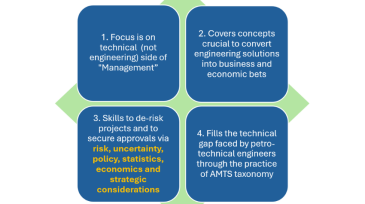
The SPE Asset Management Technical Section (AMTS) is teaming up with the University of Houston to launch a pilot program that advances asset management practices and supports the growth of energy professionals worldwide—setting a model for future collaborations between universities and SPE technical sections.
-
The SPE Management Technical Section has been officially renamed the Asset Management Technical Section. The new name better reflects the section’s focus on asset management as a core discipline in the upstream oil and gas industry.
-
This article provides an overview of risk-based measurement, monitoring, and verification (MMV) for efficient, long-term CO2 storage.
-
Delve into a method designed to analyze and solve problems in the offshore equipment inspection process in this article.
-
SPE has established three new technical sections—the Management Technical Section, the Methane Emissions Management Technical Section, and the Data Science & Engineering Analytics Technical Section.
-
A technical synopsis of major considerations for unconventional wells facing prolonged shut-ins. The review includes deciding factors for kill fluid selection and risks of incompatible fluid mixing.
-
In North America’s most active shale fields, the drilling and hydraulic fracturing of new wells is directly placing older adjacent wells at risk of suffering a premature decline in oil and gas production.