

Brownfield oil and gas projects often face schedule pressure, congested work areas, execution complexity, and increasing cost-efficiency requirements. While major engineering changes receive considerable attention, significant value can also be achieved by reviewing routine construction activities and long-standing design assumptions.
Based on 16 years of experience in construction engineering, project engineering, quality management, completions, and turnaround planning, the author observed that some activities remain in project scopes because of historical design practices rather than measurable operational value. This can result in excessive excavation, welding, civil works, material installation, inspection, temporary works, and equipment preparation, increasing cost, duration, and execution risk.
In this article, two field-driven initiatives demonstrate practical construction and inspection optimization.
- Optimization of pig-launcher vent systems on multiwell pads
- Application of nonintrusive inspection (NII) during refinery turnaround planning
Both initiatives applied a common construction-led methodology: challenging existing assumptions, identifying non-value-added scope, evaluating constructability, benchmarking proven solutions, engaging multidisciplinary stakeholders, and quantifying benefits.
The case studies demonstrate that practical engineering reviews can reduce cost, schedule, material quantities, workforce exposure, and execution risk while maintaining safety, technical integrity, operability, regulatory compliance, and long-term reliability.
Case Study 1: Vent-Line Optimization for Multiwell Pads
Original Design
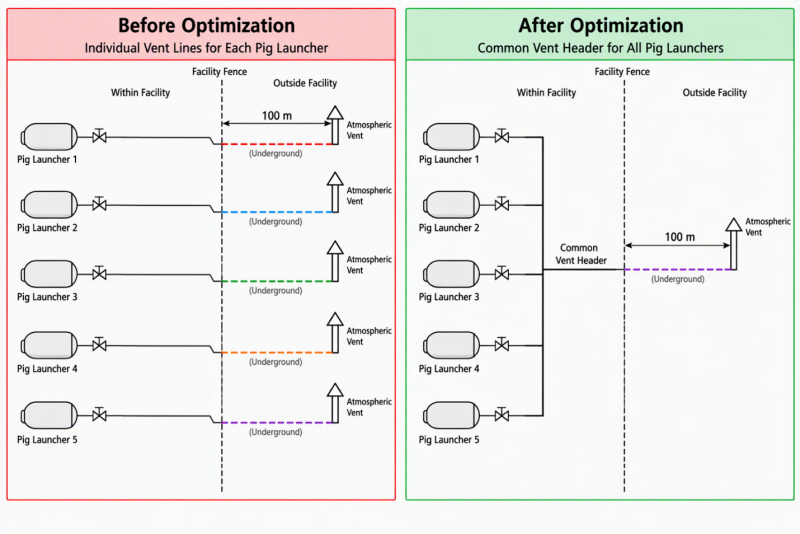
The original design required three to five separate underground vent lines extending approximately 100 m beyond the facility boundary to discharge residual gas from three to five pig-launcher systems.
Each vent line required trench excavation, welding, coating, nondestructive testing (NDT), pressure or leak testing, and subsequent backfilling. Implementation of the original design typically required approximately 4 weeks of field construction.
Engineering Review
The author challenged the need for multiple, independent vent lines because each line performed the same operational function.
A multidisciplinary review determined that a common vent-header arrangement could achieve the same operational objective while significantly reducing the construction scope. Engineering, Operations, and Construction stakeholders reviewed the proposed configuration and confirmed its technical feasibility.
Optimized Design
The revised design consolidated the individual vent lines into a single common header connected to one atmospheric discharge point located outside the facility boundary.
Additional confidence in the proposed solution was obtained by benchmarking it against existing field installations operating with a similar configuration.
Results of Optimization
For a well pad equipped with five pig launchers, the optimized design reduced the overall installed cost, including labor, construction equipment, field activities, and materials, by an estimated 60–70%. The consolidation of five individual underground vent lines into a single common vent header also reduced the major repetitive construction scope by approximately 70–80%, while the total length of long-distance underground vent lines was reduced by 70% (Fig. 1).
In addition to lowering installed costs and significantly reducing underground piping infrastructure, the optimized design simplified field execution and reduced project risk in several key areas:
- Eliminated four individual vent lines
- Eliminated more than 180 field welds
- Reduced approximately 1,000 m of coating work
- Reduced NDT and testing requirements
- Reduced trench excavation and backfilling
- Reduced the number of potential leak points
- Improved constructability
- Reduced the field execution duration
- Increased schedule certainty
Cost and Work Component | Original Design | Optimized Design | Estimated Reduction (%) |
Long underground vent lines | 5 individual lines | 1 common discharge line | 80 |
Long-distance underground piping | Approximately 500 m | Approximately 100 m, plus short header connections | Approximately 80 |
Trench excavation and backfilling | 3 m total trench width | 1 m total trench width | Approximately 67 |
Atmospheric discharge points | 5 discharge points | 1 discharge point | 80 |
Piping materials and coating | Required for 5 long vent lines | Required for 1 long discharge line and short header connections | Approximately 60–70 |
Field welding | Extensive welding for 5 separate lines | Welding for 1 discharge line and common header | Approximately 65–75 |
NDT and leak or pressure testing | Required for 5 separate systems | Required for 1 consolidated system | Approximately 60–75 |
Labor resources | Multiple repetitive installation activities | Significantly reduced installation scope | Approximately 60–70% |
Construction equipment utilization | Equipment required for approximately 3 m total trench width | Equipment required for approximately 1 m total trench width | Approximately 67 |
Overall field work complexity | 5 independent installation and testing sequences | 1 consolidated installation sequence | Approximately 70–80 |
Implementation Across Other Multiwell Pads
Following validation of the optimized configuration, the same engineering approach was applied to other multiwell pads equipped with three or five pig launchers and corresponding individual vent lines.
Instead of installing a separate 100-m vent line for each pig launcher, the individual vent connections were consolidated into a common header with a single atmospheric discharge line. This enabled the construction and risk-reduction benefits of the original optimization to be replicated across multiple well-pad installations.
Case Study 2: Turnaround Scope Optimization Through Nonintrusive Inspection (NII)
Traditional Approach
Internal inspections of pressure vessels/drums and process fixed equipment typically require equipment shutdown, cleaning, vessel opening, confined-space entry, and extensive support resources. As a result, a significant portion of turnaround scope is often driven by inspection requirements rather than confirmed equipment condition.
In many cases, maintenance work scopes are developed based on the need to gain internal access rather than on actual evidence of degradation or damage mechanisms.
Optimization Approach
An NII strategy was evaluated for selected equipment to obtain reliable condition data without requiring internal access.
The objective was not to reduce the required inspection activities, but to improve the quality of maintenance decisions by obtaining sufficient equipment-integrity information before or during the turnaround and using this information to optimize the maintenance scope. Where technically justified, NII was used to:
- Assess the actual condition of the equipment.
- Identify confirmed repair requirements.
- Determine whether additional inspection was necessary.
- Evaluate whether vessel/drums or columns opening was technically required.
This approach shifts the focus from mandatory equipment opening to condition-based decision making supported by quantitative inspection data.
Benefits
The NII approach offers several potential advantages, including:
- Fewer unnecessary equipment openings
- Reduced cleaning and preparation activities, including scaffolding, abrasive blasting, water jetting, and other access-related work
- Fewer confined-space entries
- Earlier visibility of equipment condition, either before shutdown or before the equipment is opened during the turnaround
- Improved definition of the turnaround work scope
- Better allocation of shutdown resources to confirm inspection and repair requirements
By obtaining inspection data before or during the turnaround window, project teams can better plan personnel, equipment, materials, engineering support, and repair activities, while reducing uncertainty during execution.
For example, opening, cleaning, and internally inspecting a small vessel may require approximately 700–800 direct labor hours including pre-turnaround (TA), TA, post-TA, whereas an NII scope for the same equipment may require approximately 70–80 direct labor hours, depending on the inspection plan, damage mechanisms, access requirements, and selected nondestructive evaluation techniques.
Based on these indicative values, the direct labor requirement could be reduced by approximately 90%. This reduction may significantly decrease the Class 2 cost estimate, particularly by eliminating or reducing fixed equipment opening, internal cleaning, confined-space support, scaffolding, isolation, and reinstatement activities.
Risk Reduction
The condition-based approach contributes to
- Reduced personnel exposure to confined-space hazards.
- Fewer high-risk maintenance and preparation activities.
- Better-informed inspection and maintenance decisions.
- Reduced probability of performing unnecessary work.
- Earlier identification of confirmed repair requirements.
- Improved readiness for repairs during the turnaround.
Overall, NII supports a more focused turnaround strategy by directing resources toward equipment with confirmed degradation or repair needs, rather than automatically opening equipment solely on the basis of time-based inspection intervals.
Cross-Case Analysis
Although each initiative focused on a different technical discipline, common themes emerged.
Initiative | Primary Benefit | Schedule Impact | Risk Reduction |
Vent-Line Optimization | Design simplification | High | High |
Nonintrusive Inspection (NII) | Condition-based turnaround planning | High | High |
Across all initiatives, the most significant benefits were generated through simplification, early technical review, and elimination of activities that did not directly contribute to operational performance. The projects consistently demonstrated that reducing physical scope often simultaneously reduces cost, project duration, quality risk, safety exposure, and operational complexity.
Key Lessons Learned
Construction personnel should be involved early. Construction teams frequently identify opportunities that are not visible during early engineering development.
Historical designs should be challenged. Many legacy designs remain unchanged because they have worked previously, not necessarily because they represent the most efficient solution.
Simpler designs are often better designs. Reducing quantities, interfaces, and components generally improves constructability and reliability.
Small changes can generate large benefits. Many of the initiatives described required relatively minor engineering modifications while producing meaningful execution improvements.
Multidisciplinary collaboration is essential. Successful optimization requires alignment among Operations, Engineering, Construction, and Project stakeholders.
The two case studies demonstrate that construction-led engineering optimization can generate substantial value across the entire life cycle of brownfield oil and gas facilities.
By systematically reviewing traditional design approaches, challenging historical assumptions, integrating construction knowledge into engineering decisions, and applying condition-based maintenance practices, project teams successfully reduced unnecessary work, simplified execution, improved schedule certainty, and enhanced overall project efficiency.
The initiatives demonstrate that innovation does not always require advanced technologies or major capital investments. In many cases, the greatest value comes from critically questioning established practices and finding technically sound methods of achieving the same operational objectives with less effort, lower risk, and improved constructability.
As the oil and gas industry continues to pursue safer, faster, and more cost-effective project execution, construction-driven engineering optimization and condition-based maintenance strategies should become standard components of project development, turnaround planning, and asset management processes.
