



Well PL19-3 A in the Penglai 19-3 field in Bohai Bay required sand control in eight pay intervals of unequal length. The vertically heterogeneous, unconsolidated sandstone also required separate treatment of thin zones rather than consolidation into larger treatment stages.
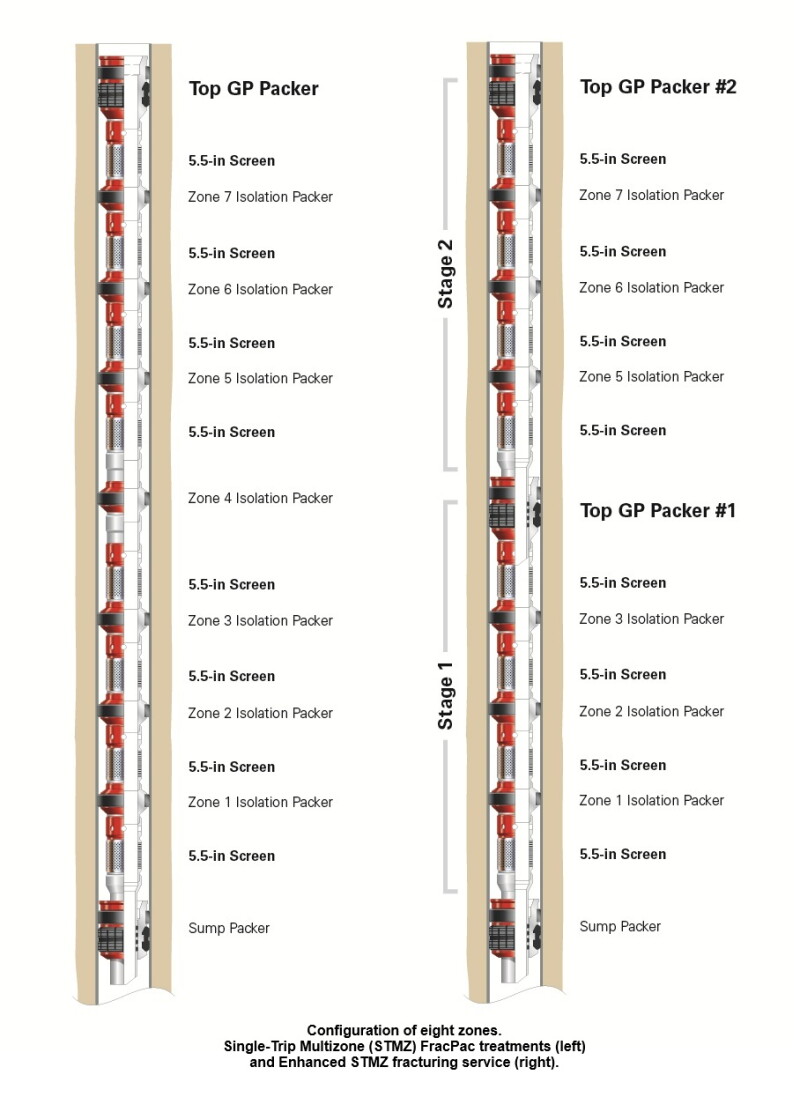
The conventional 9-5/8-in. single-trip multizone sand-control system used in the field generally supported five treatment stages per run. An eight-zone completion could therefore require two sand-control runs, with repeated perforating, wellbore cleanup, and deployment and retrieval operations.
To address these limitations, China National Offshore Oil Corporation (CNOOC) Co. Ltd., Tianjin Branch and Halliburton deployed the 9-5/8-in. Enhanced Single-Trip Multi-Zone sand-control system in well PL19-3A to treat all eight zones independently in one run. The companies selected frac-pack, gravel-pack, and high-rate water-pack treatments based on the interpreted characteristics of each interval.
The eight treatments placed 857,742 lbm of proppant in the formation. Five zones received frac-pack treatments, one received a conventional gravel-pack treatment, and two received high-rate water-pack treatments. The sand-control completion required 172.75 hours compared with 232.5 hours for an eight-zone, two-trip reference well in the same field.
Thin, Vertically Heterogeneous Reservoir
The Penglai 19-3 field contains Miocene sandstones in the Guantao and Lower Minghuazhen formations. The target section comprises braided-river sandstone and thin, interbedded meandering-river sandstone, and shale.
Xue et al. (2019) report a gross interval greater than 500 m at true vertical depths of approximately 900 to 1,600 m. Reservoir porosity ranges from 20 to 30%, and permeability ranges from 320 to 1,670 md. The field comprises 13 oil groups and 47 sublayers, and 82% of the individual intervals are less than 5 m thick.
The poorly consolidated formation presents a sand production risk, particularly after water breakthrough. The completion design therefore requires sand control and isolation among vertically separated intervals (Xue et al. 2019).
Design Considerations for the Conventional Completion Approach
The conventional cased-hole single-trip multizone system uses a 2-7/8-in. inner washpipe inside a 4-in. outer washpipe. For this application, the configuration presented two primary design constraints.
First, the service-tool geometry generally requires treatment intervals of approximately equal length. Pay zones with substantially different thicknesses may therefore require combination into composite stages or omission from the completion.
Second, the restricted annular flow area between the washpipes can increase friction pressure. For this configuration, the 2-7/8-in. washpipe length was limited to approximately 200 m, which restricted the single-trip configuration to five zones.
An eight-zone completion with this approach would typically require two four-zone runs. The second run requires another perforating sequence, wellbore conditioning, assembly deployment, packer-set sequence, treatment sequence, and service-tool retrieval. These additional operations add rig time and may increase the risk of stuck equipment, leakage, fluid loss, or other nonproductive events.
Changes to the Downhole System
The revised system eliminates the 2-7/8-in. inner washpipe and uses a single 4-in. washpipe. Modular flow-guide screens incorporate a solid base pipe and an external annular flow path between the base pipe and filtration assembly.
This configuration allows the screen and blank-pipe lengths for each zone to match the perforated interval without requiring approximately equal stage lengths.
Each zone includes a frac-circulation sleeve and a closure sleeve. After each treatment, the service tool mechanically closes the sleeves. A pressure test verifies sleeve closure before treatment of the next interval.
The system has a minimum internal diameter of 4.75 in., a pressure rating of 10,000 psi, and a maximum design flow rate of 45 bbl/min. In Well PL19-3A, the maximum treatment rate was 18 bbl/min.
Well and Completion Design
Well PL19-3A included 9-5/8-in., 40-lb/ft, 3Cr L80 production casing cemented through the pay section. The well reached a measured depth of 3,327.61 m, with a maximum inclination of 81.28° and maximum dogleg severity of 4.56°/100 ft.
The completion assembly included a top gravel-pack packer, closure-sleeve assemblies, 6-5/8-in. blank pipe, 5-1/2-in. modular screens, seven isolation-packer assemblies, and a sump packer.
The completion included eight perforated zones at measured depths from 2,355.8 to 3,160.7 m. Individual perforated intervals measured 29.6 to 123.5 m. This interval-length variation supported a completion design that did not require approximately equal stage lengths.
Single-Trip Execution
Before mobilization, the service team measured the principal subassemblies in the workshop and verified each assembly’s dimensions at the wellsite.
The crew conditioned the wellbore, displaced it with filtered completion brine, and ran, set, and tested the sump packer. Tubing-conveyed perforating opened all eight zones, followed by a cleanup trip.
The crew assembled the eight-zone sandface assembly at surface, ran it in hole, and landed it in the sump packer. Electric-line depth correlation confirmed position. The crew then set and pressure-tested the top gravel-pack packer and seven isolation packers.
The crew treated the eight zones from lowest to highest. For each zone, the crew positioned the service tool, completed the diagnostic and treatment sequence, reverse-circulated excess slurry, closed the applicable sleeves, and pressure-tested the closure. After treatment, the crew retrieved the service tools and used an intervention string to open the production sleeves.
Treatment Tailored to Each interval
The completion team selected a treatment for each zone based on interpreted thickness and mechanical characteristics.
Zones 1, 2, 3, 4, and 8 received frac-pack treatments. Perforated intervals measured 69.5 to 103 m, with maximum treatment rates of 18 bbl/min and proppant concentrations of 6 lbm/gal. The treatments created conductive hydraulic fractures to support reservoir drainage.
Zone 5 received a conventional gravel pack in a 123.5-m perforated interval. The treatment reached a maximum rate of 6 bbl/min and proppant concentration of 0.6 lbm/gal to limit fracture extension and reduce the risk of reservoir matrix damage.
Zones 6 and 7 received high-rate water packs in perforated intervals of 29.6 and 54 m, respectively. Both treatments reached maximum rates of 7 bbl/min and proppant concentrations of 0.6 lbm/gal to manage fracture geometry and reduce the risk of extension into adjacent low-permeability shale barriers.
Treatment Summary
Table 1—Treatment summary for eight zones in well PL19-3 A.
Zone | Top perforation, m | Bottom perforation, m | Perforated length, m | Proppant pumped, lbm | Proppant in formation, lbm | Maximum concentration, lbm/gal | Maximum rate, bbl/min | Treatment |
1 | 3057.7 | 3160.7 | 103 | 173,010 | 163,535 | 6 | 18 | Frac pack |
2 | 2950.6 | 3035.8 | 85.2 | 180,124 | 173,112 | 6 | 18 | Frac pack |
3 | 2843.5 | 2920.1 | 76.6 | 163,210 | 157,056 | 6 | 18 | Frac pack |
4 | 2745.1 | 2814.6 | 69.5 | 177,191 | 170,791 | 6 | 18 | Frac pack |
5 | 2589.1 | 2712.6 | 123.5 | 13,284 | 4,616 | 0.6 | 6 | Gravel pack |
6 | 2538.4 | 2568 | 29.6 | 28,606 | 23,682 | 0.6 | 7 | High-rate water pack |
7 | 2453.9 | 2507.9 | 54 | 14,423 | 9,737 | 0.6 | 7 | High-rate water pack |
8 | 2355.8 | 2426.4 | 70.6 | 160,426 | 155,213 | 6 | 18 | Frac pack |
The eight treatments pumped 910,274 lbm of proppant, with 857,742 lbm reported in the formation, for an overall placement efficiency of approximately 94.2%. Post-job records reported no screen blockage, erosion, or mechanical damage.
Rig-Time Comparison
Well PL19-3A required 172.75 hours for the single-trip completion compared with 232.5 hours for well PL19-3B, which used two conventional four-zone runs. The 59.75-hour difference represented a 25.7% reduction in completion time from the reference well.
The primary time reduction resulted from elimination of the second sandface assembly deployment and associated operations. The single-trip approach also reduced packer-setting operations, service-tool interventions, and work-string trips.
The comparison applies only to these two wells. Results may differ with well and operating conditions.
Production and Sand-Control Observations
Post-completion data reported a stable oil rate of 126.66 m³/d compared with the allocated target of 60 m³/d, a difference of 66.66 m³/d, or 111.1%.
After 6 months, production-logging data indicated inflow from all eight treated intervals and no premature water breakthrough. No sand was reported at the wellhead, and no electrical-submersible-pump abrasion failures were attributed to formation sand or proppant.
Post-startup pressure tests reportedly found no measurable interzonal communication, consistent with zonal separation during the reported period.
These observations apply to well PL19-3A and the available production history. Additional production history is required to assess completion performance over the well life.
Implications for Multizone Sand Control
In well PL19-3A, a deviated offshore well, the single-trip system independently completed and treated eight unequal-length zones in one run.
The design eliminated the inner washpipe and added a separate flow path, which allowed each stage length to match the perforated interval. This configuration supported separate completion and treatment of thin and thick intervals.
The single-trip approach reduced completion time relative to the reference well and executed five frac packs, one gravel pack, and two high-rate water packs with one sandface assembly. Six-month production data indicated inflow from all eight intervals, with no reported sand at the wellhead or premature water breakthrough.
Applicability to other multilayer completions depends on reservoir architecture, treatment-pressure requirements, intervention plans, fluid-loss risk, and the economic value of separate access to thin-zones.
References
IPTC 12388 Single Trip Multi-Zone Gravel Packing Case Study at Handil, Bekapai and Sisi-Nubi Fields by Banman, M., Delattre, E., and Sofyan, M., et al. (2008).
Hydrocarbon Accumulation Conditions and Key Exploration and Development Technologies for PL 19-3 Oilfield by Xue, Y., Deng, Y., Wang, D. et al. Petroleum Research (2019).
OTC 36419 First Field Installations of the 9-5/8-in. Enhanced Single-Trip Multi-Zone Sand Control Technology in Bohai Bay, China by Zhang, M., Li, J.B., and Zhang, X.F., et al. (2026).

S.F.Luo is Chief Engineer of the Engineering Technology Operations Center at CNOOC Tianjin Branch. He specializes in offshore drilling and completion, well intervention, large-scale hydraulic fracturing, and heavy-oil thermal recovery technologies. His work has focused on advancing stimulation and enhanced-recovery solutions for Bohai Oilfield developments. Luo has authored and coauthored numerous technical publications and papers.

X. F. Sun is the Bohai West Region Project Manager at the Engineering Technology Operations Center, CNOOC Tianjin Branch. He is a senior engineer with a bachelor’s degree, specializing in complex offshore drilling and completion technologies and engineering practices. Sun has authored and coauthored more than 20 technical papers in professional journals.

X.F.Zhang is a senior engineer at CNOOC Tianjin Branch, holding a bachelor's degree. He has 16 years of experience in development drilling and completion operations in the Bohai Oilfield and has authored and coauthored more than 20 technical papers. His primary research focuses on the theoretical and applied technologies of completion engineering.

B. Hao is a mid-level engineer at CNOOC Tianjin Branch, holding a bachelor's degree. He has 13 years of experience in development drilling and completion operations in the Bohai Oilfield and has authored more than 10 technical papers. His work focuses on offshore drilling and completion supervision, with expertise in field operation management and completion technologies such as perforating and fracturing.

C. Han serves as the senior technical engineer for Completions at Halliburton China. With a background in Electrical Engineering, he began his career with Halliburton immediately following his graduation. He brings over 15 years of comprehensive expertise in both field execution and engineering design, specializing in liner hanger systems, sand control technologies, unconventional completions, permanent downhole monitoring, and advanced completion production systems.

Y. WANG is the Service Coordinator for Halliburton Completions in China. Holding a bachelor’s degree in mechanical engineering from Northeast Petroleum University and an MBA from Nankai University, he joined Halliburton China following his graduation. Over his 12 years with the company, he has accumulated extensive field operations, technical support, and project management experience across major offshore and onshore basins, specializing in liner hanger systems, sand control and HPHT completion applications.

F. Lv is a Senior Technical Professional for Completions at Halliburton Completion Tools China. He holds a Master of Engineering degree in Petroleum and Natural Gas Engineering. Since joining Halliburton China upon graduation, he has accumulated seven years of integrated field and office engineering experience covering liner hangers, sand control systems, unconventional completions, and completion production systems

Zheng Cao is the Service Manager at Halliburton Completion Tools China. Since joining the company upon graduation, he has accumulated 15 years of experience in the oil and gas industry. His work focuses on service operations, project coordination, and customer support. His professional interests include sand control and expandable liner hanger systems.

Zheng Guan is a Senior Global Sand Control Advisor with Halliburton Completion Tools in the United States. Since joining Halliburton upon graduating from university, he has accumulated 27 years of experience in the oil and gas industry. As a subject matter expert in sand control technologies, he provides application expertise and specialized technical support to Business Development, Application Engineering, Training, Operations, and external customers, helping to support product and service applications on a global scale.
