Data & Analytics

This introduction to mixed integer linear programming explains how engineers can model operational constraints, optimize production systems, and improve decision-making across oil and gas facilities.

This article from Murphy Oil outlines a modernization effort that resulted in increased scenario simulation capacity by five to 10 times.

The emerging vision is an industry where engineers focus on judgment, risk assessments, and accountability.
-
 The free, virtual program is designed to help participants build data-driven capabilities for the energy industry.
-
Digital transformation in oil and gas depends less on adopting advanced technologies and more on maturing data so people and processes can reliably convert raw information into aligned, asset-level value.
-
As global electricity demand surges, driven by AI, digitalization, and electrification, offshore innovation, spanning oil and gas, renewables, nuclear, and data infrastructure, will be critical to delivering a cleaner, more resilient energy future.
-
Agentic AI can enhance subsurface workflows when its autonomy is deliberately designed around physics, data integrity, and accountable decision-making through architectures that separate reasoning, computation, interpretation, and validation.
-
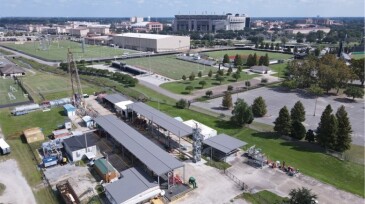
For more than a century, LSU has shaped petroleum engineering education, but few assets showcase its impact like the PERTT Lab. With six deep test wells and rare reservoir-depth gas-injection capabilities, the facility is helping drive breakthroughs in well control, carbon-dioxide injection, and next-generation energy technologies.
-
Mark your calendars for the first SPE Live featuring the 2025 TWA Energy Influencers.
-
EZOps will integrate its Mobile Oilfield Management platform into the college’s energy technology program, giving students hands-on experience with digital tools used in modern oilfield operations.
-
Switching from continuous circulation to cyclic huff-‘n’-puff operation in enhanced geothermal systems can significantly delay thermal breakthrough, sustain higher production temperatures, and improve long-term economic performance.
-
Researchers at the University of Houston have developed a new ultrathin, carbon-based film that could make AI chips run faster, cooler, and more energy-efficient.
-
The energy sector is rapidly transforming toward a data-driven, decentralized future where combining human expertise with AI and machine learning unlocks new efficiencies, solves complex challenges, and creates a decisive competitive advantage.