Data & Analytics

The emerging vision is an industry where engineers focus on judgment, risk assessments, and accountability.
AI and machine learning are transforming drilling execution, detecting downhole problems earlier, automating reporting, and closing the loop between the wellbore and the well plan through real-time geosteering.

Robotic and autonomous systems are transforming energy operations, but their full value emerges only when paired with data science, engineering analytics, and AI/ML to turn data into decisions. The transition of the SPE Robotic & Autonomous Systems Technical Section into the SPE Data Science & Engineering Analytics Technical Section helps bridge this critical technolo…
-
 As global electricity demand surges, driven by AI, digitalization, and electrification, offshore innovation, spanning oil and gas, renewables, nuclear, and data infrastructure, will be critical to delivering a cleaner, more resilient energy future.
-
Agentic AI can enhance subsurface workflows when its autonomy is deliberately designed around physics, data integrity, and accountable decision-making through architectures that separate reasoning, computation, interpretation, and validation.
-
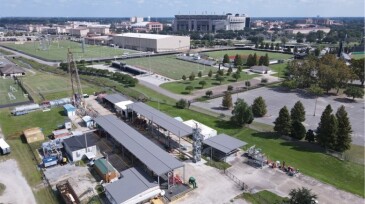
For more than a century, LSU has shaped petroleum engineering education, but few assets showcase its impact like the PERTT Lab. With six deep test wells and rare reservoir-depth gas-injection capabilities, the facility is helping drive breakthroughs in well control, carbon-dioxide injection, and next-generation energy technologies.
-
Mark your calendars for the first SPE Live featuring the 2025 TWA Energy Influencers.
-
EZOps will integrate its Mobile Oilfield Management platform into the college’s energy technology program, giving students hands-on experience with digital tools used in modern oilfield operations.
-
Switching from continuous circulation to cyclic huff-‘n’-puff operation in enhanced geothermal systems can significantly delay thermal breakthrough, sustain higher production temperatures, and improve long-term economic performance.
-
Researchers at the University of Houston have developed a new ultrathin, carbon-based film that could make AI chips run faster, cooler, and more energy-efficient.
-
The energy sector is rapidly transforming toward a data-driven, decentralized future where combining human expertise with AI and machine learning unlocks new efficiencies, solves complex challenges, and creates a decisive competitive advantage.
-
Jim Clark, a reservoir engineer with more than 4 decades of experience, reflects on the evolution of subsurface engineering and CCS, emphasizing the growing importance of analytics, cross-disciplinary skills, and technical curiosity for the next generation of engineers.
-
Marie-Hélène Pelletier presents a proactive framework for building resilience, managing uncertainty, and maintaining performance as AI reshapes work and life.