Technology

Learn how a five-step decision framework helps refineries select the right H2S removal technology by balancing compliance, risk, complexity, and cost.

A data-driven look at fuel savings, battery degradation, and net CO2 impact over a 10-year ownership period.

In an industry that rarely slows down, memory can be a powerful engineering tool. Not in terms of nostalgia, but in perspective. Many of the activities that constituted daily operations have been so deeply transformed that new generations of engineers may never have experienced them before.
-
 Explore the history of Howard Hughes Sr., inventor of the two-cone roller bit, in Part 1 of this two-part series highlighting the Hughes family legacy in the oil and gas industry.
 -
Register today for the SPE AI Hackathon taking place 7–9 May in Dubai.
-
This article provides an overview of risk-based measurement, monitoring, and verification (MMV) for efficient, long-term CO2 storage.
-
This article provides a mirror between the past and the present of well intervention technologies, including R&D to advance to downhole robots and autonomous intervention methods.
-
Explore upcoming successors in energy storage technologies in Part 2 of this series.
-
Explore the challenges associated with fiber-optics data analysis and how recent advances in technology can be leveraged to maximize the value of the data.
-
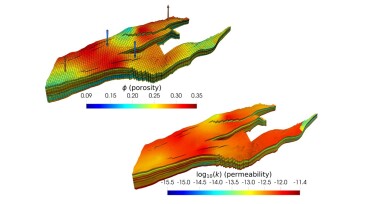
These seven open-source simulators are available for free use and are among the best available in the industry.
-
Dan Jeavons, Shell’s VP of computational science and digital innovation, discussed the findings in MIT’s recent report on digital technology’s impact on a net-zero emissions future with Aman Srivastava, TWA deputy editor in chief.
-
The free online calculators will provide industry professionals with the opportunity to make energy processes more efficient.
-
In this article, energy storage technologies are introduced as “the talk of the town” by depicting them in the form of family trees.