

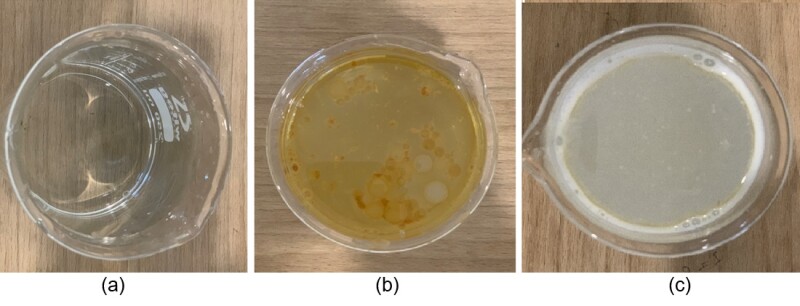
Laboratory experiments were conducted to assess the performance of a developed biodegradable surfactant in real-world conditions (Fig. 1). The surfactant was synthesized through esterification and saponification processes, with its chemical structure and purity confirmed using advanced techniques such as nuclear magnetic resonance spectroscopy, mass spectrometry, and Fourier-transform infrared spectroscopy.
Experiments evaluated the surfactant’s ability to emulsify and disperse oil in water across three different surfactant-to-oil ratios (SOR) (1:5, 1:10, 1:50). The biodegradability of the surfactant was tested using the Organisation for Economic Co-operation and Development 301 standard, and toxicity was assessed through bioassays on aquatic organisms.
Measurements of oil-droplet size reduction, water turbidity, and bacterial cell count were continuously monitored over 60 days to observe the surfactant’s efficacy.
The results demonstrated that the surfactant effectively emulsifies and disperses oil, significantly reducing residual oil in water samples and achieving optimal performance at an SOR of 1:10.
Biodegradability tests confirmed that it breaks down rapidly in natural conditions, minimizing its long-term ecological footprint.
Toxicity evaluations indicated that the surfactant is nontoxic to marine life, ensuring safe application in natural water bodies.
These findings confirm that the surfactant offers a highly effective and environmentally sustainable solution for oil-spill remediation, aligning with global efforts to promote green technologies and reduce marine pollution.