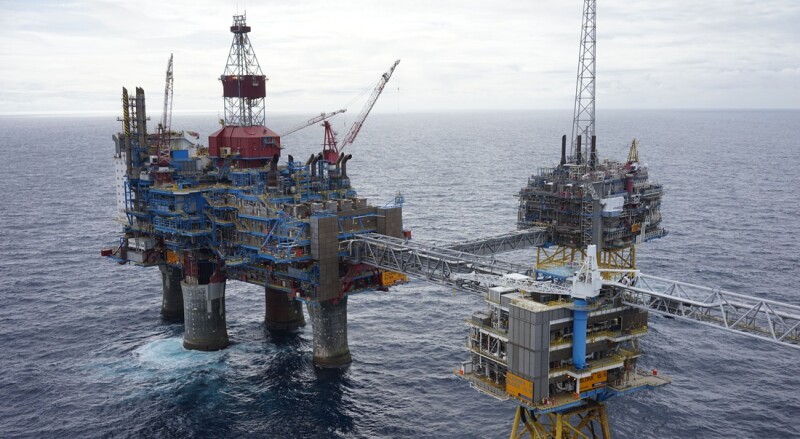
Equinor’s largest discoveries of the year, in the Sleipner area of the North Sea, can be developed through existing infrastructure, the company said.
Equinor said in a 5 December release that preliminary estimates indicate the potential to recover between 30 million and 110 million BOE from the newly discovered Lofn and Langemann gas and condensate reservoirs.
Field partner Aker BP said the partnership would evaluate development options that leverage existing infrastructure for efficient, low-emission production.
In a news release, Kjetil Hove, Equinor’s executive vice president for exploration and production Norway, said, “Discoveries near existing fields can be developed quickly through subsea facilities, with limited environmental impact, very low CO2 emissions from production, and strong profitability. Equinor plans to accelerate such developments on the Norwegian continental shelf.”

The Lofn and Langemann fields are in Production License 1140 and are between the Gudrun and Eirin fields, about 40 km northwest of the Sleipner A field center.
The discoveries reduce uncertainty in several nearby prospects, which now will be further evaluated. Hove said the discoveries have strengthened optimism for further exploration in the area.
“Together with our partners, we are committed to drill five additional exploration wells going forward,” he said.
Equinor identified the drilling targets through ocean bottom node seismic technology, and Odfjell Drilling’s Deepsea Atlantic drilled both high-pressure/high-temperature (HP/HT) wells in about 107 m water depth.
The Lofn wildcat well 15/5-8 S was drilled to a 4,636 m MD and is estimated to reach between 22 million and 63 million BOE. The well encountered gas- and condensate-bearing sandstone layers in the Hugin Formation with a thickness of 116 m, of which 36 m were sandstone layers with moderate to very good reservoir quality, according to the Norwegian Offshore Directorate. Gas/water contact was not encountered.
In the second exploration target in the Skagerrak Formation, the well encountered a 173-m thick reservoir interval, 59 m of which were sandstone layers with moderate to very poor reservoir quality. The reservoir was aquiferous.

The wildcat Langemann well 15/5-8 A was drilled to 4,932 m MD and is estimated to reach between 6 million and 50 million BOE. It encountered gas- and condensate-bearing sandstone layers in the Hugin Formation with a thickness of 125 m, of which 31 m were sandstone layers with moderate to good reservoir quality. A possible gas/water contact was interpreted between 4,141 and 4,148 m below sea level.
In the second exploration target in the Skagerrak Formation, the well encountered a 95-m-thick reservoir interval, 17 m of which were sandstone layers with very poor reservoir quality. The reservoir was aquiferous.
Both wells were permanently plugged and abandoned after extensive data collection, Aker BP said.
2025 was Aker BP’s “most successful exploration year since Johan Sverdrup was discovered in 2010,” company CEO Karl Johnny Hersvik said in a news release. “Across three major discoveries, we have added more than 100 million barrels net to the company, including Omega Alfa and Kjøttkake earlier this year.”
Equinor operates Production License 1140 with 60% interest on behalf of partner Aker BP, which holds the remaining 40% interest. Equinor was awarded the production license in 2022.