

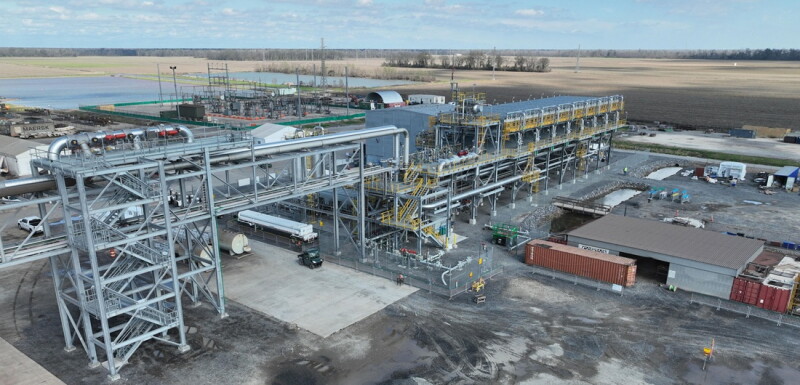
ExxonMobil announced it has begun storing carbon dioxide captured from an iron facility in Louisiana. The Nucor carbon storage project is ExxonMobil’s third active commercial carbon capture and storage (CCS) project, after its CF Industries facility and Next Generation Gas Gathering (NG3) project, both also in Louisiana.
The Nucor facility is planned to capture, transport, and store up to 800,000 tonnes of CO2 per year. The NG3 project is projected to pull up to 1.2 million tonnes of CO2 from natural gas streams, and the CF Industries project is designed to enable the transportation and permanent geological storage of up to 2 million tonnes of CO2 annually.
The company’s CCS efforts are in line with its recently released Global Outlook, which projected an approximately 70-fold increase in carbon storage from 2025 levels to 2050 levels. The report highlights a growing need for increased energy production with lowered emissions.
“Our Global Outlook projects that demand for energy will increase as economies expand, incomes rise, and living standards improve” ExxonMobil said. The report added, however, that, “progress toward emissions targets lags, climate policies have fallen short, and critical technologies remain underdeveloped.”
Despite the report’s presentation of lagging progress toward emissions targets, it still predicts that CO2 emissions will fall 20% by 2050, driven mostly by affordability and policy.
Although the report projects a decline in CO2 emissions, it still puts the level at 30 billion tonnes by 2050, which is 10% higher than what was projected last year.
“In today’s world, most lower-emission technologies are expensive,” the report says. “That’s part of the reason why today’s efforts to reduce emissions have fallen behind ambition.” The report says that alternative fuels for heavy trucking are more than 1.5 times as expensive as traditional fuels and that sustainable aviation fuel is three times more expensive than traditional jet fuel.
The company projects that oil and natural gas will still account for more than half of the world's energy mix in 2050.