Testing page for app
-
SPE’s Board of Directors has created a new Completions technical discipline, concluding that the interests of SPE professional members from the drilling and completions, and production and operations communities would be best served if completions became a separate technical discipline.
-
 Regardless of the oil price, large joint venture upstream projects have significantly underperformed on cost, schedule, and production. Smaller upstream projects have not fared much better.1 While there are a number of good books that go into some detail on reasoning focused principally on project management, poor decision quality played a very significant role in the…
 -
John H. Graham Jr., SPE, A. Paul Baclawski, SPE, John F. Templin II, Steve T. Whitaker, and Dean R. Richmond have formed a privately held, startup upstream oil and gas acquisition company titled Senex Energy Partners. Before forming the company, the founders of Senex worked together as senior analysts in Devon Energy’s new ventures and acquisitions and exploration tea…
-
A new method for accessing and cementing hard-to-reach spaces around complex offshore wells.
-
Part of what makes DME an intriguing EOR technology is that it is soluble in both water and oil—with a preference for the latter. Shell’s plan is to add DME to the waterflooding stream to reach a concentration of about 16%, the upper limit of its dissolvability.
-
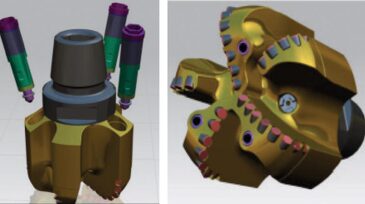
Baker Hughes is developing a drill bit capable of auto-adjusting its depth-of-cut feature to handle dynamic drilling conditions.
-
In an effort to foster collaboration in an area where there is currently very little, researchers at the University of Texas at Austin (UT) created a new web-based application for storing and sharing CT images of rocks.
-
A new techhnology aimed at treating produced water at the wellsite to near-drinking-water quality.
-
Low oil prices have taken a huge toll on exploration and production (E&P) activity, and the decline could lead to production shortfalls in the future.
-
A study done to find the root cause of coiled tubing string failures in Montney indicated microbial-induced corrosion, leading the CT service provider to create a biocide treatment program.