Testing page for app
-
 A new pulsed-eddy-current (PEC) electromagnetic (EM)-based tool called an enhanced pipe-thickness-detection tool (ePDT) has been introduced for the corrosion inspection of multiple pipes.
 -
An integrated understanding of geomechanical effects, fracture propagation, and reservoir dynamics is critical in the efficient and cost-effective application of rejuvenation technologies for unconventional plays.
-
This paper describes a comprehensive optimization-under-uncertainty work flow that combines a simulation-based approach with semiautomatic work flows and high-speed computers to facilitate the process of decision-making for investors.
-
This paper demonstrates the need to couple the wellbore model to the reservoir-simulation and hydraulic-fracturing model in shale formations to optimize well landing, trajectory profile, and long-term productivity.
-
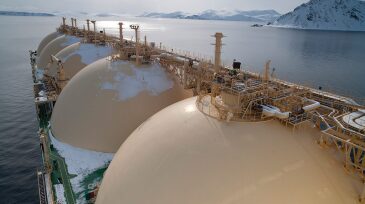
In its first 50 years, LNG has become the world’s fastest-growing gas supply source and is now part of an upheaval in the global energy market. Today, the sector stands at a crossroads, and the industry must adopt new thinking to address current and future needs of buyers, sellers, and consumers.
-
Numerical simulation methods of compositional models were incorporated with logarithmically spaced, locally refined, and dual-permeability reservoir models and local grid refinement (LGR) of hydraulic-fracture conditions to investigate the feasibility of CO2 injection in shale oil reservoirs.
-
In the first paper, a comprehensive experimental evaluation of gas injection for enhanced oil recovery (EOR) in organic-rich shale and, in the second, the effect of fluid transport in organic-rich shale on recovery mechanisms under gas injection.
-
This paper involved laboratory experiments introducing miscible gases into core samples to investigate enhanced oil recovery (EOR) mechanisms for Permian Basin shales to provide information to design field tests for a huff ’n’ puff (HNP) recovery process.
-
In recent years, some effort has been made to use EOR techniques, particularly CO2 injection, to extract additional oil and gas from unconventional resources. This has the potential to change the dynamics (again) of oil production from these tight and difficult reservoirs.
-
In recent times, we have been inundated with articles concerning the oil and gas industry’s race toward digitalization and automation. The pillars of such a transformation are the rapidly evolving industrial Internet of things, secure cloud computing, data analytics, AI, and machine learning.