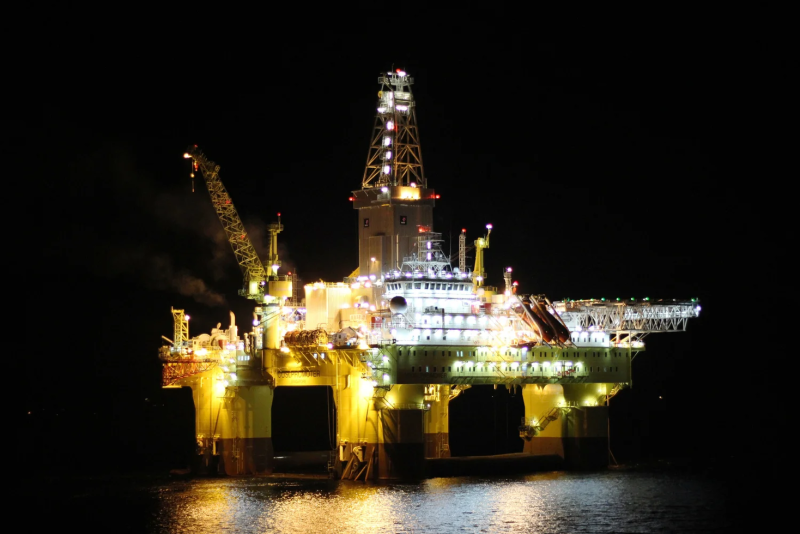
Offshore drilling rig values are recovering and are expected to continue doing so moving forward.
Average rates for drillships have improved by 10.1%, semisubmersibles by 6.2%, and jackups by 5.3% since March. Looking toward the middle of the next decade, however, the sector will likely see a shortfall of available offshore drilling rigs. In the nearer term, additional merger-and-acquisition (M&A) activity and rig transactions are expected, said Sofia Forestieri, senior vice president, offshore, at Esgian, during the firm’s 20 October webinar, “Rig Values 2026: M&As, Deals, and the Middle East.”

A lack of newbuilds entering the market and the expectation of limited to no reactivation of stacked rigs in the short term means the market has little flexibility to meet the demand expected from 2027, she said.
“What we have seen is that drillships from March until today have increased on average across fifth-, sixth-, and seventh-generation rigs around 10%, semisubs around 6%, and jackups—premium and vintage and harsh environment—around 5%,” Forestieri said.
According to Esgian, average rig values in October were $261 million for drillships, $160 million for semisubmersibles, and $58 million for jackups.
Forestieri attributed the stronger recovery in floater rig values to concerns about the security of supply and the availability of floaters.
“Other demand and rig-specific factors always tend to affect rig values as well,” she said.
Top 5 Shake-Ups
The top five ranking of offshore drilling contractors by fleet size has changed in the past year.
“The one thing that is the norm is that the top five is quite volatile,” Forestieri said. A consolidation trend in the market over the past few years is one reason, she said.
“We still hear from market players that it (M&A) will continue to happen. And that will be both as a survival strategy, but also as an economic strategy as well,” she said.
In October 2025, the top five floater companies by competitive fleet size were Transocean and Noble with 24 rigs each, followed by Valaris with 12, Seadrill with 11, and COSL with 10. As of October 2026, the pending Transocean-Valaris merger would create the largest floater fleet with 34 rigs, followed by Noble with 23, Seadrill with 11, COSL with 10, and Constellation joining the top five with seven floaters.
“When we consider just those two (Transocean-Valaris and Noble), and we look at the chart, we see that around two thirds of the top five competitive floater fleet globally will be in the hands of two players,” she said.
In October 2025, the top five jackup companies by competitive fleet size were ADES with 44, ADNOC Drilling with 34, COSL with 33, Shelf Drilling with 32, and Valaris with 25. This year, it’s ADES with 79, ADNOC Drilling with 34, COSL with 33, Borr Drilling reaching the list with 29 units, and the Transocean-Valaris combo with 25.
“Borr, who was a player that was not in the top five a year ago, has made the top five after recent acquisitions,” Forestieri said.
She expects more M&A to happen, as well as more rig transactions “in the sense of rigs exchanging hands, but also potentially we could be seeing rigs entering the market.”
Under Construction
There are 26 rigs under construction, Forestieri said, but of those, only three jackups and four semisubmersibles are considered competitive, meaning they are nearly complete and awaiting buyers, contracts, or commissioning.
“There is a supply-demand forecast in which after 2030, there starts to be an imbalance in which demand becomes higher than supply, especially when it comes to the jackups,” she said.
Esgian estimates 50 competitive jackups, largely built between 1980 and 1986, will retire between 2030 and 2035. With only three competitive jackups in the current orderbook, that means the jackup market could see significant shifts in supply and demand in the next decade.
“We see that there’s a shortage of what’s coming out and what is coming in,” she said.