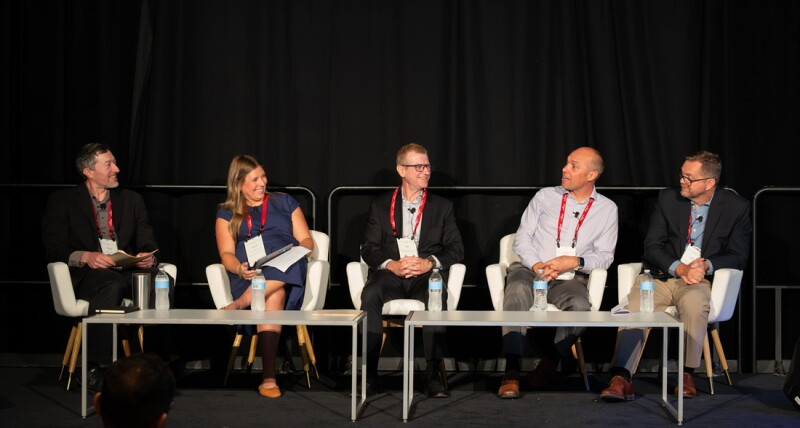
Artificial lift challenges such as equipment reliability and run life remain top of mind, but newer topics such as real-time surveillance and autonomous optimization are grabbing headlines.
Efficiently optimizing production from wells could provide a lot of value to operators, experts said during the “Improvise, Adapt and Overcome: Challenges and Fluidity in Artificial Lift” opening session on 25 August at the SPE Artificial Lift Conference and Exhibition.
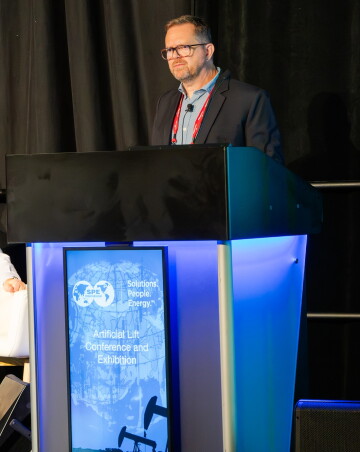
Peter Nesom, general manager for the Production Engineering Center of Excellence at Chevron, observed that artificial lift has not lacked data but the data that’s gathered is in the midst of ever-changing conditions.
“Field conditions are constantly changing. Reservoir pressure declines, water cut and GOR [gas/oil ratio] change, equipment wears out, wells influence one another, and operational priorities can change on a daily basis,” he said. “At the same time, production systems are increasingly complex and integrated. Every decision we make has consequences beyond a single well. A change that improves well performance may impact downstream processing. A change that protects facilities capacity may leave barrels in the reservoir.”
And given all those changes, and the overarching goal of optimizing production, the industry needs to find a way to do what it’s doing more efficiently, he said.
“The optimization challenge spans the entire production system, and traditional digital workflows and tools sometimes struggle with this reality. Most rely on engineers reviewing data, diagnosing issues, and implementing changes. The process works, but it doesn’t scale. By the time a recommendation is executed, field conditions may have changed and valuable optimization opportunities lost,” he said.
In short, he said, the problem that needs to be solved is combining deep engineering understanding with speed, scale, and persistence in order to optimize a dynamic and interconnected production system.
In a bid to answer that challenge, Chevron has introduced GEORGE, or the Generative Engineering, Orchestration, and Real-Time Operations Guidance Engine. Nesom called GEORGE an intelligent digital production engineering assistant and said it has been used for over 5,000 wells to facilitate analysis, optimization, and automation tasks.
“We’re not trying to solve a single problem,” he said. “The assistant is partnering with the production engineers, trying to solve many different types of problems faster and more effectively.”
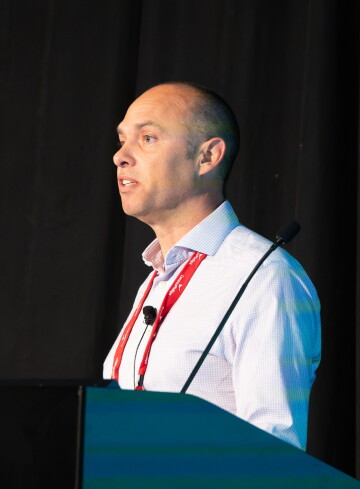
Jason White, global production engineering chief at ConocoPhillips, said tremendous value is waiting to be discovered and the key question is how companies can close the gap between potential and realizing that value. ConocoPhillips, for example, sought to improve its gas lift artificial lift process and tools, so the company targeted a way to improve that via its digital journey, he said.
Steps in that journey included solving challenges related to data, standardization, adoption, and governance, he said. Once the processes and data were in place, ConocoPhillips added artificial intelligence (AI).
“It’s been able to do the analysis much faster than we as humans can do it,” White said. “We’re trying to use that AI eventually to really leverage our engineers. So, in my mind, the goal is not to have fewer engineers. It’s to be able to let the engineers focus on where we can really find that value and to do it more efficiently and effectively.”
The next question, he said, is how success is defined once a program is put in place. “I don’t want to define success on how quickly did we put a program in place or how quickly did we do AI. It comes back to … how much value did we create? Do we get to a place where we’re able to leverage our engineers to deliver that value?”
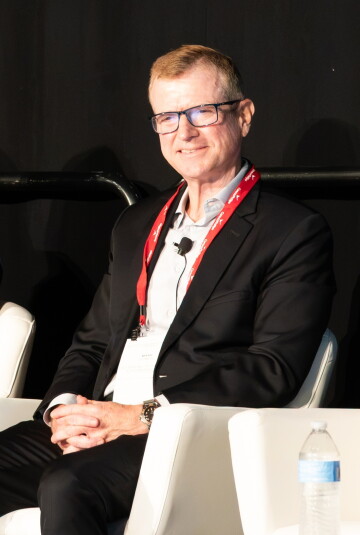
Mark Agnew, chief wells and production engineer at ExxonMobil Technology & Engineering Co., said one challenge operators face is how to optimize their well count efficiently. To address that challenge, the operator has piloted different systems
“We’re in the process of rolling out closed-loop ESP [electrical submersible pump] control across all of our wells in the Permian,” he said.
ExxonMobil’s closed-loop ESP control system, outlined in paper SPE 225261, does about 20 checks and goes beyond well optimization, he said. “It’s also looking into production facility constraints, separator constraints, and a whole host of other factors that are really, really critical in going into the overall optimization story.” The implementation has had a significant effect on Permian volumes.
In general, he said, a closed-loop system “just takes a lot of that tinkering off the engineer’s hands,” he said. “Optimization early in my career was this much technical work, this much messing with data, and this much convincing someone to go out in the field and take an action.”
Another effort the operator has underway is using machine learning and AI to optimize gas lift in the Permian, which is discussed in paper SPE 219553, he said.
White said a focus on reducing failure, specifically with wells that have failed, could save the industry a lot of money. “If we can prevent those failures in the first place, we can save a lot of money and also we can keep production on.”
Taking advantage of digital tools and production surveillance can help, he said.
And AI features can help improve repetitive workflows in general, Nesom said. “Think of what you do on a daily basis, and then ask yourself whether or not you need to do it or whether or not you can get some AI tool to do it.”
White said several AI tools can make life easier, and he urged people to take advantage of them. “We feel like we’re cheating when we use AI sometimes. ‘Did you write that email, Jason? Because it sounds a lot more polished than you,’ and ‘Did you really take those notes,’ or ‘Did you write that paper?’ I mean we’re not in school anymore. Use the tools that are available to get the job done as quickly and efficiently as you can.”
Of course, trust in AI tools and agents can be an issue. As such, White said, it makes sense to keep a human in the loop until the tools prove they are trustworthy.
In the meantime, he said, it’s important for people to embrace AI technologies or they will be left behind.
For Further Reading
SPE 225261 Closed-Loop ESP Optimization To Maximize Asset Value by C. Yao, ExxonMobil Upstream Integrated Solutions Company; P. Aher, ExxonMobil Upstream Company; A. Villarreal, ExxonMobil Upstream Integrated Solutions Company; J. Travis, ExxonMobil Upstream Company; E. Karantinos, ExxonMobil Upstream Integrated Solutions Company; and R. Brito, ExxonMobil Upstream Company.
SPE 219553 Gas Lift Optimization in the Permian Using Machine Learning and Artificial Intelligence by P. Movahed, D. Burmaster, E. Karantinos, and A. L. Villarreal, ExxonMobil Upstream Integrated Solutions Company; M. Memarzadeh, S.G. Vela, and S.C. Tapley, XTO Energy Inc.; and C. Newlin and T.A. Banes, ExxonMobil Global Services Company.