earthquake
-
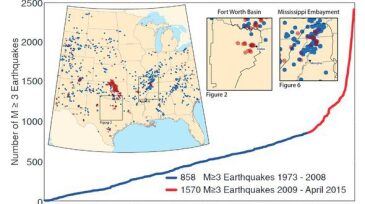
 Even though total produced volumes are projected to hit new record highs in the coming years, treated water is expected to be comparatively lower than in the past, despite water disposal practices increasing oilfield seismic activity, with earthquakes nearly doubling in West Texas alone in 2021.
-
Operators will not be able to inject wastewater below 10,000 ft in the Gardendale area.
-
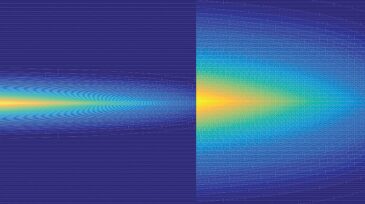
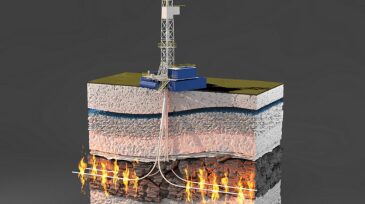
This paper presents a coupled 3D fluid-flow and geomechanics simulator developed to model induced seismicity resulting from wastewater injection.
-
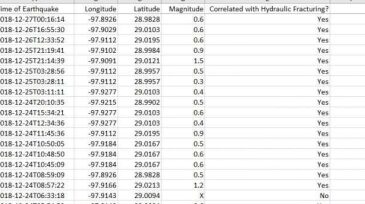
Earthquakes caused by hydraulic fracturing are more common in the Eagle Ford Shale of South Texas than previously thought, a new study reveals.
-
Stanford researchers have mapped local susceptibility to man-made earthquakes in Oklahoma and Kansas. The new model incorporates physical properties of the Earth’s subsurface and forecasts a decline in potentially damaging shaking through 2020.
-
Oklahoma is tightening its rules for hydraulic fracturing after studying a new cluster of earthquakes in one of the hottest US regions for drilling.
-
Stanford geoscientists have found a way to detect thousands of tiny tremors around hydraulic fracturing operations that could serve as predictors of eventual larger earthquakes.
-
Stanford geoscientists have found a way to detect thousands of tiny tremors around hydraulic fracturing operations that could serve as predictors of eventual larger earthquakes.
-
For 300 million years faults showed no activity, and then wastewater injections from oil and gas wells came along.
-
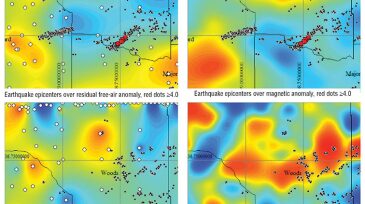
It is known that a well injecting a lot of water near a big fault can lead to earthquakes. The problem is, more often than not those faults are not known until after a tremor.