Business/economics

Lower operating expenditures and a changing asset mix helped UKCS operators cut average production costs by 9% year over year, despite relatively flat production levels, according to the NSTA.

The deal adds 40,000 B/D of production and epands Cenovus’ SAGD footprint with three Alberta assets.

The Federal Reserve Bank of Dallas’ third-quarter energy survey reflects industry views on the drawdown of the US Strategic Petroleum Reserve, the outlook for Persian Gulf crude exports, and expectations for oil prices.
-
 The Asia Pacific region is expected to be the fastest-growing region in deepwater development in the next 5 years.
 -
Decline-curve analysis (DCA) is arguably the most commonly used method for forecasting reserves in unconventional reservoirs. This paper discusses its basic theory and application, together with the potential pitfalls of using simple empirical production-forecasting methods in complex reservoirs.
-
Expectations of continued USD 100/bbl of oil were shattered by a sharp price drop last year that eventually halved the prices of benchmark crudes. Prices were still sinking at the start of the year to lows not seen since 2009 due to a global oversupply of oil.
-
A sharp decline in oil prices is pushing oil and gas companies to innovate to increase efficiency and prepare to meet the world’s long-term energy needs, panelists said at the International Petroleum Technology Conference (IPTC) held in Kuala Lumpur, Malaysia, in December.
-
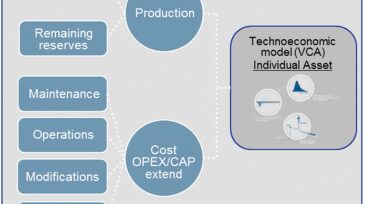
The number of aging offshore facilities in the Asia Pacific region is increasing. The decision to extend the service life of an offshore asset is made on the basis of detailed technical analyses combined with detailed economical evaluations.
-
SPE’s technical directors are focused on problems that require working outside the bounds of their discipline.
-
In this paper, the effect of timing and pattern of well placement on NPV is studied. Three scenarios were evaluated.
-
This paper describes a case study in which four reservoir models were coupled with a production-network model, with the objectives of maximizing recovery factors, identifying operational problems, and evaluating water-production effects.
-
The realization that we should not look at any individual aspect of how to estimate unconventional reserves and resources properly without considering its place in the project life cycle reflects a maturity within the industry.
-
The implementation of the PRMS has contributed significantly to the understanding of the hydrocarbon-maturation process in the Netherlands.