

Carbon capture and storage

This SPE technical section editorial synthesizes six technical themes shaping CO2 transport and storage and interprets them through a petroleum engineering capability lens.

The Pawnee Carbon Sequestration Project, which would use a repurposed well, is planned to capture and store up to 400,000 tonnes of carbon dioxide, with first injection targeted for early 2027.

This paper details the importance of and value derived from a real-time process-twin model for one of the world’s largest operating carbon dioxide sequestration projects.
-
 The deployment of appropriate CO2-separation technologies for natural gas processing is viewed as an abatement measure toward global CO2-emissions reduction. Selection of the optimum technology requires special attentiion.
-
The authors discuss the results of a pilot project to capture post-combustion CO2 for purposes of EOR.
-
Several geological settings are appropriate for geological storage of carbon dioxide (CO2), including depleted oil and gas reservoirs, deep brine-saturated formations, CO2-flood enhanced-oil-recovery (EOR) operations, and enhanced coalbed-methane recovery.
-
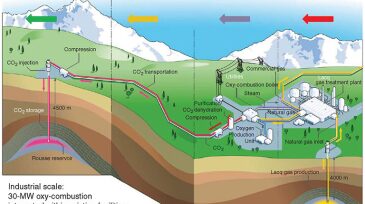
Total has been involved in CO2 injection and geological storage for more than 15 years, in Canada (Weyburn oil field) for enhanced oil recovery and in Norway (Sleipner and Snohvit fields) for aquifer storage.



Page 34 of 34