Data & Analytics

Shell has demonstrated drone-in-a-box operations from its Mars floating production unit, becoming the first operator in the region to secure FAA approval for self-approved offshore beyond-visual-line-of-sight flights. JPT Senior Technology Editor Jennifer Pallanich visited Shell Technology Center Houston to see the system in action.

Panelists at the SPE Subsea Well Intervention Symposium discussed where AI is delivering value today, where risks remain, and how engineers can best determine its usefulness.

As digital technologies become commonplace, industry leaders say core engineering knowledge remains essential for making informed decisions and avoiding costly mistakes.
-
 The future of intelligent operations in our industry is being driven by advances from other sectors that have been embraced for petroleum applications. Foundational changes already taking place include advances in the type and volume of data being acquired and how the data are used.
 -
The complete paper presents a discussion of the use of intelligent well completion in Santos Basin Presalt Cluster wells.
-
This paper describes an automated work flow that uses sensor data and machine-learning (ML) algorithms to predict and identify root causes of impending and unplanned shutdown events and provide actionable insights.
-
Increasing accuracy in models is often obtained through the first steps of data transformations. This guide explains the difference between the key feature-scaling methods of standardization and normalization and demonstrates when and how to apply each approach.
-
Rapid development of more-accurate simulator engines has given researchers the opportunity to generate sufficient data to train robotic policies for real-world deployment. However, moving from simulation to reality remains one of the greatest challenges of modern robotics.
-
Researchers have created software that borrows concepts from Darwinian evolution, including “survival of the fittest,” to build AI programs that improve generation after generation without human input.
-
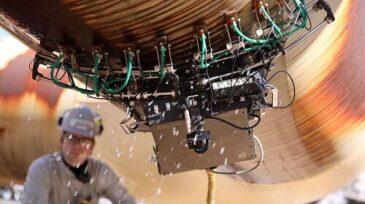
Gecko Robotics is providing the energy industry with artificial-intelligence-enabled robots to inspect infrastructure and supply massive amounts of data to help predict failures before they occur.
-
The AI journey starts with a single step, but too many companies take the wrong first step.
-
The words "disruption" and "change" are becoming more and more common in many industries, including offshore oil and gas.
-
There is often an assumption that big data, together with machine learning, will solve whatever problems asset-heavy industries such as oil and gas face. This is not the case; big data alone isn’t enough. We need something else to solve these problems, and the answer lies in the world of physics.