Data & Analytics

Shell has demonstrated drone-in-a-box operations from its Mars floating production unit, becoming the first operator in the region to secure FAA approval for self-approved offshore beyond-visual-line-of-sight flights. JPT Senior Technology Editor Jennifer Pallanich visited Shell Technology Center Houston to see the system in action.

Panelists at the SPE Subsea Well Intervention Symposium discussed where AI is delivering value today, where risks remain, and how engineers can best determine its usefulness.

As digital technologies become commonplace, industry leaders say core engineering knowledge remains essential for making informed decisions and avoiding costly mistakes.
-
 The two technology startups aim to bring scale to the visual side of oilfield automation with a new deal that will cover 90% of US energy assets.
 -
The company plans an innovative application of oceanographic instrumentation to maximize recovery at its Johan Sverdrup oil field in the North Sea.
-
Oil companies generate an enormous amount of data but are reluctant to share it. But more sharing of information may be required in the future to keep up with a rapidly changing energy landscape.
-
High-performance computing is an important piece of the puzzle for operators looking to integrate field models with surface facilities. Next-generation processors and accelerators should help build the systems needed to meet industry's growing demands, but the tools may be reaching their limits.
-
The TRITON/TRISIS/HatMan malware incident proved that the worlds of process safety and industrial control systems should be looked at holistically, not just from the standpoint of potential cyberthreats.
-
The need to understand the future trends of the oil industry has never been greater than it is today.
-
In this study, the authors investigated a fully data-driven approach using artificial neural networks (ANNs) for real-time virtual flowmetering and back-allocation in production wells.
-
The authors detail the development of a technique based on surface-to-borehole controlled-source electromagnetics (CSEM), which exploits the large contrast in resistivity between injected water and oil to derive 3D resistivity distributions, proportional to saturations, in the reservoir.
-
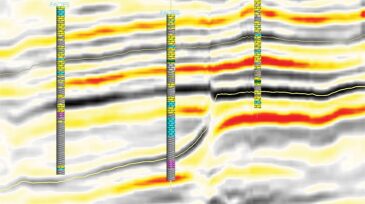
This paper discusses a project with the objective of leveraging prestack and poststack seismic data in order to reconstruct 3D images of thin, discontinuous, oil-filled packstone pay facies of the Upper and Lower Wolfcamp formation.
-
In this paper, the authors describe a project to design, field trial, and qualify an alternative solution for real-time monitoring of the oil rim in carbonate reservoirs that overcomes these disadvantages.