Data & Analytics

Canada’s development of large-scale digital drilling core libraries and open geoscience data platforms follows approaches pioneered in Australia, particularly Western Australia, through decades of government investment in geoscience data collection and preservation.

This research focuses on combining physics-based expert rules with machine learning to improve the detection of failure-related events in electrical submersible pumps.

A combination of physics principles and machine-learning techniques is used in this work to develop a virtual flowmeter for oil-production optimization in electrical-submersible-pump-lifted oil wells, resulting in reliable generalization.
-
 Digital transformation: It’s a phrase that seems to be on the lips of everyone in the oil and gas industry, and that was certainly true at the inaugural Energy in Data conference held in Austin. The conference, however, showed that the transformation is more than on its way. It’s here.
 -
Firms such as Netflix have had a solid digital transformation strategy. Now, industrial companies, including in the oil and gas sector, are on a similar, if less dramatic, trajectory.
-
First developed as a proprietary system by a large Permian Basin operator, this hydraulic fracturing schedule exchange will be run by a data company and opened up to the entire North American shale sector.
-
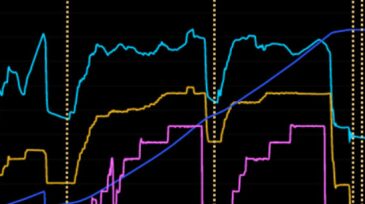
Usually, field engineers manually pick events such as start and end times out of hydraulic-fracturing pumping data. This manual process is time-consuming and prone to error. Now, a Denver-based company is using machine learning to identify these events more accurately and consistently.
-
Unlike structured data, unstructured data is information that either does not have predefined labels or is not organized in a predefined template, and inefficient management of this data is holding back the industry.
-
In recent times, we have been inundated with articles concerning the oil and gas industry’s race toward digitalization and automation. The pillars of such a transformation are the rapidly evolving industrial Internet of things, secure cloud computing, data analytics, AI, and machine learning.
-
Baker Hughes is still a GE company, but it has partnered with a second company for artificial intelligence expertise, C3.ai. The deal is expected to speed the integration of AI into oilfield operations by the company which also markets GE’s device analytics platform, Predix.
-
Quantum computers exploit the peculiar behavior of objects at the atomic scale and use the qubit as the basic unit of quantum computing. A quantum computer with only 100 qubits would, theoretically, be more powerful than all the supercomputers on the planet combined.
-
Merging tried-and-true physics-based models with data science is bolstering the Houston independent’s reservoir-engineering work on its deepwater and shale assets.
-
The company's second location in the area is expected to increase the production capacity for large-scale exploration and production digital transformation projects that are already under way.