Data & Analytics

Sponsored
With operators under pressure to deliver more energy with fewer resources, predictable drilling performance is more important than ever. Discover how a unified digital workflow can turn drilling data into better decisions and consistent execution—providing the foundation for autonomous drilling and more predictable, profitable, and productive wells at scale.
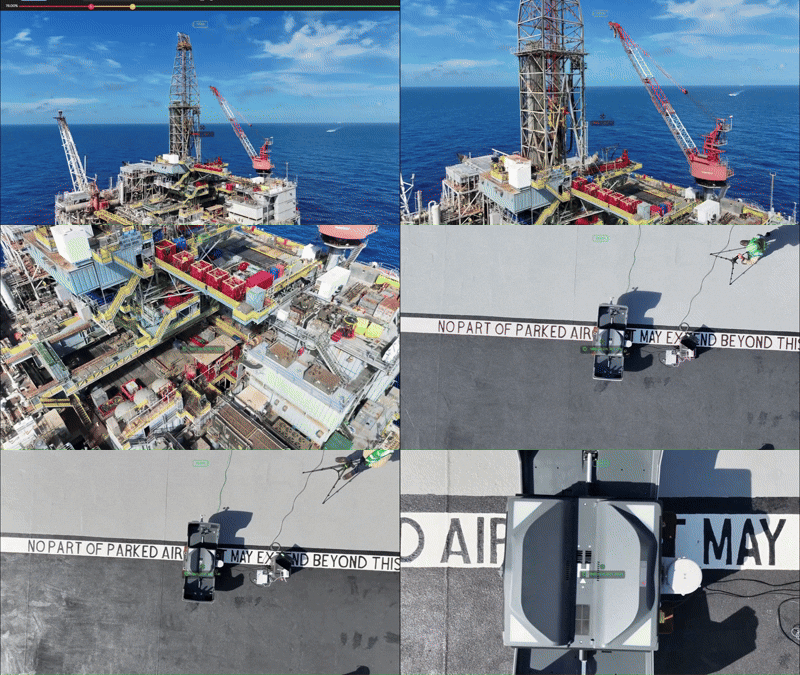
Shell has demonstrated drone-in-a-box operations from its Mars floating production unit, becoming the first operator in the region to secure FAA approval for self-approved offshore beyond-visual-line-of-sight flights. JPT Senior Technology Editor Jennifer Pallanich visited Shell Technology Center Houston to see the system in action.

Panelists at the SPE Subsea Well Intervention Symposium discussed where AI is delivering value today, where risks remain, and how engineers can best determine its usefulness.
-
 This paper presents a robot integrated with a microcontroller that provides multiple functions to help with data logging, analysis, and reporting to identify hazards and improve safety protocols.
 -
Aurora Innovation and Detmar Logistics have inked a deal for 30 autonomous trucks that will begin hauling sand in the region next year.
-
Sustainability in reservoir management emerges not from standalone initiatives but from integrated, data-driven workflows, where shared models, closed-loop processes, and AI-enabled insights reduce fragmentation and make sustainable performance a natural outcome.
-
SponsoredIn oil and gas operations, every decision counts. For more than 2 decades, SiteCom has been the trusted digital backbone for well operations worldwide, driving insight, collaboration, and efficiency.
-
This study presents a novel hybrid approach to enhance fraud detection in scanned financial documents.
-
This paper describes a decision-support system that integrates field data, system specifications, and simulation tools to quantify system performance, forecast operational challenges, and evaluate the effect of system modifications in water management.
-
This paper presents an approach to management and interpretation of pipeline-integrity data, ensuring integrity, safety, and reliability of the operator’s critical pipelines.
-
This paper describes the development of a system for comprehensive mapping and asset registration using a digital-twin approach.
-
This paper describes a machine-learning approach to accurately flag abnormal pressure losses and identify their root causes.
-
Data and impartial viewpoints can help de-risk exploration portfolios and keep resource estimates in check.