Data & Analytics

Sponsored
With operators under pressure to deliver more energy with fewer resources, predictable drilling performance is more important than ever. Discover how a unified digital workflow can turn drilling data into better decisions and consistent execution—providing the foundation for autonomous drilling and more predictable, profitable, and productive wells at scale.
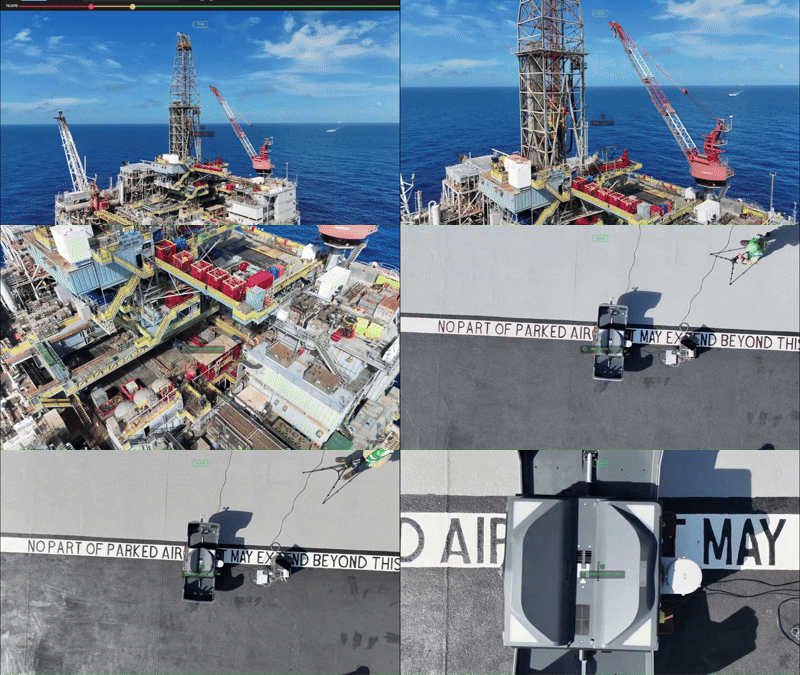
Shell has demonstrated drone-in-a-box operations from its Mars floating production unit, becoming the first operator in the region to secure FAA approval for self-approved offshore beyond-visual-line-of-sight flights. JPT Senior Technology Editor Jennifer Pallanich visited Shell Technology Center Houston to see the system in action.

Panelists at the SPE Subsea Well Intervention Symposium discussed where AI is delivering value today, where risks remain, and how engineers can best determine its usefulness.
-
 ExxonMobil's Jason Gahr uses the five stages of grief to explain how the upstream industry should respond to the rise of AI.
 -
This paper presents a robust workflow to identify optimization opportunities in gas lift wells through real-time data analysis and a surveillance-by-exception methodology.
-
This paper introduces an agentic artificial-intelligence framework designed for offshore production surveillance and intervention.
-
The objective of this study is to field test a non-nuclear multiphase flowmeter and assess its performance under challenging operating conditions.
-
In the past year, publications on CO2, natural gas, and hydrogen storage have increasingly focused on the design, evaluation, and optimization of storage plans. These efforts encompass a broad spectrum of challenges and innovations, including the expansion of storage reservoirs from depleted gas fields and saline aquifers to stratified carbonate formations and heavy-o…
-
Reaching further than dashboards and data lakes, the agentic oil field envisions artificial intelligence systems that reason, act, and optimize.
-
Autonomous drilling through managed pressure drilling (MPD) at the Atlantis field has given the operator confidence to scale the method.
-
The cloud platform provider said the initiative is designed to help energy companies manage and analyze large-scale operational data.
-
Major increases in hydrocarbon production require both incremental and revolutionary technologies, industry leaders said during the SPE Hydraulic Fracturing Technology Conference.
-
This paper presents an automated workflow deployed for scheduling and validating steady-state production-well tests across more than 2,300 wells in the Permian Basin.