Drilling

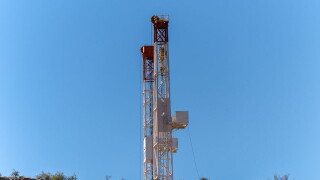
The company said that its AD-300, a 50-m-high automated island drilling rig that walks between wells, was delivered 3 months ahead of schedule.

A report commissioned by Havtil, the Norwegian Ocean Industry Authority, calls for better dialogue regarding pore-pressure uncertainty and higher-end drilling techniques like managed pressure drilling as methods to reduce the risk of well-control events.
Output is rising fast in the South American shale play and putting Argentina on a course to soon reach 1 million B/D.
-
 A real-time method is presented to predict impending stuck pipe with sufficient warning to prevent it. The new method uses automated analysis of real-time modeling coupled with real-time-data analysis.
 -
Challenging environments such as unstable clay formations represent high operational risk when running tubulars after drilling is completed.
-
Automated particle-size analyzers are something you will not see on most drilling rigs, but some think this outside-the-oil-field technology will play a big role in the future of the drilling sector.
-
Wellbore position is computed from survey measurements taken by a measurement-while-drilling (MWD) tool in the bottomhole assembly (BHA).
-
Cementing is central to the discussion of zonal isolation and well integrity.
-
Saudi Aramco operates a large offshore oilfield development that has driven achievements in multilateral and extended-reach directional wells.
-
Eight of the world’s 10 longest wells have been drilled by ExxonMobil as operator of the Sakhalin-1 project in Russia.
-
This work demonstrates cement design that includes evaluating cement-sheath mechanical integrity in intercalated salts.
-
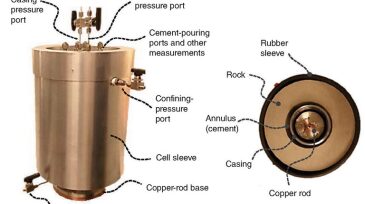
Operators in the North Sea have been concerned about the ability of the cement sheath to maintain sealing integrity because of the increasing number of reported failures in mature wells. This paper presents results from a new laboratory setup to visualize the source of issues.
-
Many wells in the Cana-Woodford shale suffer from chronic sustained casing pressure (SCP) because of poor cement-sheath bonding.