Asset Management

Talos Energy founder Tim Duncan has been named executive chairman of newly formed 1947 Oil&Gas, which will focus on acquiring and developing mature, shallow-water assets through its buyout of Renaissance Offshore. The deal is expected to close in Q2 2026.

Operators aren’t rushing to drill, even as the closure of the Strait of Hormuz drives oil prices up.

The following three papers show challenges and potential solutions across various stages of the deepwater well-development cycle from a variety of deepwater basins across the world.
-
 Due to the continued pressure from weak utilization of existing operating fleet and supply overhang of newbuilds, Keppel is cutting its yard capacity. The company is however seeking opportunities in niche and new markets.
 -
Tyer Wind in Tunisia developed a wind turbine that mimics the flapping motion of hummingbirds' wings. Rated power output is 1 kW, using two carbon-fiber wings, each 5.25-ft long. At rated power, it operates at 450 rpm. The machine is currently undergoing open air/real conditions testing.
-
Fossil fuels will probably be at the forefront of energy and environmental policy under the new Trump Administration, says Charles D. McConnell, executive director of Rice University’s Energy and Environment Initiative, at a talk hosted by the Norwegian Consulate General in Houston.
-
Scientists have developed oxidized carbon particles that extract radioactive metals, such as cesium and strontium, from water. They said the materials may help purify contaminated waters stored after the Fukushima nuclear power plant accident and also can trap common radioactive elements found in waterfloods from oil extraction, such as uranium, thorium, and radium,
-
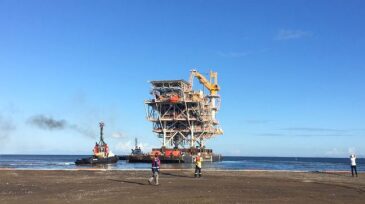
The new Juniper offshore platform began its journey toward Trinidad to be installed as BP Trinidad and Tobago LLC’s 14th offshore installation. Juniper will have a production capacity of approximately 590 MMscf/D.
-
US drilling and completion companies that were slashing workforces and cannibalizing pumping trucks for parts 6 months ago are now hiring crews and repairing equipment to meet rising demand.
-
Various incidents that took place between Transocean, the owner of Deepwater Horizon, and BP, the company that leased the rig for use at Macondo, illustrate the gap between work-as-imagined in the drilling program and work-as-done by the well operations crew.
-
Despite a turbulent time for most offshore sectors over the past 2 years, Douglas-Westwood’s latest analysis from the World Offshore Helicopters Market Forecast 2017–2021 projects USD 18 billion in oil- and gas-related expenditure over the next 5 years.
-
In the first part of this series, the author explained why the current way of performing FEED does not allow minimization of costs by optimizing the design. In this article, he describes how the current contractual setup of the EPC also fails to minimize the costs of equipment/materials and works.
-
In this column, Howard Duhon examines different types of complexity theory.