Onshore/Offshore Facilities

Despite significant progress in capturing associated gas for domestic use, Iraq remains the world’s third-largest gas-flaring country as it aims for higher oil and gas production targets.

The 2026 Upstream Scale Guidelines establish a common workflow for field measurements, scale modeling, and risk assessment to support more consistent operational decisions.

Shell has reached FID on LNG Canada Phase 2, a major expansion that will double the Kitimat facility’s LNG export capacity to 28 mtpa and strengthen long-term supply to growing Asian markets.
-
 The demand for water and disposal services in the Permian Basin has piqued the interest—and investments—of companies eager to acquire existing pipeline infrastructure and saltwater disposal facilities to capitalize on the growing need.
 -
A BP flow assurance manager explains a methodology for determining and mitigating flow assurance risks.
-
This article highlights some of the code and registration issues the Savvy Separator engineer encounters when retrofitting a vessel with internals to improve or restore the process performance of the separator.
-
Decom North Sea has developed the Late Life Planning Portal system, a web-based information portal, to capture tools that add value as well as good practices and lessons learned from the execution of decommissioning projects.
-
This paper aims to develop a Brazilian baseline for front-end planning and cost estimation of the decommissioning, removal, and disposal options.
-
Using decision analysis as a software tool helps to clarify and evaluate decommissioning alternatives against a comprehensive set of objectives, including both market and nonmarket values.
-
Whether you are involved in the design and construction of new facilities or the decommissioning of existing facilities, having a solid understanding of decom makes a lot of sense. Are you ready as all around the world offshore facilities have reached, or are reaching, the end of their design life?
-
Fluid Efficiency and Rhapsody Venture will partner to refine and launch a new molecular technology to improve the flow in pipelines.
-
Air Products, BHGE, Norsafe, and Sofec won contracts for Eni’s Coral South FLNG project in Mozambique.
-
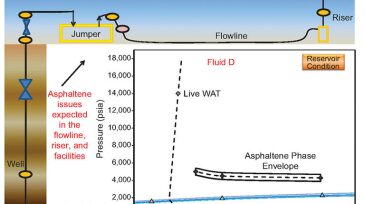
This paper presents an integrated approach to evaluate the key elements of asphaltene risk for deepwater projects, the strategy to manage the issues during production implementation, and aspects to be considered in the mitigation of asphaltene in the field-development plan.