Onshore/Offshore Facilities

With confidence in subsea boosting performance growing, BP is incorporating pumping systems into both greenfield developments and brownfield expansions.

As the pace of new discoveries slows and high-quality prospects become harder to find, oil companies may need to rely more heavily on mature fields to maintain production and support future supply.

A shared digital mindset across subsurface, subsea, and drilling and wells is accelerating well planning at Vår Energi.
-
 The authors describe coiled tubing operations that used a riser on a monohulled vessel already performing riserless interventions.
 -
With global decommissioning activities forecast to reach $100 billion through 2030, early planning for it could go far in helping to minimize risk and associated costs.
-
Production from the Dover field is expected to start in late 2024 or early 2025.
-
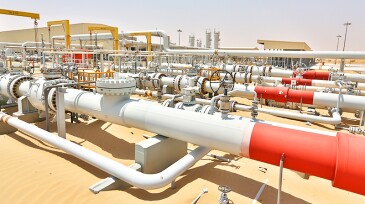
Sustaining two of the UAE’s biggest onshore fields will require hundreds of kilometers of new pipelines that are to be powered using 100% renewable energy.
-
The second phase of the project will analyze data gathered in Phase 1, with the goal of improving riser, wellhead, and conductor fatigue estimates.
-
Production from the offshore project now represents the equivalent of 7% of European oil consumption.
-
The deal covers the supply of more than 50 km of dynamic and static subsea umbilicals.
-
The multiyear, $20 million-plus contract is for a well abandonment campaign in the Balmoral area in the UK central North Sea.
-
Equinor, Shell, ExxonMobil expect the long-delayed project to come online around 2030.
-
The contracts are for work in the Black Sea and North Sea.