Onshore/Offshore Facilities

The 2026 Upstream Scale Guidelines establish a common workflow for field measurements, scale modeling, and risk assessment to support more consistent operational decisions.

Shell has reached FID on LNG Canada Phase 2, a major expansion that will double the Kitimat facility’s LNG export capacity to 28 mtpa and strengthen long-term supply to growing Asian markets.

The long-term outlook analysis says a potential shift toward new construction could push 2026 production 3% above 2025 levels.
-
 Current methods for external inspection of floating assets on station use divers or remotely operated vehicles (ROVs), but these methods incur high safety, people-on-board (POB), and cost penalties. New methods to eliminate diving are being developed.
 -
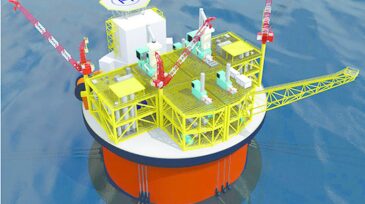
This paper describes a split-process FLNG design where primary production and gas-treatment functions are provided on a host platform while liquefaction occurs on a separate vessel.
-
A closer look at recent unmanned aerial vehicle (UAV) regulations and sensor technologies shows the areas in which they could have a major impact on oil and gas projects in the future.
-
This month's feature on Offshore Facilities is drawn from more than 200 papers presented at SPE events over the past year.
-
In this tenth article of the series, the author focuses primarily on specific operational elements of troubleshooting rather than the mechanical design of the separator.
-
The understanding of solid-particle flow regimes in pipelines for any operational conditions is important for identifying the nature of particle interaction and movement. In this paper, a comprehensive analysis of solid-particle flow regimes in stratified flow in a horizontal pipeline is presented.
-
Our industry is governed by rules that require cleanup and closure of oil and gas facilities after they cease to produce. Unlike a capital project, decommissioning is not something that you can choose to do or not to do.
-
The downturn and lack of investment for new projects are likely to impact the onshore pipeline industry toward the end of the decade. But the long-term drivers for pipeline construction, notably the increased demand for gas in regions such as Asia, remain stable.
-
A study using a dynamic multiphase-flow software simulated a rapid-unloading event and determined the gas fraction in the riser annulus and the effect on riser fluid levels.
-
This paper describes how an exploration-and-production company successfully developed and applied a qualitative risk-based abandonment-prioritization strategy for an inventory of inactive subsea wells.