Pipelines/flowlines/risers

This work introduces a novel predictive methodology combining historical metocean data with real-time riser analysis for shallow water dynamically positioned rig operations.

The deals, with a potential value exceeding $3.7 billion, are aimed at strengthening Saudi Aramco’s supply chains and expanding its use of industrial artificial intelligence.

ExxonMobil and its Area 4 partners have awarded $1.1 billion in pre-investment contracts for long-lead upstream equipment supporting Mozambique's Rovuma LNG project. The awards, led by OneSubsea, mark a key step toward FID as development advances on ExxonMobil's largest global investment.
-
 We have seen in recent years many technological advancements in tubular-manufacturing technology. Tubulars also have become part of the data-transmission network and slowly will converge with the data-handling and data-transmission systems.
 -
Sea lines transporting gas in the Persian Gulf exhibit different thermal regimes in different regions. This study summarizes hydrate-inhibition practices for these sea lines, and indicates a possibility of using them as indirect thermometers to provide important physical oceanographic data.
-
This paper discusses the planning and deployment of an expandable-liner-hanger (ELH) system in an offshore high-pressure/high-temperature (HP/HT) well for the first time in the United Arab Emirates (UAE).
-
As the offshore market downturn and bankruptcy take their toll among vessel contractors, industry consolidation and bargain vessel acquisitions take shape.
-
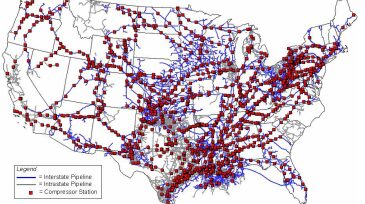
As compressor stations are added to the natural gas gathering and transmission networks, the potential noise issues are coming under increasing public scrutiny at the same time as regulations are being rolled back.
-
This paper considers some of the challenges and learnings associated with the application of chemicals for preservation of coated pipe/flowline for a major liquefied-natural-gas (LNG) project in Australia.
-
Gazprom’s third pipeline to course through the Arctic further decreases Russia’s dependence on using Eastern European countries as thoroughfares to export its gas to markets in Western Europe.
-
The understanding of solid-particle flow regimes in pipelines for any operational conditions is important for identifying the nature of particle interaction and movement. In this paper, a comprehensive analysis of solid-particle flow regimes in stratified flow in a horizontal pipeline is presented.
-
The downturn and lack of investment for new projects are likely to impact the onshore pipeline industry toward the end of the decade. But the long-term drivers for pipeline construction, notably the increased demand for gas in regions such as Asia, remain stable.
-
A study using a dynamic multiphase-flow software simulated a rapid-unloading event and determined the gas fraction in the riser annulus and the effect on riser fluid levels.