Reservoir

This case study describes how edge computing and industrial internet of things platforms were deployed to automate and optimize production operations across four distinct basins.
Output is rising fast in the South American shale play and putting Argentina on a course to soon reach 1 million B/D.
This case study presents a procedure in which the operator compared production from wells with adjusted wettability to a control group, finding that the adjustments resulted in significant improvements in production and reductions in produced water.
-
 Uncertainty comes in all scales and dimensions. This challenges us to learn at all scales possible, from the fume hoods in the laboratory to magnificently exposed outcrops and through deep narrow boreholes that drill through subsurface reservoirs. The combined efforts often convert learnings to actionable intelligence.
 -
Development and study of a new downhole bubblepoint pressure measurement technique, suitable for black oils and volatile oils, to augment downhole fluid analysis using optical spectroscopy.
-
Oil giant looks to shed Canadian tight-oil assets as it moves to wrap up merger with rival Hess.
-
At more than $140 billion, M&A market activity in the fourth quarter delivered the best showing of the year.
-
In its 2024 outlook, Enverus expects 3-mile-long lateral sections to become a new normal in the Permian and suggests the budding geothermal and lithium arenas may be the real deal.
-
Two of the most established US independents are combining to form a natural gas powerhouse that will be given a new name later this year.
-
Startup company LongPath Technologies has received conditional federal financing to install 1,000 methane detection towers spanning multiple US states.
-
Houston-based independents will combine to form a company with a production total above 500,000 BOE/D and valued at $21 billion.
-
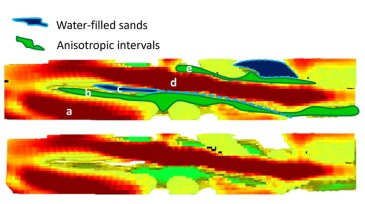
The authors of this paper describe an approach in which all available technologies are combined to improve understanding of reservoir depositional environments.
-
The authors of this paper describe a project aimed at automating the task of cuttings descriptions with machine-learning and artificial-intelligence techniques, in terms of both lithology identification and quantitative estimation of lithology abundances.