Reservoir

As Egypt’s largest oil and gas investor, Eni is ramping up its 2026–2027 drilling campaign with new investments cross the Mediterranean offshore, Nile Delta, Western Desert, and offshore Sinai to strengthen the country’s role as a regional gas and LNG export hub.

This paper presents an experiment investigating dissolution of basaltic primary minerals and conditions favorable for secondary phase formation under deep subsurface storage conditions.

This study aims to investigate the efficacy of chemical additives strontium chloride and barium hydroxide in accelerating CO₂ trapping mechanisms, their effect on dissolution of carbonate-bearing minerals, and resulting poroelastic changes in the host rock.
-
 The process of drilling a borehole is very complex, involving surface and downhole drilling systems that interact with the drilling fluid and the surrounding rocks.
 -
Enventure Global Technology is working to convince operators that its solid expandable steel liners perform better than chemical diverter agents for refracturing operations. Its technology is called the ESeal ReFrac Liner.
-
The pursuit of sweet spots in unconventional oil and gas plays is driving the creation of an emerging set of data-driven systems to measure, map, and predict how wells will perform in unconventional reservoirs.
-
At the recent 2015 Unconventional Resources Technology Conference, a major theme was how companies can improve performance without increasing the size of their budget.
-
The label unconventional oil and gas stubbornly hangs on because these formations cannot be understood using the rules of conventional petroleum engineering.
-
Permanent downhole gauges (PDGs) provide vast amounts of pressure-transient and rate data which may be interpreted with improved pressure-transient-analysis (PTA) approaches to gain more knowledge about reservoir dynamics.
-
The Bakken Petroleum System, which includes the Bakken and Three Forks shales in North America, is estimated to hold as much as 900 billion bbl of original oil in place.
-
This paper focuses on the aspects of proppant selection and adequate fracture-conductivity placement, with the goal of improving well productivity and cumulative recovery.
-
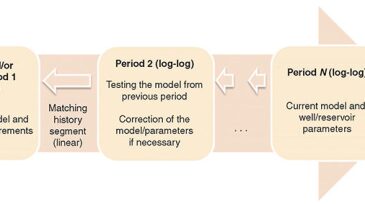
This paper proposes a framework based on proxies and rejection sampling (filtering) to perform multiple history-matching runs with a manageable number of reservoir simulations.
-
This paper provides a more straightforward method for estimating stress-dependent permeability and capillary pressure in rock fractures.