Reservoir

As Egypt’s largest oil and gas investor, Eni is ramping up its 2026–2027 drilling campaign with new investments cross the Mediterranean offshore, Nile Delta, Western Desert, and offshore Sinai to strengthen the country’s role as a regional gas and LNG export hub.

The industry is no longer short of measurements; the real challenge is converting them into timely reservoir decisions that protect value. That challenge is becoming more urgent as the industry depends increasingly on mature fields and existing infrastructure. The selected papers show how this need is being addressed across different producing regions.

This paper presents a case study from a mature field redevelopment project where pulsed neutron logging was integrated with advanced reservoir modeling to improve the understanding of fluid-contact dynamics and optimize new horizontal well placement.
-
 The acquisition adds 2 or 3 years to Enerplus Corporation's development inventory, it said of the cash deal that follows its purchase of Bruin E&P earlier this year.
 -
Asian markets continue to represent the leading edge of global economic growth, and with many of the international oil companies divested from the region, Southeast Asian operators in particular see themselves well positioned for the future.
-
A look behind-the-scenes reveals what it takes to protect innovative ideas in the fast-moving US shale sector—key lessons learned, pitfalls to avoid, and how to do it the right way, as told by two of the operator's intellectual property (IP) protection leaders.
-
Petrolern has received a $1.15-million grant from the US Department of Energy to develop and commercialize its technology that models in-situ stresses by using available data.
-
The supermajor would be the second to conduct a hydraulic fracturing pilot project in the country.
-
As we see in these papers, new tools and techniques are being developed to match the ability of engineers to meet the challenges posed by assets such as shale reservoirs and maturing fields.
-
This paper presents a step-by-step work flow to facilitate history matching numerical simulation models of hydraulically fractured shale wells.
-
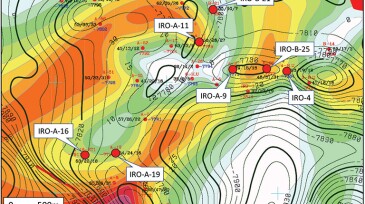
The water-shutoff technique is used in some wells of the U reservoir in the Iro field of the Oriente Basin in Ecuador to restore production after an early water breakthrough. This paper compares the production historical data, workovers, and sand-body correlation of wells to understand reservoir behavior, shale-baffle-sealing continuity, the existence of different san…
-
One should recall that statistics predict oil will continue to be the main source of energy for the next 2 decades, with heavy oil constituting a great portion of that. That means that, while the oil industry is going through unprecedented and even unpredictable economic downturns, the status of heavy oil is still unquestionable.
-
The authors demonstrate that alternating injection of polymer and water is effective and economical for heavy oil fields, even offshore.