Safety

Shell has demonstrated drone-in-a-box operations from its Mars floating production unit, becoming the first operator in the region to secure FAA approval for self-approved offshore beyond-visual-line-of-sight flights. JPT Senior Technology Editor Jennifer Pallanich visited Shell Technology Center Houston to see the system in action.

SPE’s newly renamed Safety Technical Section expands the reach of human factors by integrating safety, risk management, and system resilience expertise while preserving dedicated leadership and technical focus.

As drilling operations become increasingly digital, computer vision is emerging as a continuous safety layer that complements, not replaces, established safety practices. The challenge is no longer whether artificial intelligence can detect hazards, but how operators should deploy, integrate, and govern these systems to improve safety without adding operational comple…
-
 President Donald Trump's administration is considering revising parts of offshore drilling safety regulations intended to prevent the type of blowout that led to the 2010 Deepwater Horizon oil spill.
 -
The US Department of Labor’s Occupational Safety and Health Administration, which had ceased most programmed enforcement actions following Hurricane Harvey, resumed normal enforcement throughout Texas and Louisiana.
-
What is the reality of risk in the hydrocarbon sector? In this roundtable discussion, senior industry executives discuss what happens when process safety intent meets the reality of operations.
-
As operators seek improved but cost-effective approaches to major accident hazard management, the ability to collect, analyze, and make decisions on real-time data is emerging as a critical factor in identifying developing issues in the condition of assets and how they are operated.
-
A recently published standard addresses the need for a comprehensive set of common requirements for operators and contracting companies at fabrication yards.
-
Not doing process safety tasks correctly the first time can result in grave consequences for you, your co-workers, the community and the environment.
-
Broad agreement on safety and working environment conditions in Norway’s oil industry, and on the measures required in the future, is revealed in a report drawn up by representatives of the employers, unions and government.
-
Safety risks of drilling operations are widespread, with potentially significant consequences. Managing these safety risks is key, and intelligent safety risk software can help.
-
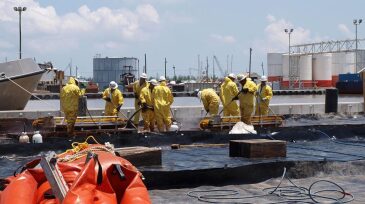
Workers who were likely exposed to dispersants while cleaning up the 2010 Deepwater Horizon oil spill experienced a range of health symptoms including cough and wheeze and skin and eye irritation, according to scientists at the National Institutes of Health (NIH).
-
The results of a virtual reality (VR) safety simulator and gaming experience presented by Lloyd’s Register at SPE Offshore Europe suggest that more needs to be done in training and understanding the daily risks of oil rig maintenance and operation.