Offshore/subsea systems

Shell has demonstrated drone-in-a-box operations from its Mars floating production unit, becoming the first operator in the region to secure FAA approval for self-approved offshore beyond-visual-line-of-sight flights. JPT Senior Technology Editor Jennifer Pallanich visited Shell Technology Center Houston to see the system in action.

This paper explores the application of a modular, high-temperature gas-cooled nuclear reactor to a Very Large Crude Carrier-class floating production, storage, and offloading vessel.

This paper describes the potential of combined-cycle technology (use of a gas turbine and a steam turbine together to turn fuel into electricity) in offshore carbon-capture applications.
-
 Testing will be performed at DNV’s labs in Columbus, Ohio, and Norway and overseen by experts in fatigue of subsea equipment, bolting connections, cathodic protection, and instrumented tests.
 -
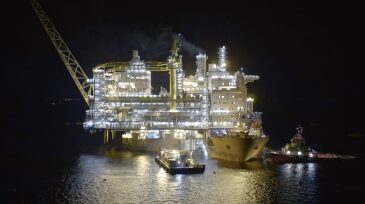
A project of “firsts,” Equinor’s Aasta Hansteen spar platform began producing gas on 16 December, opening a new region for gas export to Europe and the UK.
-
Westwood forecasts a recovery in the subsea market backed by a new wave of offshore investment. Subsea vessel operations and hardware expenditure are expected to total $152 billion from 2019 to 2023.
-
The firm hopes to remedy the cost-, labor-, and time-intensive process of executing offshore projects through deployment of “Subsea Connect,” which it says can cut project development costs by 30%.
-
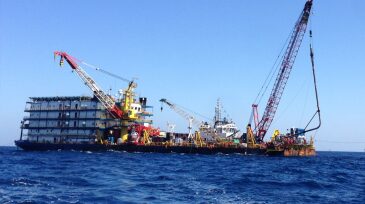
As part of a 2-year deal, the Kreuz Glorious will help with the inspection of offshore jackets in the Arabian Sea. Kreuz will also provide personnel for project management and offshore construction.
-
The paper provides a fast-track approach to perform screening assessment of multiple subsea concepts.
-
As the hunger for data grows, long stepouts become more common, and fiber communication becomes standard, the use of fiber in subsea oil and gas fields is set to increase.
-
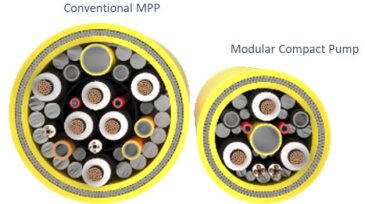
The latest entrants to tackle the development of barrier-fluid-less subsea pumps are Saipem and Curtiss-Wright Corp., who agreed to collaborate in designing and building pumps for water treatment and injection.
-
The JIP aims to bring to market a single-phase subsea boosting system that does not require barrier fluid or a mechanical seal.
-
An increasingly buzzy term tossed around at industry events, “digital twin” is leveraging data analytics, machine learning, and artificial intelligence to improve efficiencies from design to decommissioning.