Water management

The startup company’s Midland Basin demonstration plant, located in the Permian Basin, takes a major step toward commercialization by proving its direct lithium extraction technology can refine battery-grade lithium carbonate from produced water under multiple 24/7 production cycles.
This paper presents an approach to the identification, selection, and implementation of initiatives for sustainable water management, withdrawal reduction, and water valorization.

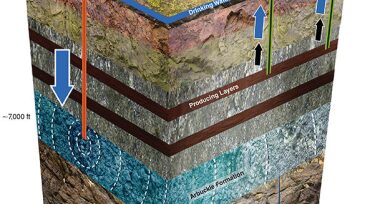
Disposal wells remain the lowest-cost solution for produced water, but concerns over seismicity and long-term sustainability are accelerating interest in alternatives.
-
 Research and development firm Battelle is working on a new induced-seismicity study that aims to help wastewater disposal well operators in Ohio stay on the good side of state regulators.
 -
Tiny bubbles, called nanobubbles, are the focal point of a new innovation aimed at transforming produced water from a costly byproduct into a valuable asset.
-
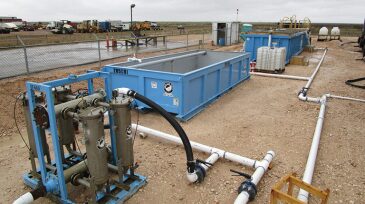
A new techhnology aimed at treating produced water at the wellsite to near-drinking-water quality.
-
Industry regulators in Oklahoma have rolled out broad new restrictions on more than 600 disposal wells as part of the largest action of its kind taken in response to earthquakes.
-
As the cost to source, transport, store, treat, and dispose of water remains relatively high, water management programs will become a greater priority in the coming year.
-
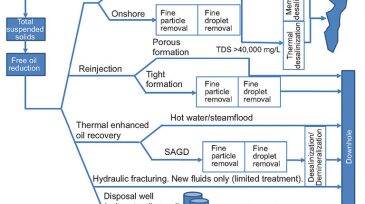
Produced water has become the largest byproduct in the oil and gas industry. Treatment and disposal or reuse of this byproduct requires a good understanding of conditions and options to devise the optimal strategy.
-
In the interest of conservation and sustainability, it is highly desirable to maximize any opportunity to reuse the produced water for subsequent fracturing treatments.
-
This paper reports the completion of a two-lateral well in the Williston basin where produced water (PW), filtered but otherwise untreated, was used throughout the slickwater and crosslinked components of approximately 60 hydraulic-fracturing stages.
-
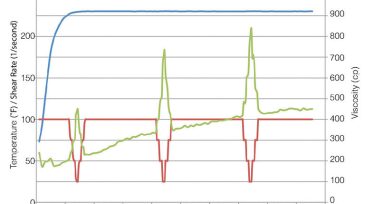
This paper details the experience of using new stabilized crosslinked-fracturing-fluid systems in the Permian Basin using borated produced water.
-
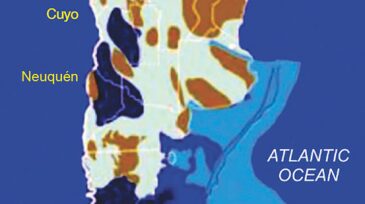
This paper discusses aspects of water logistics necessary during the well-completion phase, fracture-treatment designs applied in Vaca Muerta, and laboratory studies performed on flowback and produced water to help evaluate the potential for water reuse.