In 2010, the Macondo blowout changed everything about how the industry approached containing an offshore oil spill.
At Macondo, multiple containment efforts failed before a specially designed capping stack was installed to shut in the well. In the years following, well capping essentially became its own industry within the larger oil and gas industry.
One remaining challenge has been deploying a capping stack when conditions above the well make it unsafe for vessels to station directly overhead. Surface boil, volatile organic compounds, gas releases, or lower explosive limit concerns can prevent safe vertical access directly above the well. In other cases, congested seabed locations with a lot of infrastructure can restrict the placement of conventional seabed equipment.
Oil Spill Response Limited (OSRL), a global, industry-funced cooperative that provides oil spill emergency response and subsea well-intervention services to energy companies worldwide, viewed this as a preparedness gap, Brett Morry, OSRL’s subsea manager-Americas, told JPT.

“Shallow-water deployment has always been problematic for capping stack deployment, and the biggest problem that we have is around response times and trying to increase or improve our response times,” he said.
He said OSRL worked with its members to identify an offset method of installing a capping stack more quickly than the alternative of a relief well, because in source control, time is the enemy.
“If you physically can’t cap it, you’re waiting for the relief well,” he said.
The new shallow-water deployment capability integrates existing technologies from InterMoor and Oceaneering to enable offset capping stack deployment in water depths of 75 m to 600 m when direct vertical access is not possible. The integration combines three vessels and four winches to meet the single objective of landing a capping stack from an offset location.
He described it as a split lowering system that makes it possible to suspend the capping stack between multiple vessels.
“We can then position these vessels outside of the plume, outside of harm’s way for the individuals on those vessels and still provide us with some means to bring that capping stack in and position it on top of this well,” he said.
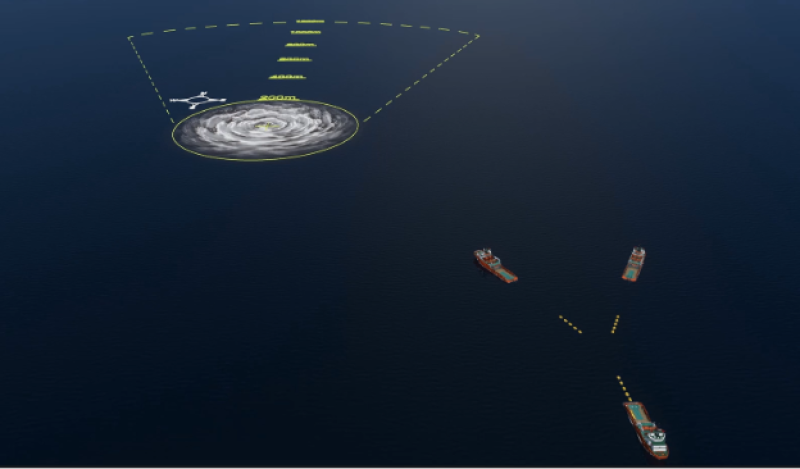
OSRL said this capability, which combines InterMoor’s Split Lowering System (SLS) and Oceaneering’s new Snub Line Winch System (SLWS), builds on already-established capping stack experience.
Morry described the SLS as the part that “gets the capping stack safely to the well. The SLWS positions and lands it precisely.”
The SLS uses three anchor-handling vessels, buoyancy strings, chain assemblies, work wires, a construction or inspection, maintenance, and repair vessel, connection hardware, and ROV support to lower and move the stack toward the incident well. The SLWS comprises four hydraulic winches mounted on the capping stack. The winches connect to the blowout preventer and can be operated independently or in combination to support final alignment, stabilization, pull-in, and seating.
According to Morry, a key advantage of the SLS concept is that it does not require deployment equipment to be prepositioned on the seabed, which is useful where surrounding infrastructure or debris limits available space.
Work developing this newest capability dates back to 2023, when OSRL contracted Oceaneering to develop the SLWS. The following year, OSRL contracted InterMoor to develop the SLS for three-vessel deployment. In February 2025, Oceaneering delivered the first SLWS to OSRL’s base in Norway, and in September 2025, the SLWS successfully completed site integration testing. In October 2025, OSRL held an SLS/SLWS “cap the well on paper” workshop in Stavanger.
The capability is operationally ready, with equipment being stored at Sløvåg and Tanager in Norway, ready to be mobilized for global response.
The capability “wasn’t developed in a silo. It was developed with the active participation of all of our member companies,” Morry said.