Testing page for app
-
 While many factors may influence fracture-height evolution in multilayer formations, the consensus is that the so-called “equilibrium height belonging to a certain treating pressure” provides an upper limit, at least for nonnaturally fractured media.
 -
A new unconventional proppant technology—a rod-shaped proppant—delivered 25% higher oil per net pay compared with offset wells using conventional proppant.
-
To sustain the current level of heavy-oil production, which comprises roughly 12–15% of total production, process efficiency must be enhanced to control costs.
-
The Samarang oil field, offshore Sabah, Malaysia, is undergoing a redevelopment project with integrated operations. Several work flows were designed and deployed in order to achieve an early milestone of providing real-time well-performance monitoring, surveillance, and optimization.
-
In the past decade, fiber-optic -based sensing has opened up opportunities for in-well reservoir surveillance in the oil and gas industry. In this paper, the authors present a recent example of single-phase-flow profiling with distributed acoustic sensing.
-
The industry is in one of its periodic downturns. Jobs are uncertain or scarce. Profitability is challenged. Bankruptcy looms. Projects are being canceled. Deals are dropped or delayed. It seems there is bad news everywhere. So how do we survive in this environment?
-
The world’s first reflection seismic field tests were conducted near Oklahoma City in 1921, and, ever since then, the industry has endeavored to improve that seismic imaging process.
-
Thermal steam stimulation is considered the most effective of current methods for heavy-oil production. However, the method has problems with low coverage by steam injection and decreased efficiency.
-
Acquiring new 3D broadband seismic data of a gas field containing legacy 3D conventional towed-streamer seismic data.
-
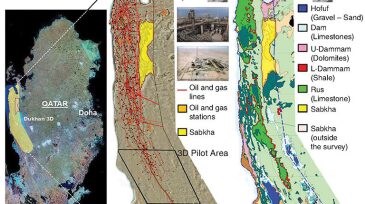
Integration of microgravity, resistivity, and seismic data improves the fidelity of seismic images and the depth match.